
 Search
Traveling Luck for China. China, Asia
China is located in Eastern Asia, bordering the East China Sea, Korea Bay, Yellow Sea, and South China Sea, between North Korea and Vietnam.
Land in China is mostly mountains, high plateaus, deserts in west; plains, deltas, and hills in east.
Chinese land covers an area of 9596960 square kilometers which is slightly smaller than the US
China has borders with Mongolia for 4677km, Nepal for 1236km, Bhutan for 470km, Laos for 423km, Kazakhstan for 1533km, Afghanistan for 76km, India for 3380km, North Korea for 1416km, Vietnam for 1281km, Tajikistan for 414km, Russia for 3645km, Kyrgyzstan for 858km, Myanmar for 2185km and Pakistan for 523km.
 Chinese national flag (Flag of China)
 China country profile
 Travel advice for China
As for the Chinese climate; extremely diverse; tropical in south to subarctic in north.
Chinese (singular and plural) speak Standard Chinese or Mandarin (Putonghua, based on the Beijing dialect), Yue (Cantonese), Wu (Shanghaiese), Minbei (Fuzhou), Minnan (Hokkien-Taiwanese), Xiang, Gan, Hakka dialects, minority languages (see Ethnic groups entry).
Places of note in China
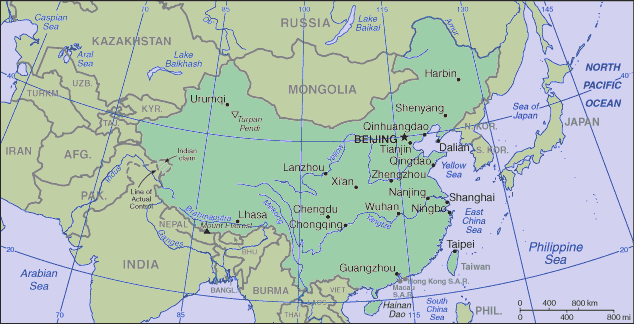 Chinese map
Regions of China
For centuries China stood as a leading civilization, outpacing the rest of the world in the arts and sciences, but in the 19th and early 20th centuries, the country was beset by civil unrest, major famines, military defeats, and foreign occupation. After World War II, the Communists under MAO Zedong established an autocratic socialist system that, while ensuring China's sovereignty, imposed strict controls over everyday life and cost the lives of tens of millions of people. After 1978, his successor DENG Xiaoping and other leaders focused on market-oriented economic development and by 2000 output had quadrupled. For much of the population, living standards have improved dramatically and the room for personal choice has expanded, yet political controls remain tight.
China's economy during the last quarter century has changed from a centrally planned system that was largely closed to international trade to a more market-oriented economy that has a rapidly growing private sector and is a major player in the global economy. Reforms started in the late 1970s with the phasing out of collectivized agriculture, and expanded to include the gradual liberalization of prices, fiscal decentralization, increased autonomy for state enterprises, the foundation of a diversified banking system, the development of stock markets, the rapid growth of the non-state sector, and the opening to foreign trade and investment. China has generally implemented reforms in a gradualist or piecemeal fashion. The process continues with key moves in 2005 including the sale of equity in China's largest state banks to foreign investors and refinements in foreign exchange and bond markets. The restructuring of the economy and resulting efficiency gains have contributed to a more than tenfold increase in GDP since 1978. Measured on a purchasing power parity (PPP) basis, China in 2005 stood as the second-largest economy in the world after the US, although in per capita terms the country is still lower middle-income and 150 million Chinese fall below international poverty lines. Economic development has generally been more rapid in coastal provinces than in the interior, and there are large disparities in per capita income between regions. The government has struggled to: (a) sustain adequate job growth for tens of millions of workers laid off from state-owned enterprises, migrants, and new entrants to the work force; (b) reduce corruption and other economic crimes; and (c) contain environmental damage and social strife related to the economy's rapid transformation. From 100 to 150 million surplus rural workers are adrift between the villages and the cities, many subsisting through part-time, low-paying jobs. One demographic consequence of the "one child" policy is that China is now one of the most rapidly aging countries in the world. Another long-term threat to growth is the deterioration in the environment - notably air pollution, soil erosion, and the steady fall of the water table, especially in the north. China continues to lose arable land because of erosion and economic development. China has benefited from a huge expansion in computer Internet use, with more than 100 million users at the end of 2005. Foreign investment remains a strong element in China's remarkable expansion in world trade and has been an important factor in the growth of urban jobs. In July 2005, China revalued its currency by 2.1% against the US dollar and moved to an exchange rate system that references a basket of currencies. Reports of shortages of electric power in the summer of 2005 in southern China receded by September-October and did not have a substantial impact on China's economy. More power generating capacity is scheduled to come on line in 2006 as large scale investments are completed. Thirteen years in construction at a cost of $24 billion, the immense Three Gorges Dam across the Yangtze River will be essentially completed in 2006 and will revolutionize electrification and flood control in the area. The Central Committee of the Chinese Communist Party in October 2005 approved the draft 11th Five-Year Plan and the National People's Congress is expected to give final approval in March 2006. The plan calls for a 20% reduction in energy consumption per unit of GDP by 2010 and an estimated 45% increase in GDP by 2010. The plan states that conserving resources and protecting the environment are basic goals, but it lacks details on the policies and reforms necessary to achieve these goals.
Chinese natural resources include coal, iron ore, petroleum, natural gas, mercury, tin, tungsten, antimony, manganese, molybdenum, vanadium, magnetite, aluminum, lead, zinc, uranium, hydropower potential (world's largest)
world's fourth largest country (after Russia, Canada, and US); Mount Everest on the border with Nepal is the world's tallest peak
Chinese religion is Daoist (Taoist), Buddhist, Christian 3%-4%, Muslim 1%-2%.
Natural hazards in China include frequent typhoons (about five per year along southern and eastern coasts); damaging floods; tsunamis; earthquakes; droughts; land subsidence.
Travel Advice for China
ChinaSUMMARY
- Outbreaks of Avian Influenza (Bird Flu) in China have resulted in a small number of human fatalities. As a precaution, you should avoid live animal markets, poultry farms and other places where you might come into contact with domestic, caged or wild birds; and ensure poultry and egg dishes are thoroughly cooked. For further information see the Health section below and also read the FCO’s Avian and Pandemic Influenza Factsheet.
- British nationals require visas to enter China. Visas cannot be obtained on arrival except at Hainan Island. Carefully check your visa validity as fines can be levied for overstaying.
- The threat from terrorism in China is low but you should be aware of the global risk of indiscriminate terrorist attacks, which could be against civilian targets, including places frequented by foreigners.
- Most visits to China are trouble-free. The main type of incident for which British nationals require consular assistance in China is for replacing lost or stolen passports. Please note that only the British Embassy in Beijing has the facility to issue replacement passports, although applications can be submitted at the Consulates in Shanghai, Guangzhou and Chongqing.
- We strongly recommend that you obtain comprehensive travel and medical insurance before travelling. You should check any exclusions, and that your policy covers you for the activities you want to undertake. Please see: Travel Insurance.
SAFETY AND SECURITY
LOCAL LAWS AND CUSTOMS
There are restrictions on undertaking certain religious activities, including preaching and distributing religious materials. The Falun Gong movement is banned in China.
Homosexuality is not illegal although there are no laws specifically protecting the rights of homosexuals.
ENTRY REQUIREMENTS
British nationals require visas to enter Mainland China, but not Hong Kong. Visas cannot be obtained on arrival except at Hainan Island. Carefully check your visa validity as fines can be levied for overstaying.
If you visit Hong Kong from Mainland China you should ensure you have a double or multiple entry visa to gain re-entry to the mainland.
British nationals who are transiting China en route to a third country do not require a transit visa if staying within the confines of the airport for less than 24 hours. If your stopover requires you to leave the airport, you will need a transit visa for both the outward and return journeys.
Single parents or other adults travelling alone with children should be aware that some countries require documentary evidence of parental responsibility before allowing lone parents to enter the country or, in some cases, before permitting the children to leave. For further information on exactly what will be required at immigration please contact the Chinese Embassy: Chinese representation in the UK.
HEALTH
The WHO does not currently consider Severe Acute Respiratory Syndrome (SARS) to be a significant threat to public health. For further information on SARS, you should access the World Health Organisation website http://www.who.int/csr/sars/en/.
China has around 1,000 human Rabies cases every year. Since January 2006, outbreaks of Rabies have been reported in Shandong and Yunnan Provinces due to infected dogs. A small number of human deaths have occurred. The Chinese authorities have announced a cull of dogs within 5 kilometres of the infected area, and others will be vaccinated against the disease.
Since 18 August 2006, there have been reports of a number of deaths related to Japanese Encephalitis in Henan, Shaanxi and Shanxi provinces in northern China. The advent of cooler temperatures should decrease the risk of this mosquito-transmitted infection.
In September, an outbreak of Dengue fever was reported in Southern China. The majority of cases, almost 500, have occurred in Guangdong Province. Some Southern Chinese provinces (Chongqing Municipality, Guangxi Zhuang Autonomous Region, Guangdong, Fujian, Hainan, Sichuan, Guizhou and Yunnan) have ordered stricter medical inspections at ports of people, vehicles, cargoes and containers arriving from Southeast Asian regions. There is no vaccine to protect against dengue fever and you should protect yourself against mosquito bites. Symptoms of dengue include fever with headache and aching bones and joints. If you develop these symptoms you should consult a doctor.
You should seek medical advice before travelling and ensure that all appropriate vaccinations are up to date. For further information on health, check the Department of Health’s website at www.dh.gov.uk.
Avian Influenza (Bird Flu)
There have been outbreaks of Avian Influenza (Bird Flu) in poultry in China. Since November 2005, this has led to a small number of human fatalities in rural areas of Liaoning, Guangxi, Anhui, Sichuan, Hunan, Guangdong provinces, and the Xinjiang Uighur Autonomous Regions, believed to have arisen through close contact with infected poultry. In January 2007, the WHO confirmed that a human was infected with, but did not die from, Avian Influenza in Anhui province. Since the end of 2003, a number of human deaths have also occurred in Azerbaijan, Cambodia, Indonesia, Egypt, Iraq, Thailand, Turkey and Vietnam.
The risk to humans from Avian Influenza is believed to be low. However, as a precaution, you should avoid visiting live animal markets, poultry farms and other places where you may come into close contact with domestic, caged or wild birds; and ensure poultry and egg dishes are thoroughly cooked.
The WHO has warned of the possibility that the Avian Influenza outbreaks could lead at some point to a human flu pandemic, if the virus mutates to a form which is easily transmissible between people.
British nationals living longer term in an Avian Influenza affected region should take personal responsibility for their own safety in the event of a future pandemic, including considering their access to adequate healthcare and ensuring travel documents are up to date.
You should read this advice in conjunction with the: Avian and Pandemic Influenza Factsheet
NATURAL DISASTERS
China is located in an active seismic zone and is periodically subject to earthquakes. The most recent earthquakes occurred in Gansu Province in north west China on 25 October 2003, measuring 6.1 and 5.8 on the Richter scale. Earthquakes of similar magnitude have occurred in the Inner Mongolian Autonomous Region, the Xinjiang Autonomous Region, and Yunnan Province in 2003.
Parts of central, southern and western China, particularly those bordering the Yangtze River, are susceptible to flooding. You should check your route and the weather forecast locally before setting off on your journey.
Typhoons occasionally hit the south eastern coastal regions of China. The typhoon season is generally between May and November.
GENERAL
If you are travelling independently, or planning an extended visit, we advise you to register with the nearest British representation, the British Embassy in Beijing or the British Consulate-General in Shanghai, Guangzhou or Chongqing. You can find information about this on the website: http://www.uk.cn.
It is not possible to change Scottish or Northern Irish bank notes. Outside major cities, credit cards are not always readily acceptable and the availability of cash point machines (ATMs) is limited.
Fire protection standards in Chinese accommodation are not always the same as in the UK. You are advised to check fire precautions such as access to fire exits.
Teaching appointments
An increasing number of British nationals are becoming attracted to opportunities to teach English in China. Most of those who do so have an extremely positive and enjoyable experience. However, some have experienced difficulties. The most common problems encountered arise from being faced with living or working conditions that do not meet expectations and complications over obtaining the correct visas and residence permits. There have also been complaints of breach of contract, confiscation of passports and of payment being withheld.
If you wish to take up teaching appointments in China it is illegal to work on a tourist visa, and we advise you to contact the nearest Chinese Diplomatic Mission for information on obtaining the appropriate documentation. In addition, you should research the educational establishment and the area in which you intend to work as thoroughly as possible. Further information can be found in the consular area of the web-site of the British Embassy Beijing at website: http://www.uk.cn.
TIBET
You should obtain prior permission from the Chinese authorities for travel to Tibet. The Chinese authorities state that foreigners entering Tibet can only do so on a group visa. It is not possible to change or extend a group visa on re-entering China from Tibet.
At some border crossings local officials have demanded additional travel permit fees from foreigners and have sometimes resorted to violence to secure payment.
You should avoid becoming involved in any demonstrations or calls for Tibetan independence. The authorities would regard videotaping or photographing any such activities as provocative.
The local authorities will react strongly if you are found to be carrying letters or packages from Tibetan nationals to be posted in other countries.
The extreme altitude in Tibet may cause altitude sickness. If you are elderly or have a heart condition, pulmonary or bronchial problems you should seek medical advice before travelling to this region.
You should normally seek permission to take photographs in Buddhist monasteries. Negotiate fees beforehand.
The country code for China is 00 86. You should omit the first zero of the numbers listed below if calling from outside China.