
 Search
Traveling Luck for Afghanistan. Afghanistan, Asia
Afghanistan is located in Southern Asia, north and west of Pakistan, east of Iran.
Land in Afghanistan is mostly rugged mountains; plains in north and southwest.
Afghan land covers an area of 647500 square kilometers which is slightly smaller than Texas
Afghanistan has borders with China for 76km, Iran for 936km, Pakistan for 2430km, Tajikistan for 1206km, Turkmenistan for 744km and Uzbekistan for 137km.
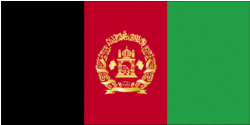 Afghan national flag (Flag of Afghanistan)
 Afghanistan country profile
 Travel advice for Afghanistan
As for the Afghan climate; arid to semiarid; cold winters and hot summers.
Afghan(s) speak Afghan Persian or Dari (official) 50%, Pashtu (official) 35%, Turkic languages (primarily Uzbek and Turkmen) 11%, 30 minor languages (primarily Balochi and Pashai) 4%, much bilingualism.
Places of note in Afghanistan
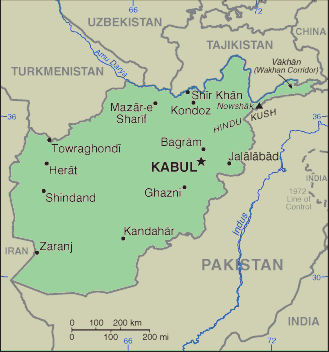 Afghan map
Regions of Afghanistan
- (AF15)
- (AF16)
- (AF21)
- Afghanistan (general)
- Badakhshān
- Bādghīs
- Baghlān
- Balkh
- Bāmīān
- Dāykondī
- Farāh
- Fāryāb
- Ghaznī
- Ghowr
- Helmand
- Herāt
- Jowzjān
- Kābol
- Kandahār
- Kāpīsā
- Khowst
- Konar
- Kondoz
- Laghmān
- Lowgar
- Nangarhār
- Nīmrūz
- Nūrestān
- Orūzgān
- Orūzgān
- Paktīā
- Paktīkā
- Panjshīr
- Parvān
- Parvān
- Samangān
- Sar-e Pol
- Takhār
- Vardak
- Zābol
Ahmad Shah DURRANI unified the Pashtun tribes and founded Afghanistan in 1747. The country served as a buffer between the British and Russian empires until it won independence from notional British control in 1919. A brief experiment in democracy ended in a 1973 coup and a 1978 Communist counter-coup. The Soviet Union invaded in 1979 to support the tottering Afghan Communist regime, but withdrew 10 years later under relentless pressure by internationally supported anti-Communist mujahedin rebels. A civil war between mujahedin factions erupted following the 1992 fall of the Communist regime. The Taliban, a hardline Pakistani-sponsored movement that emerged in 1994 to end the country's civil war and anarchy, seized Kabul in 1996 and most of the country outside of opposition Northern Alliance strongholds by 1998. Following the 11 September 2001 terrorist attacks, a US, Allied, and Northern Alliance military action toppled the Taliban for sheltering Osama BIN LADIN. In late 2001, a conference in Bonn, Germany, established a process for political reconstruction that included the adoption of a new constitution and a presidential election in 2004, and National Assembly elections in 2005. On 7 December 2004, Hamid KARZAI became the first democratically elected president of Afghanistan. The National Assembly was inaugurated on 19 December 2005.
Afghanistan's economic outlook has improved significantly since the fall of the Taliban regime in 2001 because of the infusion of over $8 billion in international assistance, recovery of the agricultural sector and growth of the service sector, and the reestablishment of market institutions. Real GDP growth is estimated to have slowed in the last fiscal year primarily because adverse weather conditions cut agricultural production, but is expected to rebound over 2005-06 because of foreign donor reconstruction and service sector growth. Despite the progress of the past few years, Afghanistan remains extremely poor, landlocked, and highly dependent on foreign aid, farming, and trade with neighboring countries. It will probably take the remainder of the decade and continuing donor aid and attention to significantly raise Afghanistan's living standards from its current status, among the lowest in the world. Much of the population continues to suffer from shortages of housing, clean water, electricity, medical care, and jobs, but the Afghan government and international donors remain committed to improving access to these basic necessities by prioritizing infrastructure development, education, housing development, jobs programs, and economic reform over the next year. Growing political stability and continued international commitment to Afghan reconstruction create an optimistic outlook for continuing improvements in the Afghan economy in 2006. Expanding poppy cultivation and a growing opium trade may account for one-third of GDP and looms as one of Kabul's most serious policy challenges. Other long-term challenges include: boosting the supply of skilled labor, reducing vulnerability to severe natural disasters, expanding health services, and rebuilding a war torn infrastructure.
Afghan natural resources include natural gas, petroleum, coal, copper, chromite, talc, barites, sulfur, lead, zinc, iron ore, salt, precious and semiprecious stones
landlocked; the Hindu Kush mountains that run northeast to southwest divide the northern provinces from the rest of the country; the highest peaks are in the northern Vakhan (Wakhan Corridor)
Afghan religion is Sunni Muslim 80%, Shi'a Muslim 19%, other 1%.
Natural hazards in Afghanistan include damaging earthquakes occur in Hindu Kush mountains; flooding; droughts.
Travel Advice for Afghanistan
AfghanistanSUMMARY
- We strongly advise against all but essential travel to Kabul and against all travel to the provinces of Farah, Nimroz, Helmand, Kandahar, Uruzgan, Zabol, Paktika, Khost, Nangarhar, Ghazni, Nuristan, Laghman, Balkh and Kunar. You should only consider travel to other provinces if you have strong commercial or professional reasons to do so.
- There is a high threat of terrorism in Afghanistan. Specific methods of attack are evolving and increasing in sophistication. There continues to be a high threat from vehicle-borne suicide bombers in Kabul and other urban areas. On 8 September 2006, a suicide car bombing in Kabul killed at least 16 people, including two US soldiers, and injured approximately 30 more. Attacks could be targeted at other vehicles as well as buildings. You should maintain a high level of vigilance, restrict your movements, observe the strictest of security measures, and defer any unnecessary travel around the city.
- There is a continuing kidnap threat against British nationals, including those working for NGOs, in Afghanistan. The security situation remains serious and the threat to Westerners from terrorist or criminal violence remains high. Numerous foreign nationals have been kidnapped across the country and some victims have been killed. If travelling by road you should only travel in fully protected transport, with reputable local drivers and guides.
- If you believe that your visit is essential we strongly recommend that you seek local advice before undertaking your journey. You should review your security arrangements in-country and you should seek professional advice on whether they are adequate. Information on specific and urgent threats is circulated via the Warden network within Afghanistan. It is therefore important that you register with the British Embassy in Kabul on arrival (see below for contact details).
- We strongly advise you to avoid any protests, demonstrations and large gatherings.
- You should be aware that there is a widespread danger from mines and unexploded ordnance throughout Afghanistan.
- We strongly recommend that comprehensive travel and medical insurance is obtained before travelling. You should check any exclusions, and that your policy covers you for the activities you want to undertake. Please see: Travel Insurance.
SAFETY AND SECURITY
You should be aware of the continuing high threat from terrorism within Afghanistan. Threats, specific or otherwise, are reported on an almost daily basis and may, in some cases, lead the Embassy to limit staff movement to essential travel only.
We continue to receive reports which indicate specific terrorist threats against visibly British and Western institutions, organisations and individuals. Threats also apply to those involved in work with the United Nations as well as those working in the humanitarian and reconstruction fields. Future attacks throughout Afghanistan might include bombs, suicide bombs (either on foot or by vehicle), kidnapping and violent crime.
If you remain in Afghanistan, particularly outside Kabul, you should continue to reassess your position. You should exercise the utmost care and vary your routines. You should always ensure car doors are locked and windows closed, and if possible maintain radio or telephone communications to report your movements. You should also remain constantly aware of the risks posed by the large amounts of unexploded ordnance and land mines throughout the country.
You should avoid regular visits to public places frequented by foreigners, including hotels, restaurants, shops and market places, especially at times of day when they are particularly busy and congested. The British Embassy has currently placed certain less well protected restaurants off limits to staff. We strongly recommend you to consult the warden network via the British Embassy for further information on the security of venues across Kabul and elsewhere before undertaking any travel.
If, despite this Travel Advice, you travel outside Kabul, you should only do so with reputable local guides and only to fully protected workplaces. You should consider permanent armed protection. You should be aware that even these precautions cannot guarantee your safety. The threat from kidnapping throughout Afghanistan remains.
You should be aware of the global risk of indiscriminate terrorist attacks, which could be against civilian targets including places frequented by foreigners. Please read Security and General Tips and Risk of Terrorism when Travelling Overseas pages on the FCO website for further information and advice.
Afghanistan NGO Security Offices (ANSO) issues regular security updates, which can be obtained from: data@afgnso.org.
In Kabul
We advise against all but essential travel to Kabul. On 8 September 2006, a suicide car bombing in Kabul killed at least 16 people, including two US soldiers, and injured approximately 30 more. On 4 July 2006, two IEDs (Improvised Explosive Devices) detonated in Kabul, killing two people and injuring another four. A further three IED attacks took place in the city on 5 July 2006. Reports indicate one person died and around 40 people were injured in these explosions. There continues to be a threat from vehicle-borne suicide bombers in Kabul and other urban areas.
There are regular indiscriminate rocket and bomb attacks and targeted attacks against NATO’s International Security Assistance Force (ISAF) patrols. On 26 September 2006, a bomb attack on an ISAF patrol killed an Italian soldier and injured a further five. Reports continue to indicate that further attacks are likely, possibly by suicide bombers, against Western targets in central Kabul, along the Jalalabad Road and in the vicinity of Kabul airport. Hotels and other guest houses where foreigners might stay will continue to be likely targets. There have been a number of attacks against Kabul International Airport and further attacks cannot be ruled out. You should exercise extreme caution if you intend to use the Jalalabad Road and you should avoid travelling at night if at all possible.
There is an ongoing threat of kidnap to foreign nationals in Kabul. We strongly advise you to maintain a high level of vigilance and to seek professional security advice on adequate security arrangements.
Outside Kabul
We advise against all travel to the provinces of Farah, Nimroz, Helmand, Kandahar, Zabol, Paktika, Paktya, Khost, Ghazni, Nangahar, Kunar, Laghman and Nuristan. You should only consider travelling to other provinces if you have strong commercial or professional reasons to do so.
There have been a number of serious attacks on both Western and Afghan NGOs and on vehicles belonging to them, in which a number of people have been killed or injured. Most attacks continue to occur in the south and east of Afghanistan, but there have been sporadic but serious incidents in other regions such as Badghis, Kunduz and Jowzjan that have otherwise been considered comparatively secure. The threat from kidnapping to employees of NGOs and foreign companies throughout Afghanistan remains.
North Afghanistan
Provinces covered in this section are Faryab, Jawzjan, Sari Pul, Balkh, Samangan, Kunduz, Badakshan, Talhar and Baghlan.
There have been a number of attacks against aid workers and military vehicles in Jawzjan, Mazar-e Sharif and Baghlan provinces resulting in fatalities and injuries. In early October 2006, two German journalists were killed by unidentified attackers in Baghlan province. You are advised to exercise extreme caution and to remain vigilant at all times, as Western civilians remain targets for insurgents and kidnapping gangs.
Eastern Afghanistan
Provinces covered in this section include Laghman, Khost Paktya, Nangarhar, Kunar and Nuristan. We advise against all travel to these provinces.
There are ongoing military operations in this region. There have been a number of reported attacks against the Afghan National Army and US-led coalition forces. There are also regular reports of Improvised Explosive Device (IED) and rocket attacks. On 6 June 2006, two US soldiers were killed in a roadside bomb attack in Nangahar.
Southern Afghanistan
Provinces covered in this section include Kandahar, Uruzgan, Helmand, Zabul, Nimroz, Paktika and Ghazni. We advise against all travel to these provinces.
Western Afghanistan
Provinces covered in this section include Farah, Badghis, Ghor and Herat. There have been incidents of car bomb attacks, rocket attacks and kidnapping throughout these provinces.
On 18 September 2006, a suicide attack in Heart killed at least 10 people and injured a further 18. On 13 May 2006, a suicide car bomb attack in the city resulted in the death of a US citizen. On 12 May 2006, two NGO workers were killed and one seriously injured in a rocket attack on their vehicle while travelling between Badghis and Heart. On 31 August 2005, a British national was abducted and subsequently murdered while working on an engineering project in Farah province.
Political Situation
Country Profile: Afghanistan
Road Safety
Most road surfaces are in a very poor condition. The overall standard of driving is poor and most local drivers are uninsured. Accidents may lead to a confrontation and threatening behaviour.
Air Safety
The UK Civil Aviation Authority has not assessed whether safety standards on Ariana Airlines comply with international aviation standards because there is no direct commercial air service between the UK and Afghanistan. However, the Technical Co-operation Bureau of the International Civil Aviation Organisation carried out an assessment in 2003, which highlighted a number of safety concerns about Ariana Airlines. British Government employees are advised to avoid using Ariana Airlines.
In February 2005, a Kam Air Boeing 727-200 flying from Herat to Kabul crashed in snowstorms 17 miles out of Kabul. All 96 passengers and eight crew on board were killed in the incident. British Government employees are advised to avoid using Kam Air.
The EU has published a list of air carriers that are subject to an operating ban or restrictions within the community. You should check the following link to see whether this will affect your travel: http://europa.eu.int/comm/transport/air/safety/flywell_en.htm.
LOCAL LAWS AND CUSTOMS
ENTRY REQUIREMENTS
HEALTH
Only very limited medical facilities are available. You should also ensure that you have all the prescription medication you require during your visit, as supplies of them are unlikely to be available locally.
Diarrhoeal diseases and other gastrointestinal infections are common causes of ill health, becoming worse in the hotter months. The dry dusty conditions in both summer and winter can cause irritation to eyes, throat, nose and skin. Respiratory tuberculosis is common in the Afghan population. Malaria is a potential hazard except in the high mountainous regions of the country and in winter.
Malaria is a potential hazard except in the high mountainous regions of the country and in winter. More than three-quarters of British travellers who contracted malaria in 2005 did not take preventive measures, such as malaria prevention tablets. However, malaria can occur despite appropriate prevention, and therefore you should promptly seek medical care in the event of a fever or flu-like illness in the first year following your return from travelling to a malaria risk country. Before travelling you should seek medical advice about the malaria risk in Afghanistan.
You should seek medical advice before travelling and ensure that all appropriate vaccinations are up-to-date. For further information on health, check the Department of Health’s website: www.dh.gov.uk.
Avian Influenza
The risk from Avian Influenza is believed to be very low, provided you avoid live animal markets, poultry farms and other places where you may come into close contact with domestic, caged or wild birds. You should also ensure that poultry and egg dishes are thoroughly cooked.
You should read this advice in conjunction with Avian and Pandemic Influenza Factsheet, which gives more detailed advice and information.
GENERAL