
 Search
Traveling Luck for Tajikistan. Tajikistan, Asia
Tajikistan is located in Central Asia, west of China.
Land in Tajikistan is Pamir and Alay Mountains dominate landscape; western Fergana Valley in north, Kofarnihon and Vakhsh Valleys in southwest.
Tajikistani land covers an area of 143100 square kilometers which is slightly smaller than Wisconsin
Tajikistan has borders with Afghanistan for 1206km, China for 414km, Kyrgyzstan for 870km and Uzbekistan for 1161km.
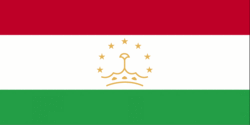 Tajikistani national flag (Flag of Tajikistan)
 Tajikistan country profile
 Travel advice for Tajikistan
As for the Tajikistani climate; midlatitude continental, hot summers, mild winters; semiarid to polar in Pamir Mountains.
Tajikistani(s) speak Tajik (official), Russian widely used in government and business.
Places of note in Tajikistan
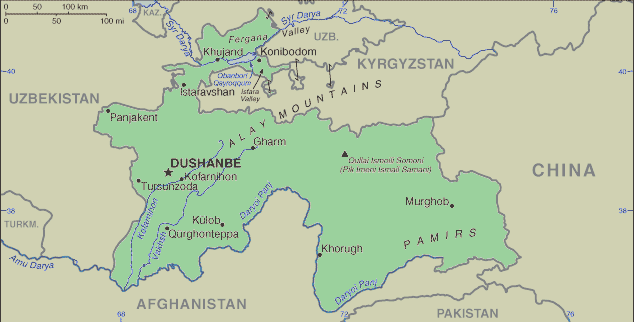 Tajikistani map
Regions of Tajikistan
The Tajik people came under Russian rule in the 1860s and 1870s, but Russia's hold on Central Asia weakened following the Revolution of 1917. Bolshevik control of the area was fiercely contested and not fully reestablished until 1925. Tajikistan became independent in 1991 following the breakup of the Soviet Union, and it is now in the process of strengthening its democracy and transitioning to a free market economy after its 1992-1997 civil war. There have been no major security incidents in recent years, although the country remains the poorest in the former Soviet sphere. Attention by the international community in the wake of the war in Afghanistan has brought increased economic development assistance, which could create jobs and increase stability in the long term. Tajikistan is in the early stages of seeking World Trade Organization membership and has joined NATO's Partnership for Peace.
Tajikistan has one of the lowest per capita GDPs among the 15 former Soviet republics. Only 6% of the land area is arable; cotton is the most important crop. Mineral resources, varied but limited in amount, include silver, gold, uranium, and tungsten. Industry consists only of a large aluminum plant, hydropower facilities, and small obsolete factories mostly in light industry and food processing. The civil war (1992-97) severely damaged the already weak economic infrastructure and caused a sharp decline in industrial and agricultural production. Even though 64% of its people continue to live in abject poverty, Tajikistan has experienced steady economic growth since 1997, but experienced a slight drop in its growth rate to 8% in 2005 from 10.6% in 2004. Continued privatization of medium and large state-owned enterprises would further increase productivity. Tajikistan's economic situation, however, remains fragile due to uneven implementation of structural reforms, weak governance, widespread unemployment, and the external debt burden. A debt restructuring agreement was reached with Russia in December 2002, including a $250 million write-off of Tajikistan's $300 million debt to Russia. Tajikistan ranks third in the world in terms of water resources per head. A proposed investment to finish the hydropower dams Rogun and Sangtuda would substantially add to electricity production. If finished, Rogun will be the world's tallest dam.
Tajikistani natural resources include hydropower, some petroleum, uranium, mercury, brown coal, lead, zinc, antimony, tungsten, silver, gold
landlocked; mountainous region dominated by the Trans-Alay Range in the north and the Pamirs in the southeast; highest point, Qullai Ismoili Somoni (formerly Communism Peak), was the tallest mountain in the former USSR
Tajikistani religion is Sunni Muslim 85%, Shi'a Muslim 5%, other 10% (2003 est.).
Natural hazards in Tajikistan include earthquakes and floods.
Travel Advice for Tajikistan
TajikistanSUMMARY
- You should avoid off-road areas immediately adjoining the Afghan, Uzbek and Kyrgyz borders, which may be mined.
- There is a threat from terrorism in Tajikistan. Attacks could be indiscriminate and against civilian targets (see Terrorism section).
- The overall security situation in Tajikistan is currently stable.
- The tourism, health and transport infrastructure of Tajikistan is poor and travel within the country requires careful planning.
- Few British nationals visit Tajikistan. We are not aware of any British nationals who have required consular assistance in Tajikistan in the past year.
- We strongly recommend that you obtain comprehensive travel and medical insurance including evacuation by air ambulance before travelling. You should check any exclusions, and that your policy covers you for the activities you want to undertake. Please see: Travel Insurance.
SAFETY AND SECURITY
There have been no reported cases of avian influenza (bird flu) in Tajikistan during the current series of outbreaks. But the World Health Organisation (WHO) has confirmed cases elsewhere in the region.
Further information and advice is provided in the FCO’s: Avian and Pandemic Influenza Factsheet.
NATURAL DISASTERS
Tajikistan is located in an active seismic zone. Avalanches and landslides frequently block roads in the spring.
GENERAL
Tajikistan has not yet developed a tourist infrastructure. You should preferably arrange to be met on arrival and guided by a responsible local business, NGO, tourist or other organisation. Medical and travel insurance is essential.
OTHER