
 Search
Traveling Luck for Pakistan. Pakistan, Asia
Pakistan is located in Southern Asia, bordering the Arabian Sea, between India on the east and Iran and Afghanistan on the west and China in the north.
Land in Pakistan is flat Indus plain in east; mountains in north and northwest; Balochistan plateau in west.
Pakistani land covers an area of 803940 square kilometers which is slightly less than twice the size of California
Pakistan has borders with Afghanistan for 2430km, China for 523km, India for 2912km and Iran for 909km.
 Pakistani national flag (Flag of Pakistan)
 Pakistan country profile
 Travel advice for Pakistan
As for the Pakistani climate; mostly hot, dry desert; temperate in northwest; arctic in north.
Pakistani(s) speak Punjabi 48%, Sindhi 12%, Siraiki (a Punjabi variant) 10%, Pashtu 8%, Urdu (official) 8%, Balochi 3%, Hindko 2%, Brahui 1%, English (official and lingua franca of Pakistani elite and most government ministries), Burushaski, and other 8%.
Places of note in Pakistan
- Karāchi
- Lahore
- Faisalābād
- Rāwalpindi
- Multān
- Hyderābād
- Gujrānwāla
- Peshāwar
- Quetta
- Islamabad
- Bahāwalpur
- Sargodha
- Siālkot
- Sukkur
- Lārkāna
- Shekhūpura
- Jhang Sadr
- Gujrāt
- Mardān
- Kasūr
- Dera Ghāzi Khān
- Sāhīwāl
- Nawābshāh
- Mingāora
- Okāra
- Mīrpur Khās
- Chiniot
- Kāmoke
- Sādiqābād
- Būrewāla
- Jacobābād
- Muzaffargarh
- Murīdke
- Jhelum
- Shikārpur
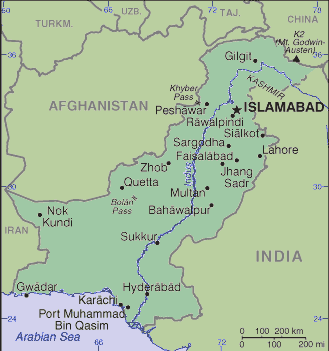 Pakistani map
Regions of Pakistan
The separation in 1947 of British India into the Muslim state of Pakistan (with two sections West and East) and largely Hindu India was never satisfactorily resolved, and India and Pakistan fought two wars - in 1947-48 and 1965 - over the disputed Kashmir territory. A third war between these countries in 1971 - in which India capitalized on Islamabad's marginalization of Bengalis in Pakistani politics - resulted in East Pakistan becoming the separate nation of Bangladesh. In response to Indian nuclear weapons testing, Pakistan conducted its own tests in 1998. The dispute over the state of Kashmir is ongoing, but discussions and confidence-building measures have led to decreased tensions since 2002.
Pakistan, an impoverished and underdeveloped country, has suffered from decades of internal political disputes, low levels of foreign investment, and a costly, ongoing confrontation with neighboring India. However, IMF-approved government policies, bolstered by generous foreign assistance and renewed access to global markets since 2001, have generated solid macroeconomic recovery the last four years. The government has made substantial macroeconomic reforms since 2000, although progress on more politically sensitive reforms has slowed. For example, in the budget for fiscal year 2006, Islamabad did not impose taxes on the agriculture or real estate sectors, despite Pakistan's chronically low tax-to-GDP ratio. While long-term prospects remain uncertain, given Pakistan's low level of development, medium-term prospects for job creation and poverty reduction are the best in more than a decade. Islamabad has raised development spending from about 2% of GDP in the 1990s to 4% in 2003, a necessary step towards reversing the broad underdevelopment of its social sector. GDP growth, spurred by double-digit gains in industrial production over the past year, has become less dependent on agriculture, and remained above 7% in 2004 and 2005. Inflation remains the biggest threat to the economy, jumping to more than 9% in 2005. The World Bank and Asian Development Bank announced that they would provide US $1 billion each in aid to help Pakistan rebuild areas hit by the October 2005 earthquake in Kashmir. Foreign exchange reserves continued to reach new levels in 2005, supported by steady worker remittances. In the near term, growth probably cannot be sustained at the 7% level; however, massive international aid, increased government spending, lower taxes, and pay increases for government workers will help Pakistan maintain strong GDP growth over the longer term.
Pakistani natural resources include land, extensive natural gas reserves, limited petroleum, poor quality coal, iron ore, copper, salt, limestone
controls Khyber Pass and Bolan Pass, traditional invasion routes between Central Asia and the Indian Subcontinent
Pakistani religion is Muslim 97% (Sunni 77%, Shi'a 20%), Christian, Hindu, and other 3%.
Natural hazards in Pakistan include frequent earthquakes, occasionally severe especially in north and west; flooding along the Indus after heavy rains (July and August).
Travel Advice for Pakistan
PakistanSUMMARY
- We advise against all travel to areas where there are ongoing reports of militant activity. This applies particularly to northern and western Balochistan, including the Sui/Dera Bugti and Kohlu areas, the Federally Administered Tribal Areas including Waziristan, and border areas except for official crossing points (see the Terrorism and Sectarian Violence and Local Travel sections of this travel advice for more details).
- We advise against all but essential travel to Peshawar until further notice, following an explosion on 27 January 2007, which killed and injured several people.
- There is a high threat from terrorism and sectarian violence throughout Pakistan. Attacks can be indiscriminate and in public places, including those frequented by foreigners. In January-February 2007 there has been a series of attacks and suicide bombings targeted both at the authorities and at locations frequented by foreigners. As of late January, the Pakistani authorities have increased security throughout Pakistan due to the threat of further imminent attacks.
- On 6 February 2007, a bomber exploded a grenade outside the terminal of IslamabadInternationalAirport. On 28 January, security forces were targeted in an attack in Dera Ismail Khan. On 27 January a suicide attack on police in Peshawar killed several people. On 26 January, a suicide bomb exploded outside the Marriott Hotel in Islamabad.
- You should follow this advice, and, if appropriate, seek local advice on the latest situation from the British High Commission Security Section or the British Deputy High Commission in Karachi.
- You should be particularly vigilant during the Shia Islamic holy month of Muharram which ends on 18 February 2007, as militants have used such occasions to mount attacks in the past. This applies particularly to religious processions; you should avoid crowds gathered for religious events associated with this period.
- You should avoid in general any large gatherings and demonstrations.
- We advise you against using the rail network and buses in Balochistan. Special advice applies to the Karakoram Highway (see the Local Travel section of this travel advice for more details).
- If you or your father were born in Pakistan special considerations apply (see the Local Laws and Customs section of this travel advice for more details).
- The majority of our Consular assistance is provided to victims of forced marriage or child abduction. If you are concerned about forced marriage or child abduction, please see our separate guidance on these matters on forced marriages and child abduction.
- You should obtain comprehensive travel and medical insurance before travelling. You should check any exclusions, and ensure that your policy covers you for the activities you want to undertake. Please see: Travel Insurance.
SAFETY AND SECURITY
There is a high threat from terrorism throughout Pakistan.
We advise against all travel to areas where there are ongoing reports of military or militant activity. This applies particularly to Waziristan, and to northern and western Balochistan including the Sui/DeraBugti and Kohlu areas. On 26 August 2006, major military activity led to the death of a senior tribal leader, Nawab Akbar Bugti. There has been street violence in Quetta, and there have been other more recent bombings in Quetta/Balochistan. Military operations continue against terrorists and insurgents in Waziristan and Balochistan. You should avoid travel by bus (as well as rail) in Balochistan. If planning to travel to Quetta contact the British Deputy High Commission, Karachi (00 92 21 582 7000) in advance for current advice.
Please read the Security and General Tips and Risk of Terrorism when Travelling Overseas on the FCO website for further information and advice.
Criminal and other Violence
In February 2007, there were reports of threats and attacks against non-Governmental Organisations (NGOs) engaged in earthquake reconstruction work in the area of Batgran (North West Frontier Province), which sits on the main road from Abbottabad to Gilgit. Travellers in transit should remain alert. Aid workers in the area should remain in touch with local UN co-ordination officials and the Pakistani authorities for the latest security advice.
Criminal violence, including armed car-jacking, robbery, kidnap and murder, is common, especially in Karachi. Travellers have been offered drugged food and then robbed. You should be very careful about, and confident of your personal security arrangements throughout your visit.
Much of Balochistan, rural Sindh and the North West Frontier Province, including the Federally-Administered Tribal Areas and Agencies, have a high incidence of lawlessness.
Other Crime
Beware of the risk of street crime and take personal security measures. Take particular care to safeguard your passport, bank cards, laptops and mobiles, particularly when travelling by public transport and when walking in crowded areas. There is an active black market in forged and stolen passports. Credit card fraud is common.
Political Situation
Political demonstrations and large gatherings of people for political or religious purposes occur regularly in major cities. These usually pass off peacefully, but there may be risks of clashes with police or political rivals. We recommend that you avoid political demonstrations and large crowds assembled for political or religious purposes.
Local Travel
We advise against all travel to the Federally Administered Tribal Areas. If travelling on the Karakoram Highway towards Gilgit and Hunza you are advised to travel in daylight as the road can be narrow, with sudden precipitous drops.
Except for official border crossing-points, the authorities prohibit travel by foreigners within 10 miles of Pakistan’s international borders and the Kashmir Line of Control, and within 30 miles of the Afghan border in the Northern Areas.
If you have to travel to these regions, you or your travel agent should contact the authorities in advance. They may arrange police protection as necessary and will advise whether you need a No Objection Certificate issued by the Pakistani Ministry of Foreign Affairs.
The Consular sections of the High Commission in Islamabad (0092 51 201 2000) and the Deputy High Commission in Karachi (0092 21 582 7000) can provide advice on specific local security advice including travel in those cities.
Rail Travel
Nationalist militants regularly plant bombs on the rail network in Baluchistan. You should avoid using the rail network in Baluchistan.
There were serious rail accidents causing many fatalities in Sindh in July 2005, and in Punjab in January/February 2006, as a result of sabotage by unknown perpetrators. Pakistan's railways have had a reasonable safety record, but you should be aware that there are risks associated with this mode of travel.
Road Safety
Take particular care on long road journeys and when travelling cross-country. Local driving standards are erratic, especially at night, road conditions are poor and there is a risk of car-jacking.
When driving, it is advisable to lock all doors and keep the windows up. Use well-travelled, well-lit routes where possible. We recommend you do not purchase anything from street vendors or have contact with beggars while travelling by car.
Air Safety
On 10 July 2006, a Pakistan International Airlines Fokker aircraft, flight PK 688 from Multan to Lahore, crashed shortly after taking off from Multan, some 400 km south of Islamabad. All 45 passengers and crew were killed. Causes of the crash are still being investigated. PIA had retained eight such aircraft for internal flights. These are ageing, but all planes are regularly maintained.
From 1 September 2006, all passengers on domestic flights must present one of the following forms of photo ID at check-in: National Identity card (computerised), passport, driving licence, photo credit card, or school ID card (for children under the age of 18). This must be an original document, and bear the same name as on your ticket.
LOCAL LAWS AND CUSTOMS
Consular assistance in remote areas might be delayed.
Pakistan is a Muslim state and local customs, such as dress and behaviour, should be respected, especially during the holy month of Ramadan. Dress modestly. Men and women should cover their shoulders and legs when in public. Women should cover their heads when entering mosques or other holy places, and when travelling in more rural areas. During Ramadan (which in 2006 has already begun and will end on or around 23 October), eating, drinking and smoking between sunrise and sunset is forbidden for Muslims (though children under the age of puberty are not required to fast).
Importing alcohol and pork products is illegal. Homosexuality and co-habitation by an unmarried couple are illegal. Possession of even small quantities of illegal drugs can lead to imprisonment. Drug smuggling can attract the death penalty.
Do not take photographs at military establishments, airports or any infrastructure, including bridges and dams or from aircraft. In the past British nationals have been arrested on suspicion of ‘spying’. You should seek prior permission from any official present if you are photographing these types of places, especially in border areas.
ENTRY REQUIREMENTS
Journalists’ visas often have additional travel restrictions, which should be observed.
A parent or other adults travelling alone with children should be aware that the immigration authorities demand documentary evidence of parental responsibility before allowing the children to leave the country, especially those of Pakistani origin.
For further information consult: Pakistani representation in the UK, your local Pakistani Consulate, or the Pakistan High Commission or Embassy in the country of your residence.
British nationals travelling on a Pakistani passport will need the appropriate visa to re-enter the UK. Children need their own passports.
There is a legal requirement for some foreign nationals to register with the Police after arrival in Pakistan. If you are stopped by the Police for any reason, and you have not registered then you are likely to be arrested. You should check with the Pakistani representation in the UK before travelling to see if this affects you.
HEALTH
Outside the major cities there are few hospitals of UK standards.
Malaria and Mosquito-borne Dengue fever exist in coastal and low-lying parts of Pakistan. More than three-quarters of British travellers who contracted malaria in 2005 did not take preventive measures, such as malaria prevention tablets. However, malaria can occur despite appropriate prevention, and therefore you should promptly seek medical care in the event of a fever or flu-like illness in the first year following your return from travelling to a malaria risk country. Before travelling you should seek medical advice about the malaria risk in Pakistan.
You should seek medical advice before travelling and ensure that all appropriate vaccinations are up to date. For further information on health, check the Department of Health's website at: www.dh.gov.uk
Avian Influenza (Bird Flu)
On 6 February 2007 a Government spokesman confirmed the presence of the H5N1 strain of avian influenza in a small flock of domestic poultry in Rawalpindi, which has now been slaughtered. The virus was also detected in a flock of peacocks in Mansehra in North West Frontier Province, where similar action has been taken. Farmers have been supplied with vaccine. To date no human cases have been reported in Pakistan.
The risk to humans from Avian Influenza is believed to be very low. As a precaution you should avoid visiting live animal markets, poultry farms and other places where you may come into close contact with domestic, caged or wild birds; and ensure poultry and egg dishes are thoroughly cooked.
You should read this advice in conjunction with the Avian and Pandemic Influenza Factsheet, which gives more detailed advice and information.
NATURAL DISASTERS
On 8 October 2005, a catastrophic earthquake with its epicentre near Muzaffarabad in Pakistani-administered Kashmir, caused widespread damage and loss of life. Infrastructure and services in northern Pakistani-administered Kashmir and surrounding areas have been severely disrupted. The main devastation is in the towns of Muzaffarabad, Rawalakot, Bagh, Balakot and Mansehra.
The focus has now moved from relief to reconstruction. You should be aware that facilities may be limited in affected areas. Aid workers in the affected areas should maintain contact with local UN co-ordination officials and Pakistani authorities for the latest security advice.
Earth tremors are common and mountainous areas experience floods and landslides.
GENERAL
All British nationals visiting or resident in Pakistan should register with the British Consular Sections of the British High Commission in Islamabad or the Deputy High Commission in Karachi: www.britishhighcommission.gov.uk/pakistan
You should carry a photocopy of the data page and Pakistani visa from your passport at all times, plus copies of other important travel documents. These should be kept separately from the originals, and copies left with friends or relatives in the UK.
The majority of our Consular assistance is provided to victims of forced marriage or child abduction. If you are concerned about a forced marriage or child abduction, please see our separate guidance using the following links on the FCO website: forced marriages and child abduction.
Among British nationals of Pakistani origin we are often asked for assistance with land or property ownership disputes. You should consider taking legal advice before entering into any agreement over the ownership or use of property or other assets. The British High Commission cannot intervene in these matters.
We advise you to consult the Know Before You Go information page before travelling to Pakistan (link shown above).
OTHER