
 Search
Traveling Luck for Bhutan. Bhutan, Asia
Bhutan is located in Southern Asia, between China and India.
Land in Bhutan is mostly mountainous with some fertile valleys and savanna.
Bhutanese land covers an area of 47000 square kilometers which is about half the size of Indiana
Bhutan has borders with China for 470km and India for 605km.
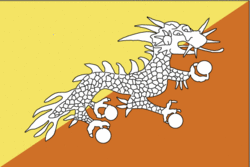 Bhutanese national flag (Flag of Bhutan)
 Bhutan country profile
 Travel advice for Bhutan
As for the Bhutanese climate; varies; tropical in southern plains; cool winters and hot summers in central valleys; severe winters and cool summers in Himalayas.
Bhutanese (singular and plural) speak Dzongkha (official), Bhotes speak various Tibetan dialects, Nepalese speak various Nepalese dialects.
Places of note in Bhutan
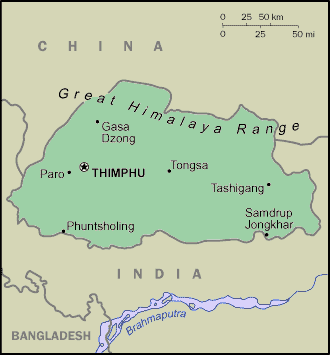 Bhutanese map
Regions of Bhutan
In 1865, Britain and Bhutan signed the Treaty of Sinchulu, under which Bhutan would receive an annual subsidy in exchange for ceding some border land to British India. Under British influence, a monarchy was set up in 1907; three years later, a treaty was signed whereby the British agreed not to interfere in Bhutanese internal affairs and Bhutan allowed Britain to direct its foreign affairs. This role was assumed by independent India after 1947. Two years later, a formal Indo-Bhutanese accord returned the areas of Bhutan annexed by the British, formalized the annual subsidies the country received, and defined India's responsibilities in defense and foreign relations. A refugee issue of some 100,000 Bhutanese in Nepal remains unresolved; 90% of the refugees are housed in seven United Nations Office of the High Commissioner for Refugees (UNHCR) camps. In March 2005, King Jigme Singye WANGCHUCK unveiled the government's draft constitution - which would introduce major democratic reforms - and pledged to hold a national referendum for its approval. A referendum date has yet to be named.
The economy, one of the world's smallest and least developed, is based on agriculture and forestry, which provide the main livelihood for more than 90% of the population. Agriculture consists largely of subsistence farming and animal husbandry. Rugged mountains dominate the terrain and make the building of roads and other infrastructure difficult and expensive. The economy is closely aligned with India's through strong trade and monetary links and dependence on India's financial assistance. The industrial sector is technologically backward, with most production of the cottage industry type. Most development projects, such as road construction, rely on Indian migrant labor. Bhutan's hydropower potential and its attraction for tourists are key resources. Model education, social, and environment programs are underway with support from multilateral development organizations. Each economic program takes into account the government's desire to protect the country's environment and cultural traditions. For example, the government, in its cautious expansion of the tourist sector, encourages visits by upscale, environmentally conscientious tourists. Detailed controls and uncertain policies in areas like industrial licensing, trade, labor, and finance continue to hamper foreign investment.
Bhutanese natural resources include timber, hydropower, gypsum, calcium carbonate
landlocked; strategic location between China and India; controls several key Himalayan mountain passes
Bhutanese religion is Lamaistic Buddhist 75%, Indian- and Nepalese-influenced Hinduism 25%.
Natural hazards in Bhutan include violent storms from the Himalayas are the source of the country's name, which translates as Land of the Thunder Dragon; frequent landslides during the rainy season.
Travel Advice for Bhutan
BhutanSUMMARY
- There is no British representation in Bhutan. The nearest consular office is the British Deputy High Commission in Kolkata (formerly Calcutta). Contact details are below.
- You must arrange any visit to Bhutan through an authorised travel agent. Those travelling independently on British passports are not permitted to enter Bhutan.
- Over 1,400 British nationals visited Bhutan last year. We are not aware of any British nationals who have required consular assistance in Bhutan in the past year.
- We strongly recommend that you obtain comprehensive travel and medical insurance before travelling. You should check any exclusions, and that your policy covers you for the activities you want to undertake. Please see Travel Insurance.
SAFETY AND SECURITY
You should be aware of the global risk of indiscriminate terrorist attacks which could be against civilian targets, including places frequented by foreigners. Please read Security and General Tips and Risk of Terrorism when Travelling Overseas for further information and advice.
Political Situation
Air Travel
Druk Air is the only scheduled carrier into Bhutan, with services from New Delhi, Kathmandu, Kolkata, Dhaka and Bangkok. Its services can be subject to disruption. You should be flexible with your travel plans if you intend to fly into Bhutan.
LOCAL LAWS AND CUSTOMS
It is illegal to sell tobacco. Offenders will be charged with smuggling and can expect to be fined. Imported tobacco products demonstrably for personal use are subject to a 100 percent tax.
Personal computers, cellular telephones, cameras, or any other electronic device must be registered with Bhutanese customs upon arrival. These items will also be checked upon departure. The export of all antiques is strictly monitored.
ENTRY REQUIREMENTS
HEALTH
Bhutanese hospitals provide only basic health care.
There are no particular health concerns but you may find the high mountain altitudes demanding. You should familiarise yourself with the dangers of High Altitude (Mountain) Sickness especially if you are trekking in remote areas.
You should seek medical advice before travelling and ensure that all appropriate vaccinations are up to date. For further information on health, check the Department of Health’s website at www.dh.gov.uk.
GENERAL
There is no British representation in Bhutan. The nearest consular office is the British Deputy High Commission in Kolkata (formerly Calcutta), (Tel: +91 33 2288 5172 or 73 or 74 or 75 or 76; Fax: +91 33 2288 3435 or 3996).