
 Search
Traveling Luck for Colombia. Colombia, South America
Colombia is located in Northern South America, bordering the Caribbean Sea, between Panama and Venezuela, and bordering the North Pacific Ocean, between Ecuador and Panama.
Land in Colombia is flat coastal lowlands, central highlands, high Andes Mountains, eastern lowland plains.
Colombian land covers an area of 1138910 square kilometers which is slightly less than twice the size of Texas
Colombia has borders with Brazil for 1643km, Ecuador for 590km, Panama for 225km, Peru for 1496km and Venezuela for 2050km.
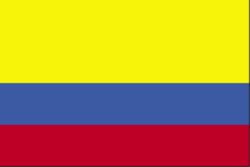 Colombian national flag (Flag of Colombia)
 Colombia country profile
 Travel advice for Colombia
As for the Colombian climate; tropical along coast and eastern plains; cooler in highlands.
Colombian(s) speak Spanish.
Places of note in Colombia
- Bogotá
- Cali
- Medellín
- Barranquilla
- Cartagena
- Cúcuta
- Bucaramanga
- Pereira
- Santa Marta
- Ibagué
- Bello
- Pasto
- Manizales
- Neiva
- Soledad
- Villavicencio
- Armenia
- Soacha
- Valledupar
- Itagüí
- Montería
- Sincelejo
- Floridablanca
- Buenaventura
- Palmira
- Buenaventura
- Barrancabermeja
- Dos Quebradas
- Tuluá
- Envigado
- Cartago
- Maicao
- Florencia
- Girardot
- Sogamoso
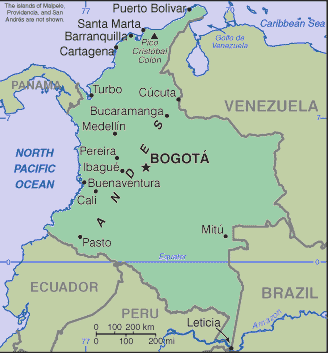 Colombian map
Regions of Colombia
- Amazonas
- Antioquia
- Arauca
- Archipiélago de San Andrés, Providencia y Santa Catalina
- Atlántico
- Bolívar
- Bolívar
- Boyacá
- Boyacá
- Caldas
- Caldas
- Caquetá
- Casanare
- Cauca
- Cesar
- Chocó
- Colombia (general)
- Córdoba
- Cundinamarca
- Distrito Capital
- Guainía
- Guaviare
- Huila
- La Guajira
- Magdalena
- Magdalena
- Meta
- Nariño
- Norte de Santander
- Putumayo
- Quindío
- Risaralda
- Santander
- Sucre
- Tolima
- Valle del Cauca
- Vaupés
- Vichada
Colombia was one of the three countries that emerged from the collapse of Gran Colombia in 1830 (the others are Ecuador and Venezuela). A 40-year conflict between government forces and anti-government insurgent groups and illegal paramilitary groups - both heavily funded by the drug trade - escalated during the 1990s. The insurgents lack the military or popular support necessary to overthrow the government and violence has been decreasing since about 2002, but insurgents continue attacks against civilians and large swaths of the countryside are under guerrilla influence. Paramilitary groups challenge the insurgents for control of territory and the drug trade. Most paramilitary members have demobilized since 2002 in an ongoing peace process, although their commitment to ceasing illicit activity is unclear. The Colombian Government has stepped up efforts to reassert government control throughout the country, and now has a presence in every one of its municipalities. However, neighboring countries worry about the violence spilling over their borders.
Colombia's economy has been on a recovery trend during the past two years despite a serious armed conflict. The economy continues to improve thanks to austere government budgets, focused efforts to reduce public debt levels, an export-oriented growth strategy, and an improved security situation in the country. Ongoing economic problems facing President URIBE range from reforming the pension system to reducing high unemployment. New exploration is needed to offset declining oil production. On the positive side, several international financial institutions have praised the economic reforms introduced by URIBE, which succeeded in reducing the public-sector deficit below 1.5% of GDP. The government's economic policy and democratic security strategy have engendered a growing sense of confidence in the economy, particularly within the business sector. Coffee prices have recovered from previous lows as the Colombian coffee industry pursues greater market shares in developed countries such as the United States.
Colombian natural resources include petroleum, natural gas, coal, iron ore, nickel, gold, copper, emeralds, hydropower
only South American country with coastlines on both the North Pacific Ocean and Caribbean Sea
Colombian religion is Roman Catholic 90%, other 10%.
Natural hazards in Colombia include highlands subject to volcanic eruptions; occasional earthquakes; periodic droughts.
Travel Advice for Colombia
ColombiaSUMMARY
- We advise against all travel to Putumayo, Arauca, Nariño, Caqueta, Guaviare and Norte de Santander departments, and to rural areas of Sucre, Bolivar, Choco, Antioquia, Valle de Cauca, Cauca and Huila departments. We also advise against all travel to southern parts of Meta department and to the Sierra Nevada de Santa Marta (including the ‘Lost City’). There is a high risk to your personal safety in these areas.
- There is a high threat of terrorism in Colombia. You should be extremely vigilant throughout Colombia, particularly when visiting or staying in public places used by foreigners, such as hotels, bars, restaurants, nightclubs and shopping malls and in the vicinity of government buildings and military establishments.
- There is a serious risk of kidnapping and crime throughout most parts of the country.
- The threat level for the Galeras Volcano, in Nariño Department, was raised to Level 2 on 22 November 2006. The Colombian authorities believe that the volcano may erupt within days or weeks. You should avoid restricted areas, pay careful attention to all warnings issued and follow the advice of the local Colombian authorities. (Also see Natural Disasters Section below).
- Around 11,000 British nationals visit Colombia every year. Most visits are trouble-free. The main type of incident for which British nationals require consular assistance in Colombia is the theft of personal belongings, including passports.
- We strongly recommend that you obtain comprehensive travel and medical insurance before travelling. You should check any exclusions, and that your policy covers you for the activities you want to undertake. Please see Travel Insurance.
SAFETY AND SECURITY
Politically-driven and criminal violence is a serious problem in Colombia.
In many cases, it is not possible to separate crimes and violence by terrorist groups from crimes committed by criminal groups. Colombia’s illegal armed groups are heavily involved in the drugs trade (as are many other criminal groups) and in other sorts of serious crime including kidnapping (for ransom and for political purposes) money laundering, and the running of extortion and prostitution rackets.
Kidnapping in Colombia is a serious problem. Most foreign nationals are potential targets for kidnapping – backpackers as much as those working for foreign multinationals. A number of Britons have been kidnapped in recent years, including one who was subsequently killed. Colombia continues to have a high rate of kidnapping for ransom, with 800 kidnappings reported in 2005. In addition to the departments mentioned in the ‘Terrorism’ section above, we also advise against all travel to Arauca, Nariño and Norte de Santander departments and to rural areas of Choco, Sucre, Antioquia, Valle de Cauca departments (including the port of Buenaventura in Valle de Cauca where illegal armed groups and criminal gangs are very active), where you would be at particularly high risk of being kidnapped. Most recently, a Briton and a Dutchman were kidnapped on 3 February 2006 in Norte de Santander department. They were released unharmed on 9 February 2006. Two Spanish nationals were kidnapped in the Darien region, close to the Colombian-Panamanian border, in January 2006.
We advise against all travel to the Sierra Nevada de Santa Marta, including the ‘Lost City’. Two British tourists from an organised tour group to the ‘Lost City’ in the Sierra Nevada de Santa Marta national park were kidnapped in September 2003. The victims spent some months in captivity, before being freed. There is evidence that the illegal armed group responsible for the kidnapping wanted to sell the hostages on to the FARC. Armed groups are still active in this area and the risk of kidnap in this area remains high.
Since March 2005, there has been a marked increase in criminal activity in urban areas, particularly in Bogota. This increase has been linked to the demobilisation of AUC members (see ‘Political Situation’ below).
For tourists and short-term visitors, especially in urban areas, common crime, muggings and pickpocketing, often accompanied by violence, are likely to be a greater danger than getting caught up in guerrilla and paramilitary activity. Foreign visitors present a tempting target to thieves, pickpockets and drug traffickers. When walking in urban areas, you should avoid any unnecessary display of wealth.
You should be wary of unsolicited approaches from strangers. There have been several cases of assailants using drugs to subdue their intended victims. Drugs can be administered through food, drinks, needles, cigarettes, aerosols, powder, or have even been impregnated in ‘flyers’ handed out at traffic lights. Sometimes drugs are administered in food sold by cheap takeaways. These drugs can take effect extremely quickly, allowing an assailant to rob the victim and escape before the attack can be reported. It can take several days for the drug to wear off and the victim to recover. These attacks frequently occur on public transport. You should never accept offers of food, drink or cigarettes from strangers – no matter how friendly or well dressed the person offering you something appears.
There have been reports, including in Bogota, of bogus policemen approaching foreigners to "check" documents or foreign currency. If approached you should avoid handing over money or documents, unless threatened, and ask the "policeman" to accompany you to the nearest police station, police post or to your hotel.
You should take particular care if visiting poorer areas of cities. In Bogota, you should be vigilant in areas to the south of Candelaria and to the south of the airport road as these parts of the city are particularly dangerous. You should be cautious in city streets, especially after dark. You should avoid hailing taxis on the street but should book them through hotels or by phoning a reputable taxi company.
Political Situation
Colombia Country Profile.
Colombia has suffered from an internal armed conflict for over forty years. The “democratic security policy” adopted by the current Colombian Government to bring greater stability and security to the country has, however, yielded some success. But Colombia still has a long way to go to in solving its problems. By April 2006 over 30,000 paramilitaries had demobilized. This process is being monitored by representatives of the Organisation of American States (OAS).
Local Travel
We strongly advise against all travel to Putumayo, Arauca, Caqueta, Nariño, Guaviare, Norte de Santander departments and rural areas of Choco because of a high risk to personal safety. For the same reason, we advise against travel to the rural areas of Sucre and Bolivar where one or more of the illegal armed groups and drugs cartels are currently active. The risks to British nationals of being kidnapped, caught up in the fighting, or otherwise of getting into serious trouble are high. The effective authority of the Colombian State in many of these areas is limited. The British Embassy’s ability to try to assist British nationals in trouble in these areas could be similarly limited. Two British backpackers were kidnapped in Choco department's border area with Panama in 2000, and a British backpacker was killed near Quibdo, the provincial capital, in 2001.
We also advise against all travel to rural areas of Antioquia, southern Meta, Valle de Cauca, Cauca departments and to rural areas of Huila department (including San Agustin). The illegal armed groups are active in these areas. However, the capitals of these departments may still be visited by air.
The departments of Norte de Santander and Arauca, and Nariño, Caqueta and Putumayo border Venezuela and Ecuador respectively. The FARC regularly carry out raids on government forces and civilians in these border regions. In January 2005, the Governor’s Office in Arauca was bombed and, in the same month, 17 farmers were killed. The southern departments bordering Ecuador, and also southern Meta department, are also areas in which the Colombian authorities are concentrating their efforts in their war against insurgents and drug-traffickers, as part of the Plan Patriota. There are frequent clashes between government forces and illegal armed groups.
We do not currently advise against travel to Leticia, the jungle town on the Amazonian border with Peru and Brazil.
AUC (or former AUC) members, despite the demobilisation process, continue to set up illegal roadblocks in Sucre and Bolivar departments, providing an increased risk of kidnap and extortion. Likewise, the FARC and ELN are setting up similar roadblocks in Valle de Cauca and Cauca departments.
If you travel to major cities in Colombia, we do encourage you to take sensible precautions. In addition to Bogota, important business centres include Medellin, Cali, Barranquilla, Bucaramanga and Cartagena. Cartagena is a popular tourist destination and venue for major conferences.
If you intend to visit areas not specifically mentioned in this advice, you should check with the British Embassy's Consular Section in Bogota if you are in any doubt about your safety. You should also check with the Embassy before undertaking any trips to remote areas, even if these are to recognised tourist destinations.
Road Safety
Road surfaces, even in large cities, are variable. Driving standards are low and traffic accidents are common. You will need to have an international driving licence and car insurance is compulsory.
The risk of violence and kidnapping is high in rural areas, as is the threat of being caught in roadblocks set up by illegal armed groups. Travel by road outside the major cities, including by public transport, is dangerous. Roads are generally safer to travel on during daylight hours at weekends and on public holidays when more troops are deployed to enhance road safety. North-east of the capital, the roads as far as Paipa and Villa de Leiva, both in Boyaca department, are deemed safe to travel throughout the week in daylight hours, as is the road south-west of the city to Melgar, on the border between Cundinamarca and Tolima departments.
Rail Safety
There is no significant rail transport system in Colombia.
Air Safety
The national carrier, Avianca, and other national airlines and all international airlines comply with International Air Safety Regulations. However, West Caribbean Airways, which operates out of Medellin, has suffered three serious accidents in the last year. All its planes have been grounded pending an investigation.
We advise you to enter or leave Colombia by air only and not by land borders given the general dangers of travel by road and the location of border crossings. You should note, however, that there have been hijackings of aircraft serving secondary airports, where security measures often do not meet the standards obtained at the major city airports.
LOCAL LAWS AND CUSTOMS
Homosexuality is legal but not widely socially accepted, especially in rural areas.
Dress sense is comparable to Europe.
Photography of military or strategic sites is not permitted.
ENTRY REQUIREMENTS
Our current understanding is that a British national may enter Colombia for up to 90 days as a visitor without a visa, but that there is no unconditional right to do so. The decision on whether to permit entry and length of stay rests with the Immigration Officer on arrival. You should have a valid return ticket with you and your passport should have at least six month's validity. We advise you to enter Colombia by air only and not to try to enter by any overland route. You may be able to extend your stay up to a maximum of a further 90 days on application and payment of fee at the immigration office of the Department of Administration and Security once in Colombia. As a visitor, you cannot remain in Colombia more than 180 days in any twelve-month period.. You should not outstay your visa.
Single parents or other adults travelling alone with children should be aware that the Colombian authorities may require you to produce documentary evidence of parental authority before allowing you and your children to enter or leave the country. For further information on exactly what will be required at immigration please contact the Colombian Consulate-General in London (info@colombianconsulate.co.uk).
HEALTH
You should also take sensible medical precautions and seek advice from your doctor before travelling.
We strongly advise all travellers intending to visit Magdalena, Cesar, La Guajira, Atlantico, Santander, Norte de Santander and Amazona areas to have yellow fever inoculations and to carry vaccination certificates. Colombian immigration officials may insist upon seeing such proof.
There is a high incidence of malaria in low-land tropical areas, particularly in Choco and north-western Antioquia. Before travelling you should take medical advice on anti-malarial medication, and during your stay in Colombia ensure that you take adequate precautions against being bitten by mosquitoes. Dengue fever is prevalent on the north Caribbean coast, particularly in Choco, Antioquia, Cordoba, Sucre, Bolivar and Atlantico departments.
You should seek medical advice before travelling and ensure that all appropriate vaccinations are up to date. For further information on health, check the Department of Health’s website at www.dh.gov.uk.
NATURAL DISASTERS
Heavy rain throughout most parts of Colombia has increased the risk of floods and landslides. There are occasional volcanic eruptions and earthquakes.
The threat level for the Galeras Volcano, Nariño Department was raised to Level 2 on 22 November 2006. The Colombian authorities believe that the volcano may erupt within days or weeks. The surrounding area is being evacuated. Notwithstanding our advice against all travel to Nariño Department, visitors to the area should avoid restricted areas, pay careful attention to all warnings issued and follow the advice of the local Colombian authorities.
GENERAL
You should pack all your luggage yourself, and not carry items for other people.
You should ensure that you have comprehensive medical and travel insurance.
You should ensure you bring enough money. US dollars and travellers’ cheques are most widely accepted. Airport tax for international departures for visitors who stay in Colombia for less than two months is US $30. For stays in excess of two months the tax is $51. However, the charge depends on the type of visa with which you are issued. The Colombian Embassy in London can advise further.
You should use your credit and debit cards with caution and are advised to keep receipts. If you use an ATM, try to do so during business hours at a location inside a bank, supermarket or large commercial building.
You should not outstay your visa.
You should avoid all dealings with illegal drugs.
You should only use pre-booked taxis.
We encourage all British nationals visiting or resident in Colombia to register with the Consular Section of the British Embassy in Bogota.
You should carry a photocopy of the data page and Colombian visa from your passport at all times, plus copies of other important documents. These should be kept separately from the originals, and copies left with friends or relatives in the UK.
You should enter your next of kin details in the back of your passport.
You should reconfirm your onward flight at least 72 hours before departure.
There are also British Honorary Consulates in Cali and Medellin, which can provide consular assistance. Contact details can be found on the Embassy website.