
 Search
Traveling Luck for Peru. Peru, South America
Peru is located in Western South America, bordering the South Pacific Ocean, between Chile and Ecuador.
Land in Peru is western coastal plain (costa), high and rugged Andes in center (sierra), eastern lowland jungle of Amazon Basin (selva).
Peruvian land covers an area of 1285220 square kilometers which is slightly smaller than Alaska
Peru has borders with Bolivia for 900km, Brazil for 1560km, Chile for 160km, Colombia for 1496km and Ecuador for 1420km.
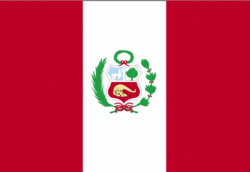 Peruvian national flag (Flag of Peru)
 Peru country profile
 Travel advice for Peru
As for the Peruvian climate; varies from tropical in east to dry desert in west; temperate to frigid in Andes.
Peruvian(s) speak Spanish (official), Quechua (official), Aymara, and a large number of minor Amazonian languages.
Places of note in Peru
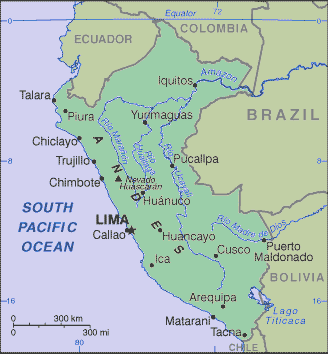 Peruvian map
Regions of Peru
Ancient Peru was the seat of several prominent Andean civilizations, most notably that of the Incas whose empire was captured by the Spanish conquistadors in 1533. Peruvian independence was declared in 1821, and remaining Spanish forces defeated in 1824. After a dozen years of military rule, Peru returned to democratic leadership in 1980, but experienced economic problems and the growth of a violent insurgency. President Alberto FUJIMORI's election in 1990 ushered in a decade that saw a dramatic turnaround in the economy and significant progress in curtailing guerrilla activity. Nevertheless, the president's increasing reliance on authoritarian measures and an economic slump in the late 1990s generated mounting dissatisfaction with his regime. FUJIMORI won reelection to a third term in the spring of 2000, but international pressure and corruption scandals led to his ouster by Congress in November of that year. A caretaker government oversaw new elections in the spring of 2001, which ushered in Alejandro TOLEDO as the new head of government; his presidency has been hampered by allegations of corruption.
Peru's economy reflects its varied geography - an arid coastal region, the Andes further inland, and tropical lands bordering Colombia and Brazil. Abundant mineral resources are found in the mountainous areas, and Peru's coastal waters provide excellent fishing grounds. However, overdependence on minerals and metals subjects the economy to fluctuations in world prices, and a lack of infrastructure deters trade and investment. After several years of inconsistent economic performance, the Peruvian economy grew by more than 4 percent per year during the period 2002-2005, with a stable exchange rate and low inflation. Risk premiums on Peruvian bonds on secondary markets reached historically low levels in late 2004, reflecting investor optimism regarding the government's prudent fiscal policies and openness to trade and investment. Despite the strong macroeconomic performance, the TOLEDO administration remained unpopular in 2005, and unemployment and poverty have stayed persistently high. Economic growth will be driven by the Camisea natural gas megaproject and by exports of minerals, textiles, and agricultural products. Peru is expected to sign a free-trade agreement with the United States in early 2006.
Peruvian natural resources include copper, silver, gold, petroleum, timber, fish, iron ore, coal, phosphate, potash, hydropower, natural gas
shares control of Lago Titicaca, world's highest navigable lake, with Bolivia; a remote slope of Nevado Mismi, a 5,316 m peak, is the ultimate source of the Amazon River
Peruvian religion is Roman Catholic 81%, Seventh Day Adventist 1.4%, other Christian 0.7%, other 0.6%, unspecified or none 16.3% (2003 est.).
Natural hazards in Peru include earthquakes, tsunamis, flooding, landslides, mild volcanic activity.
Travel Advice for Peru
PeruSUMMARY
- Street crime is a problem, particularly in Lima and other big cities. Robberies by rogue taxi drivers in the main tourist areas, including Lima airport, Cusco and Arequipa, are an increasing problem. You are advised to book taxis through reputable companies rather than hailing them in the street. Please see the Crime Section of this travel advice for more details.
- There is a risk of "express kidnappings". You should exercise caution when arriving in, and travelling around Peru and be aware of the general risks of crime for visitors. Please see the Crime section of this travel advice for more details.
- Heavy rains in Junin Department (Central Highlands) have led to mudslides causing deaths. More rains are expected with subsequent travel disruption. Please see the States of Emergency section of this travel advice for more details.
- Street demonstrations and protests are commonplace in Peru, and sometimes turn violent. You should take care to avoid any area in which large crowds are gathering.
- You should be aware of the global risk of indiscriminate terrorist attacks, which could be against civilian targets, including places frequented by foreigners.
- Around 62,000 British tourists visit Peru every year. Most visits are trouble-free. The main type of incident for which British nationals require consular assistance in Peru is in connection with opportunistic street crime or robberies, involving pick-pocketing or bag snatches, crimes resulting from riding in rogue taxis, and bus crashes.
- The Inca Trail will be closed during the month of February. This is an annual closure in order to carry out maintenance and conservation works.
- You should carry some form of identification with you at all times. A photocopy of the relevant pages from your passport is sufficient.
- We strongly recommend that you obtain comprehensive travel and medical insurance before travelling. You should check any exclusions, and that your policy covers you for the activities you want to undertake. Please see: Travel Insurance
SAFETY AND SECURITY
Street crime, including muggings and thefts, is a significant problem in Lima, Cusco and other major cities. You should take care when using web-cafes and similar services as thieves operate in places where people are easily distracted.
Political Situation
You are encouraged to seek advice from the local Tourist Protection Service, whose operators can handle calls and enquiries in English. They can be contacted on +51 1 424 2053 (24 hours a day).
You can drive for up to one month in Peru on a UK driving licence and up to one year on an international driving licence. In either case, you should carry your passport with you to prove how long you have been in the country.
Sand Buggies
LOCAL LAWS AND CUSTOMS
You are not allowed to take any valuable artefacts from the country without the proper authority.
Homosexuality is legal in Peru but social attitudes generally are fairly conservative. Any outward display of homosexual behaviour is likely to be frowned upon. Same-sex partnerships are not formally recognised.
You should avoid taking photographs of anything of a military nature anywhere in Peru.
ENTRY REQUIREMENTS
You should keep the immigration paper given to you on arrival in a safe place as you will need to show this upon departure. We recommend that your passport should have a remaining validity of at least six months.
Business visitors entering Peru on a business visa are required to complete on departure a form from SUNAT, the Peruvian tax authority. The form can be acquired from the Peruvian Embassy in London before travelling or at Lima airport on arrival.
Single parents or other adults travelling alone with children should be aware that some countries require documentary evidence of parental responsibility before allowing lone parents to enter the country or, in some cases, before permitting the children to leave the country. For further information on exactly what will be required at immigration, please contact: Peruvian Representation in the UK.
HEALTH
Yellow fever is endemic to Peru and in 2006 cases were reported in the mountainous and jungle areas of Peru.
You are advised to seek medical advice before travelling and to ensure that all appropriate vaccinations are up to date. For further information, visit the Department of Health’s website at: www.dh.gov.uk or contact your GP.
NATURAL DISASTERS
Peru is in an active earthquake zone and tremors are frequent.
GENERAL
You should carry identification with you at all times. It is permissible to carry photocopies of the relevant pages of passports to avoid losing the original, which should be kept in a safe place. If you are remaining in Peru for a longer period you should register with the British Embassy in Lima.
There is a departure tax of US$30.25 (per person) for international flights from Peru. There is also an airport tax for internal flights. This varies according to the airport but internal departures from Lima cost US$6.05 per person. The equivalent sum in Peruvian soles is accepted.
Money
ATM machines can be found in the main cities. Not all shops, restaurants, bars and hotels accept credit cards and it is worth checking whether they do before purchasing or ordering anything. Western Union is represented in Peru, with bureaux in all main cities. This is a quick, reliable way of receiving money from abroad. You should be alert to the possibility of being passed counterfeit US dollars or local currency.
In addition to the Embassy in Lima, there are Honorary British Consuls in Cusco, Arequipa and Trujillo (See below for contact details).
British Honorary Consuls in Peru
Arequipa
Honorary Consul: Mr Reynaldo Roberts MBE
Tacna y Arica 156, Arequipa
Tel: (+51) (54) 24 60 6600
Fax: (+ 51) (54) 606 601
Email: gerencia@gruporoberts.com
Cusco
Honorary Consul: Mr Barry Walker MBE
Manu Expeditions, Urbanización Magisterial
Tel: (+ 51) (84) 23 9974 - 22 6671
Fax: (+ 51) (84) 23 6706
Email: bwalker@terra.com.pe
Trujillo
Honorary Consul: Mr Winston Barber
Jr Alfonso Ugarte 310, Trujillo
Tel/Fax: (+ 51) (44) 24 5935; (+51) (44) 035 6963
Email: winstonbarber@terra.com.pe