
 Search
Traveling Luck for Venezuela. Venezuela, South America
Venezuela is located in Northern South America, bordering the Caribbean Sea and the North Atlantic Ocean, between Colombia and Guyana.
Land in Venezuela is Andes Mountains and Maracaibo Lowlands in northwest; central plains (llanos); Guiana Highlands in southeast.
Venezuelan land covers an area of 912050 square kilometers which is slightly more than twice the size of California
Venezuela has borders with Brazil for 2200km, Colombia for 2050km and Guyana for 743km.
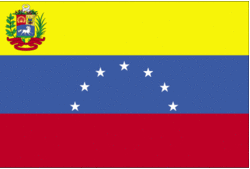 Venezuelan national flag (Flag of Venezuela)
 Venezuela country profile
 Travel advice for Venezuela
As for the Venezuelan climate; tropical; hot, humid; more moderate in highlands.
Venezuelan(s) speak Spanish (official), numerous indigenous dialects.
Places of note in Venezuela
- Caracas
- Valencia
- Barquisimeto
- Ciudad Guayana
- Barcelona
- Maturín
- Petare
- Turmero
- Alto Barinas
- Santa Teresa
- Cumaná
- San Cristóbal
- Baruta
- Mucumpiz
- Cabimas
- Coro
- Guatire
- Cúa
- Guarenas
- Ocumare del Tuy
- Guacara
- El Tigre
- El Limón
- Acarigua
- Punto Fijo
- Charallave
- Palo Negro
- Cagua
- Anaco
- Calabozo
- Guanare
- Carúpano
- Ejido
- Catia La Mar
- Mariara
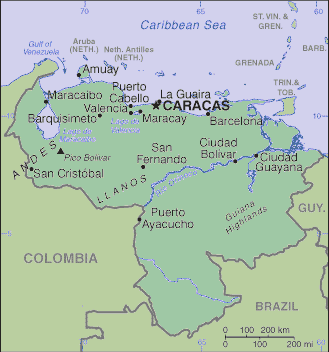 Venezuelan map
Regions of Venezuela
Venezuela was one of three countries that emerged from the collapse of Gran Colombia in 1830 (the others being Ecuador and New Granada, which became Colombia). For most of the first half of the 20th century, Venezuela was ruled by generally benevolent military strongmen, who promoted the oil industry and allowed for some social reforms. Democratically elected governments have held sway since 1959. Current concerns include: a weakening of democratic institutions, political polarization, a politicized military, drug-related violence along the Colombian border, increasing internal drug consumption, overdependence on the petroleum industry with its price fluctuations, and irresponsible mining operations that are endangering the rain forest and indigenous peoples.
Venezuela continues to be highly dependent on the petroleum sector, accounting for roughly one-third of GDP, around 80% of export earnings, and over half of government operating revenues. Government revenue also has been bolstered by increased tax collection, which has surpassed its 2005 collection goal by almost 50%. Tax revenue is the primary source of non-oil revenue, which accounts for 53% of the 2006 budget. A disastrous two-month national oil strike, from December 2002 to February 2003, temporarily halted economic activity. The economy remained in depression in 2003, declining by 9.2% after an 8.9% fall in 2002. Output recovered strongly in 2004-2005, aided by high oil prices and strong consumption growth. Venezuela continues to be an important source of crude oil for the US market. Both inflation and unemployment remain fundamental problems.
Venezuelan natural resources include petroleum, natural gas, iron ore, gold, bauxite, other minerals, hydropower, diamonds
on major sea and air routes linking North and South America; Angel Falls in the Guiana Highlands is the world's highest waterfall
Venezuelan religion is nominally Roman Catholic 96%, Protestant 2%, other 2%.
Natural hazards in Venezuela include subject to floods, rockslides, mudslides; periodic droughts.
Travel Advice for Venezuela
VenezuelaSUMMARY
- In the early hours of 7 February 2007, a significant landslide on the temporary main road (La Trocha) connecting Caracas International Airport with the city blocked the road, closing both carriageways. The landslide has now been cleared but the embankments are still being shored up. Restrictions on movement on this road have been introduced resulting in severe delays. In addition the road will be closed between 2200 and 0300 every night until the work to stabilise the ground has been completed. Travellers are advised to allow extra time for journeys or use alternative routes.
- The incidence of street crime in Venezuela is high. There have been muggings and kidnappings by bogus taxi operators at Caracas International Airport (Maiquetia). The road from the airport to Caracas is dangerous. Where possible, journeys on this route should be made in daylight hours. There are currently significant delays on this road and you should allow extra time for your journey to and from the airport.
- Political demonstrations may occur at any time in the major cities, possibly leading to localised violence. You should avoid large public gatherings.
- Do not handle illicit drugs. Penalties for doing so are amongst the most severe in the Americas. The main type of incident for which British nationals require consular assistance in Venezuela is involvement in drug trafficking.
- “Express kidnappings” are on the increase. You should exercise caution when arriving in, and travelling around, Venezuela and be aware of the general risks of crime for visitors. Please see the Crime section of this travel advice for more details.
- You should be aware of the global risk of indiscriminate terrorist attacks, which could be against civilian targets, including places frequented by foreigners.
- Cases of Dengue Fever, which can be fatal, are common throughout Venezuela. Dengue is spread by mosquitoes. You are advised to use mosquito repellent and cover up, especially at dusk.
- If you plan to stay in Venezuela for over three months, you are advised to register at the British Embassy in Caracas on arrival (tel: 0212 263 8411) or on-line at http://www.britain.org.ve.
- We strongly recommend that you obtain comprehensive travel and medical insurance before travelling. You should check any exclusions, and that your policy covers you for the activities you want to undertake. Please see Travel Insurance.
SAFETY AND SECURITY
There is a constant risk of street crime (often armed), especially in Caracas and other cities. Contrary to the advice in at least one widely used travel guide, Sabana Grande is not a safe area in which to stay in Caracas. Budget hotels can be found in the safer areas such as Chacao, La Castellana and Altamira. It is not advisable to visit "barrios” (heavily populated slums), as many of these are unsafe. The risk of crime is higher after dark. Try not to go out alone. People carrying large amounts of money, wearing valuable watches or jewellery or using mobile phones in the street are especially vulnerable.
Do not accept pamphlets in the street or major shopping centres, as there have been incidents of these having been impregnated with potent and disorienting drugs, which permeate the skin. Tourist’s drinks have also been spiked.
”Express kidnappings” – short-term, opportunistic abductions, aimed at extracting cash from the victim – continue in Venezuela. Victims can be targeted or selected at random and held while criminals empty their bank accounts with stolen cash cards. Once the ransom is paid the victim is usually quickly released. Tourists and business visitors have been targeted.
Political Situation
Political opinion in Venezuela is polarised. Demonstrations may take place with little warning and can turn violent. Many Venezuelans carry guns and the police and Guardia Nacional are often heavily armed when involved in crowd control situations.
You should exercise caution in Caracas and other major urban centres and avoid large public gatherings. Demonstrations happen frequently. Larger demonstrations are announced in advance in the local media, including the English language newspaper "Daily Journal".
Local Travel
The road from the airport to Caracas is undergoing major reconstructions, and journey times can be long and unpredictable. In the early hours of 7 February, a significant landslide on the temporary main road (La Trocha) connecting Caracas International Airport with the city blocked the road, closing both carriageways. The landslide has now been cleared but the embankments are still being shored up. Restrictions on movement on this road have been introduced resulting in severe delays. In addition the road will be closed between 2200 and 0300 every night until the work to stabilise the ground has been completed. Travellers are advised to allow extra time for journeys or use alternative routes.
Try to avoid travelling after dark, and allow plenty of time for your journey to and from the airport.
There have been cases of passengers being robbed at gunpoint by bogus taxi-drivers at Caracas airport (Maiquetia) and being “express kidnapped”(see Crime section). You are advised not to board a taxi if there are other passengers already inside the car. Do not accept offers of transport in the arrivals hall. If you have no alternative but to take a taxi, ensure it is one of those parked at the official taxi rank outside. If possible, you should arrange to be met by friends, business contacts, or tour operators. Only licensed taxis bearing a clearly identifiable number should be used.
Road Safety
It is possible to drive in Venezuela on a British driving licence for up to one year. After that it is necessary to obtain a Venezuelan driving licence. You should ensure you have copies of insurance documents, driving licence and passport with you at all times. Failure to produce documents can result in the vehicle being seized by the police.
All vehicles must carry a spare tyre, wheel block, jack wrench and special reflector triangle. In many areas roads are poor and potholed and a four-wheel drive vehicle is recommended.
Driving under the influence of alcohol is common, especially during weekends. Many vehicles are in poor condition and drivers routinely ignore red lights, especially at night. In the event of an accident, however badly traffic may be blocked, both vehicles must remain in the position of the accident until a Traffic Police Officer arrives. Insurance companies are unable to pay claims on vehicles that have been moved without a Traffic Police accident report.
Air Safety
Visiting tourist destinations in Venezuela can often involve flying in light aircraft. Safety standards are variable and there have been several significant accidents on the main tourist routes, including Margarita and Canaima/Angel falls since 2003, two with fatal consequences.
Sea Safety
There have been incidents of piracy and armed robbery against ships and small vessels in and around Venezuela's waters, especially east of Puerto La Cruz and in waters between Venezuela and Trinidad. Mariners are advised to take appropriate precautions and avoid these areas if possible.
LOCAL LAWS AND CUSTOMS
ENTRY REQUIREMENTS
The Venezuelan Nationality and Citizenship Law, which came into force on 1 January 2005, requires any dual national Venezuelan to use their Venezuelan identity to enter, reside in and leave the country. Dual British/Venezuelan nationals entering, leaving or residing in Venezuela should ensure that they are in compliance with these Venezuelan Government requirements.
Adults travelling alone with children should be aware that Venezuelan authorities usually require documentary evidence of parental responsibility before permitting the children to leave the country. For further information on exactly what will be required at immigration please contact the Venezuelan representation in the UK.
HEALTH
Non-malarial mosquitoes and tropical parasite diseases are endemic. Cases of dengue fever are common. In the interior of the country precautions must be taken against dengue, malaria and yellow fever. There have been sporadic cases of Yellow Fever in a number of different states of Venezuela. Many countries in the region, such as Brazil, require those arriving from Venezuela to have proof of a yellow fever vaccination. You should check with the relevant embassy before travel. A yellow fever vaccination certificate is not a requirement to enter Venezuela, but there have been cases where officials have illegitimately fined travellers who have been unable to produce such a certificate.
You should seek medical advice before travelling and ensure that all appropriate vaccinations are up to date. For further information on health, check the Department of Health’s website at www.dh.gov.uk.
NATURAL DISASTERS
During the rainy season, there is the possibility of flooding in certain low-lying areas of the country (eg the Llanos) and in some valleys in the Andes (Merida State). Venezuela is vulnerable to earthquakes. In August and September 2006 – tremors radiating from earthquakes with epicentres offshore were felt in Caracas and throughout the east of the country.
GENERAL
Strict currency controls remain in place in Venezuela, but Bolivares can be obtained in the UK through banks and some travel agencies. It is best to obtain local currency where possible before travelling. Bureaux de change, including at the airport, will exchange US dollars for Bolivars, as will some major hotels. Some banks (e.g. Banco Mercantil) will buy US dollars for Bolivars or sell Bolivars against a foreign credit card. US dollar travellers' cheques are accepted at most Italcambios offices.
In most towns and all major cities, credit cards are accepted. However, it can be difficult to withdrawing cash from ATMs. There is also a serious problem with credit card fraud and cards being "cloned."
If you are staying in Venezuela for over three months, you are advised to register at the British Embassy in Caracas on arrival (tel: 0212 263 8411) or on-line at http://www.britain.org.ve.
OTHER