
 Search
Traveling Luck for Ecuador. Ecuador, South America
Ecuador is located in Western South America, bordering the Pacific Ocean at the Equator, between Colombia and Peru.
Land in Ecuador is coastal plain (costa), inter-Andean central highlands (sierra), and flat to rolling eastern jungle (oriente).
Ecuadorian land covers an area of 283560 square kilometers which is slightly smaller than Nevada
Ecuador has borders with Colombia for 590km and Peru for 1420km.
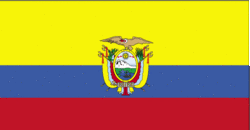 Ecuadorian national flag (Flag of Ecuador)
 Ecuador country profile
 Travel advice for Ecuador
As for the Ecuadorian climate; tropical along coast, becoming cooler inland at higher elevations; tropical in Amazonian jungle lowlands.
Ecuadorian(s) speak Spanish (official), Amerindian languages (especially Quechua).
Places of note in Ecuador
- Guayaquil
- Quito
- Cuenca
- Santo Domingo de los Colorados
- Machala
- Manta
- Portoviejo
- Durán
- Ambato
- Riobamba
- Quevedo
- Loja
- Ibarra
- Propicia
- Babahoyo
- La Libertad
- Latacunga
- Velasco Ibarra
- Ventanas
- Pasaje
- Chone
- Salinas
- Santa Elena
- Rosa Zárate
- Santa Rosa
- Balzar
- Huaquillas
- Bahía de Caráquez
- La Troncal
- Jipijapa
- Azogues
- Naranjito
- Vinces
- Otavalo
- El Triunfo
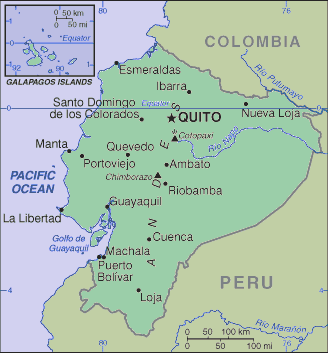 Ecuadorian map
Regions of Ecuador
The "Republic of the Equator" was one of three countries that emerged from the collapse of Gran Colombia in 1830 (the others are Colombia and Venezuela). Between 1904 and 1942, Ecuador lost territories in a series of conflicts with its neighbors. A border war with Peru that flared in 1995 was resolved in 1999. Although Ecuador marked 25 years of civilian governance in 2004, the period has been marred by political instability. Seven presidents have governed Ecuador since 1996.
Ecuador has substantial petroleum resources, which have accounted for 40% of the country's export earnings and one-third of central government budget revenues in recent years. Consequently, fluctuations in world market prices can have a substantial domestic impact. In the late 1990s, Ecuador suffered its worst economic crisis, with natural disasters and sharp declines in world petroleum prices driving Ecuador's economy into free fall in 1999. Real GDP contracted by more than 6%, with poverty worsening significantly. The banking system also collapsed, and Ecuador defaulted on its external debt later that year. The currency depreciated by some 70% in 1999, and, on the brink of hyperinflation, the MAHAUD government announced it would dollarize the economy. A coup, however, ousted MAHAUD from office in January 2000, and after a short-lived junta failed to garner military support, Vice President Gustavo NOBOA took over the presidency. In March 2000, Congress approved a series of structural reforms that also provided the framework for the adoption of the US dollar as legal tender. Dollarization stabilized the economy, and growth returned to its pre-crisis levels in the years that followed. Under the administration of Lucio GUTIERREZ - January 2003 to April 2005 - Ecuador benefited from higher world petroleum prices. However, the government under Alfredo PALACIO has reversed economic reforms that reduced Ecuador's vulnerability to petroleum price swings and financial crises, allowing the central government greater access to oil windfalls and disbursing surplus retirement funds.
Ecuadorian natural resources include petroleum, fish, timber, hydropower
Cotopaxi in Andes is highest active volcano in world
Ecuadorian religion is Roman Catholic 95%, other 5%.
Natural hazards in Ecuador include frequent earthquakes, landslides, volcanic activity; floods; periodic droughts.
Travel Advice for Ecuador
EcuadorSUMMARY
- We advise against all travel to the province of Sucumbios, which borders Colombia. Armed groups are active in this province and there is a risk of kidnapping and crime.
- You should exercise caution if travelling to the tourist destination of Baños and certain areas to the west, southwest and northwest of the Tungurahua volcano following major eruptions in July and August 2006. Please see the Natural Disasters section of this travel advice for more details.
- In view of recent activity at the Sangay volcano, located between the provinces of Chimborazo and Morona Santiago, we advise you not to attempt to climb the volcano or hike in the immediate surrounding area. Please see the Natural Disasters section of this travel advice for more details.
- Street demonstrations, protests and strikes are commonplace in Ecuador, and they sometimes turn violent. You should take care to avoid any area in which large crowds are gathering. Please see the Political Situation section of this travel advice for more details.
- Around 15,000 British nationals visit Ecuador every year. Most visits are trouble-free. The main type of incident for which British nationals require consular assistance in Ecuador is theft of passports or bankcards. It is a legal requirement to carry some form of identification with you at all times. A photocopy of your passport is sufficient.
- You should be aware of the risks of crime in all areas and take sensible precautions at all times. You should be particularly vigilant in poorer urban areas, after dark and on public transport. We recommend that you do not travel alone. Please see the Crime section of this travel advice for more details.
- "Express kidnappings" are on the increase. You should exercise caution when arriving in, and travelling around, Ecuador and be aware of the general risks of crime for visitors. Please see the Crime section of this travel advice for more details.
- The threat from terrorism is low. But you should be aware of the global risk of indiscriminate terrorist attacks which could be against civilian targets, including places frequented by foreigners.
- We strongly recommend that you obtain comprehensive travel and medical insurance before travelling. You should check any exclusions, and that your policy covers you for the activities you want to undertake. Please see: Travel Insurance.
SAFETY AND SECURITY
Muggings and pick pocketing are common, particularly in the cities. You should avoid wearing expensive jewellery in the streets and on public transport. When travelling on public transport, we recommend that rucksacks should be worn on the front of your body. Do not store small bags under your seat or in overhead storage.
You should be aware of the increased number of so called "express kidnappings" - short-term opportunistic abductions, aimed at extracting cash from the victim - that continue to occur in Ecuador. Victims are normally selected at random and held while criminals empty their bank accounts with stolen cash cards. Once the ransom is paid the victim is usually quickly released. Although tourists are not currently targeted, visitors to the Guavas area in and around Guayaquil should be particularly aware as the majority of reported cases come from this area.
There have been occasional cases of rape and armed attacks against visitors both in rural and urban areas. Remote sites should be visited in groups.
There have been several cases of assailants using drugs to subdue their intended victims. The drug 'scopolamine', which is manufactured in Ecuador for medical purposes, leaves victims in a sedated, compliant state and causes amnesia. Drugs can be administered through food, drinks, cigarettes, aerosols, or powder. In one incident drugs were administered through a chemical soaked into a leaflet. You should be wary of unsolicited approaches from strangers offering you food, drinks, leaflets, telephone cards or cigarettes, no matter how friendly or well dressed the individual appears.
There have been cases of attacks by drivers of unregistered taxis. Only use registered taxis, which display their taxi registration sticker on the windscreen or side doors. If possible do not hail taxis on the street but book through hotels or taxi radio services. Larger supermarkets and airports also have reliable taxi ranks.
There have been several incidents of armed gunmen holding up buses after daylight hours. You should therefore avoid travel by road after dark, in particular on long distance and international coaches.
Political Situation
Ecuador Country Profile
Street demonstrations, protests and strikes are commonplace in Ecuador, and sometimes turn violent. You should take care to avoid any area in which large crowds are gathering.
Local Travel
You should avoid all travel to the northern provinces of Sucumbios. There have been cases of armed robbery of jungle lodges in Sucumbios and on the lower Napo River, which borders the province of Orellana. Colombian guerrilla groups are known to have influence in all regions bordering Colombia. Foreign oil workers are targets for kidnappers in these areas and the rate of crime is also high. In July 2002, a British oil worker and his driver were kidnapped and subsequently killed.
You should avoid hiking to the antennas of Volcan Pichincha via Cruz Loma, west of Quito, as violent gangs are known to operate in the wooded areas.
Road Safety
If you intend to hire a car you must hold a valid British or international driver's licence. The Ecuadorian police also recommend the use of a local temporary driver's permit. You should contact the British Embassy if you require further details.
Sea Safety
There have been attacks of piracy and armed robbery against ships in and around Ecuador’s waters. Mariners are advised to be vigilant and take appropriate precautions.
LOCAL LAWS AND CUSTOMS
ENTRY REQUIREMENTS
If, as a British national, you intend to marry in Ecuador, you do not need to obtain a visa before travelling to Ecuador, as you may enter on the entry stamp provided on arrival, as above. However, you will need to fulfil some requirements before you can marry. Please contact the British Embassy in Quito for further details or refer to the Consular services section of the Embassy’s website: British Embassy, Quito
If you wish to work or study in Ecuador or if you have been involved in criminal activity in Ecuador, you should check visa requirements with the Embassy of Ecuador, Ecuadorian Representation in the UK.
Single parents or other adults travelling alone with children should be aware that some countries require documentary evidence of parental responsibility before allowing lone parents to enter the country or, in some cases, before permitting their children to leave the country. For further information on exactly what will be required please contact the Ecuadorian Embassy in London.
HEALTH
Malaria and dengue fever are health risks in all the coastal and jungle provinces, the interior and in the highlands up to 2000 metres. In 2006, there were reported cases of dengue in the provinces of Guayas, Manabi and El Oro. A small number of cases were also reported in Los Rios and Esmeraldas. Nearly 100 cases have been reported so far in 2007, including the potentially deadly strain of dengue, mainly during the rainy season in the coastal region. Dengue has been reported in the provinces of Guayas, El Oro, Los Rios, Esmeraldas and Sucumbios. Malaria is traditionally found mainly in the coastal province of Esmeraldas. More than three-quarters of British travellers who contracted malaria in 2005 did not take preventive measures, such as malaria prevention tablets. Other good preventative measures include wearing light coloured clothes and using insect repellent. However, malaria can occur despite appropriate prevention, and therefore you should promptly seek medical care in the event of a fever or flu-like illness in the first year following your return from travelling to a malaria risk country. Before travelling you should seek medical advice about the malaria risk in Ecuador.
High altitude, eg in Quito (2800 metres) can affect some people's health. You should take sensible medical precautions and seek advice from your doctor before travelling. If visiting Quito you are advised to take it easy for the first few days and drink plenty of water.
You should seek medical advice before travelling and ensure that all appropriate vaccinations are up-to-date. For further information on health, check the Department of Health’s website at: www.dh.gov.uk.
NATURAL DISASTERS
There are many active volcanoes in Ecuador given that the country lies on a destructive plate boundary.
For further information see the National Ecuadorean geophysics Institute website: http://www.igepn.edu.ec (in Spanish) or Smithsonian Global Volcano Programme (in English). We also advise that you consider what action to take in the event of an eruption.
Ecuador is also affected by the irregular “El Niño” climatic phenomenon. The last time strong effects were experienced was between 1997 and 1998. It is difficult to predict when strong effects might be felt but some experts are of the view that moderate effects might be felt this year. The strongest effects are normally felt in coastal regions but it may also affect the jungle regions of Orellana, Morona Santiago and Sucumbios (we advise against travel to this province), where widespread flooding can occur. Other “El Niño” effects include the risk of landslides in the regions of Bolivar, Cañar and Azuay; and a hotter climate in all parts of Ecuador.
GENERAL
You should reconfirm your onward flight at least 72 hours before departure.