
 Search
Traveling Luck for Chile. Chile, South America
Chile is located in Southern South America, bordering the South Pacific Ocean, between Argentina and Peru.
Land in Chile is low coastal mountains; fertile central valley; rugged Andes in east.
Chilean land covers an area of 756950 square kilometers which is slightly smaller than twice the size of Montana
Chile has borders with Argentina for 5150km, Bolivia for 861km and Peru for 160km.
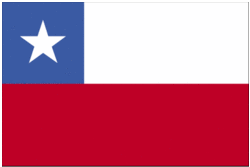 Chilean national flag (Flag of Chile)
 Chile country profile
 Travel advice for Chile
As for the Chilean climate; temperate; desert in north; Mediterranean in central region; cool and damp in south.
Chilean(s) speak Spanish.
Places of note in Chile
- Santiago
- Puente Alto
- Antofagasta
- Viña del Mar
- Valparaíso
- Talcahuano
- San Bernardo
- Temuco
- Iquique
- Concepción
- Rancagua
- Talca
- Arica
- Coquimbo
- Puerto Montt
- La Serena
- Chillán
- Calama
- Osorno
- Valdivia
- Quilpué
- Copiapó
- Los Ángeles
- Punta Arenas
- Curicó
- Villa Alemana
- Coronel
- San Antonio
- Chiguayante
- Ovalle
- Linares
- Quillota
- Peñaflor
- Melipilla
- San Felipe
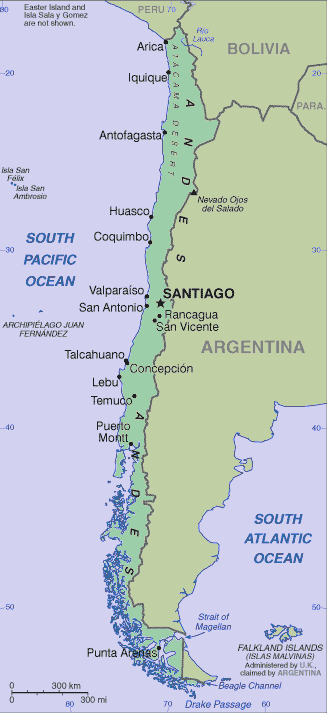 Chilean map
Regions of Chile
Prior to the coming of the Spanish in the 16th century, northern Chile was under Inca rule while Araucanian Indians inhabited central and southern Chile; the latter were not completely subjugated until the early 1880s. Although Chile declared its independence in 1810, decisive victory over the Spanish was not achieved until 1818. In the War of the Pacific (1879-84), Chile defeated Peru and Bolivia and won its present northern lands. A three-year-old Marxist government of Salvador ALLENDE was overthrown in 1973 by a dictatorial military regime led by Augusto PINOCHET, who ruled until a freely elected president was installed in 1990. Sound economic policies, maintained consistently since the 1980s, have contributed to steady growth and have helped secure the country's commitment to democratic and representative government. Chile has increasingly assumed regional and international leadership roles befitting its status as a stable, democratic nation.
Chile has a market-oriented economy characterized by a high level of foreign trade. During the early 1990s, Chile's reputation as a role model for economic reform was strengthened when the democratic government of Patricio AYLWIN - which took over from the military in 1990 - deepened the economic reform initiated by the military government. Growth in real GDP averaged 8% during 1991-97, but fell to half that level in 1998 because of tight monetary policies implemented to keep the current account deficit in check and because of lower export earnings - the latter a product of the global financial crisis. A severe drought exacerbated the recession in 1999, reducing crop yields and causing hydroelectric shortfalls and electricity rationing, and Chile experienced negative economic growth for the first time in more than 15 years. Despite the effects of the recession, Chile maintained its reputation for strong financial institutions and sound policy that have given it the strongest sovereign bond rating in South America. By the end of 1999, exports and economic activity had begun to recover, and growth rebounded to 4.2% in 2000. Growth fell back to 3.1% in 2001 and 2.1% in 2002, largely due to lackluster global growth and the devaluation of the Argentine peso. Chile's economy began a slow recovery in 2003, growing 3.2%, and accelerated to 6.1% in 2004-05, while Chile maintained a low rate of inflation. GDP growth benefited from high copper prices, solid export earnings (particularly forestry, fishing, and mining), and stepped-up foreign direct investment. Unemployment, however, remains stubbornly high. Chile deepened its longstanding commitment to trade liberalization with the signing of a free trade agreement with the US, which took effect on 1 January 2004. Chile signed a free trade agreement with China in November 2005, and it already has several trade deals signed with other nations and blocs, including the European Union, Mercosur, South Korea, and Mexico. Record-high copper prices helped to strengthen the peso to a 5 year high, as of December 2005, and will boost GDP in 2006.
Chilean natural resources include copper, timber, iron ore, nitrates, precious metals, molybdenum, hydropower
strategic location relative to sea lanes between Atlantic and Pacific Oceans (Strait of Magellan, Beagle Channel, Drake Passage); Atacama Desert is one of world's driest regions
Chilean religion is Roman Catholic 89%, Protestant 11%, Jewish NEGL%.
Natural hazards in Chile include severe earthquakes; active volcanism; tsunamis.
Travel Advice for Chile
ChileSUMMARY
- Minefields are located in regions I, II and XII. We recommend checking with the local authorities before travelling to the border areas of these regions.
- The threat from terrorism is low. But you should be aware of the global risk of indiscriminate terrorist attacks which could be against civilian targets, including places frequented by foreigners.
- Around 50,000 British tourists visit Chile every year. Most visits are trouble-free. The main type of incident for which British nationals require consular assistance in Chile is replacing lost and stolen passports. Pickpocketing, other thefts and muggings are increasingly common.
- We strongly recommend that you obtain comprehensive travel and medical insurance before travelling. You should check any exclusions, and that your policy covers you for the activities you want to undertake. Please see: Travel Insurance.
SAFETY AND SECURITY
Pickpocketing, other thefts and muggings are common throughout Chile, particularly around well-known tourist sites and bus stations. You should not leave luggage unattended and be particularly attentive at bus terminals, restaurants and whilst travelling through the Lake District (iePucon, Villarrica) as there has been a rise in theft in these areas. There have been reports of muggings, sometimes by armed groups, in popular walking/scenic areas such as Cerro San Cristobal, Cerro Santa Lucia and Cerro Manquehue. You are therefore advised to take great care with your belongings, keep in groups and not walk alone late at night. There have been increased reports of people being given ‘spiked’ drinks in nightclubs and bars, particularly in the Suecia and Bellavista areas of Santiago. These can have the effect of causing short-term amnesia, leaving the victim open to theft or worse.
You are advised to leave your passport, tourist card (given upon entry into Chile), most bank cards and larger amounts of money in a safe place and to carry a photocopy of the details page of your passport.
Political Situation
Chile Country Profile.
Nationwide protests often take place on 11 September (anniversary of the military coup) and 1 May (Workers’ Day). They frequently become violent. The largest protests usually take place in central Santiago. Demonstrations have in the past resulted in destruction to property and arrests. Police can use tear gas and water cannons against protesters. You should avoid political protests, particularly on these dates.
Local Travel
Chile has a small but significant landmine problem. Landmine accidents mainly affect livestock and small numbers of local people crossing the borders at unauthorised crossing points. Minefields are located primarily in border areas adjacent to Peru and Bolivia in the extreme north of Chile Regions I and II, and Argentina in the south in Region XII. Although most minefields are clearly marked, some signs and fences have been subjected to the effects of weather or vandalism and may be hard to recognise, particularly in the north of the country. Minefields are, in some cases, laid right up to the edge of highways. You should also be aware that there are mined areas in six government-protected wilderness areas in Regions I, II and XII. Although neither Park Rangers nor visitors have ever been injured or killed by landmines, you are advised to check with local authorities before travelling to border areas of Regions I, II and XII, stick to clearly marked roads and observe all warnings signs.
If you wish to go exploring or mountaineering, we strongly recommend that you notify the local authorities of your intended expedition before you set off. For further information on mountaineering you should contact the Federación de Andinismo de Chile, at Almirante Simpson 77, Santiago, Chile. Tel: (56 2) 2220888. For any other type of exploring, we advise that you contact: Chilean Representation in the UK to see if any permits are required. There are good rescue facilities in Chile. They may charge you for the service provided.
Road Safety
Car hire is possible throughout Chile and the most well known firms are represented. You are advised to take out adequate insurance including for windscreen damage, which can be expensive. You will require a valid international driving licence or new European format driving licence (bearing a photograph).
Main roads in Chile are paved. However, you may wish to consider a four-wheel drive vehicle for driving in the countryside. Chile contains a complete range of driving conditions, from snow and ice to hot sandy deserts. Road tolls are increasingly common.
Sea Safety
Travel on ferries and cruises within Chilean waters is generally considered safe, though you are advised to take care on local ferries where standards might not be up to British ones.
LOCAL LAWS AND CUSTOMS
ENTRY REQUIREMENTS
HEALTH
There are good health facilities in Santiago and the major cities, but private clinics/hospitals are expensive. Air pollution in Santiago during winter (June-September) is a major problem. You may therefore suffer from eye irritation and respiratory problems.
There are sporadic cases of cholera outside Santiago. Typhoid and hepatitis are fairly common, especially during the warm season, which lasts from December to March in Central Chile.
You should seek medical advice before travelling and ensure that all appropriate vaccinations are up to date. For further information on health and vaccinations, check the Department of Health’s website at: www.dh.gov.uk. More information concerning health risks in Chile can also be found on the World Health Organisation website at: http://www.who.int/csr/don/archive/country/chl/en/.
NATURAL DISASTERS
Chile is in a high-risk zone for earthquakes. A powerful 7.9 magnitude earthquake struck northern Chile on 14 June 2005, causing 11 deaths and cuts in power and communication for several days. The last major earthquake was in Santiago in March 1985. Some of the older constructions were severely damaged, and 177 deaths were recorded.
A serious earthquake is always a possibility; however, building regulations require new structures to take account of seismic risks. Safety measures are widely known and put into practice by national organisations and local authorities.
GENERAL
Money
If you are a British national staying in Chile other than as a tourist, you are advised to register with the Consular Section of the British Embassy, Santiago.
ATMs are widely available. Be aware that your debit/credit card company will charge you for using an ATM overseas.
Credit cards (Visa, Mastercard and, to a lesser extent, American Express) are accepted in most large shops and hotels. Dollar travellers’ cheques are more widely accepted than travellers’ cheques in other currencies. It is possible to transfer money from the UK to Chile through Western Union.