
 Search
Traveling Luck for Honduras. Honduras, North America
Honduras is located in Central America, bordering the Caribbean Sea, between Guatemala and Nicaragua and bordering the Gulf of Fonseca (North Pacific Ocean), between El Salvador and Nicaragua.
Land in Honduras is mostly mountains in interior, narrow coastal plains.
Honduran land covers an area of 112090 square kilometers which is slightly larger than Tennessee
Honduras has borders with Guatemala for 256km, Nicaragua for 922km and El Salvador for 342km.
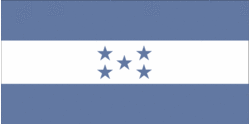 Honduran national flag (Flag of Honduras)
 Honduras country profile
 Travel advice for Honduras
As for the Honduran climate; subtropical in lowlands, temperate in mountains.
Honduran(s) speak Spanish, Amerindian dialects.
Places of note in Honduras
- Tegucigalpa
- San Pedro Sula
- Choloma
- La Ceiba
- El Progreso
- Ciudad Choluteca
- Comayagua
- Puerto Cortez
- La Lima
- Danlí
- Siguatepeque
- Juticalpa
- Villanueva
- Tocoa
- Tela
- Santa Rosa de Copán
- Olanchito
- San Lorenzo
- Cofradía
- El Paraíso
- La Paz
- Yoro
- Potrerillos
- Santa Bárbara
- La Entrada
- Nacaome
- Intibucá
- Talanga
- Guaimaca
- Santa Rita
- Morazán
- Santa Cruz de Yojoa
- Marcala
- Sabá
- Trujillo
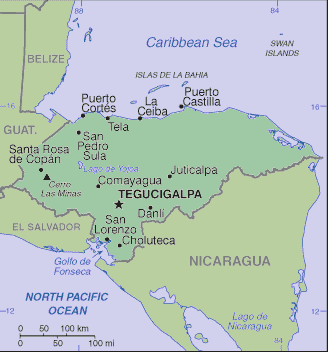 Honduran map
Regions of Honduras
Once part of Spain's vast empire in the New World, Honduras became an independent nation in 1821. After two and a half decades of mostly military rule, a freely elected civilian government came to power in 1982. During the 1980s, Honduras proved a haven for anti-Sandinista contras fighting the Marxist Nicaraguan Government and an ally to Salvadoran Government forces fighting leftist guerrillas. The country was devastated by Hurricane Mitch in 1998, which killed about 5,600 people and caused approximately $2 billion in damage.
Honduras, one of the poorest countries in the Western Hemisphere with an extraordinarily unequal distribution of income and massive unemployment, is banking on expanded trade under the US-Central America Free Trade Agreement (CAFTA) and on debt relief under the Heavily Indebted Poor Countries (HIPC) initiative. The country has met most of its macroeconomic targets, and began a three-year IMF Poverty Reduction and Growth Facility (PGRF) program in February 2004. Growth remains dependent on the economy of the US, its largest trading partner, on continued exports of non-traditional agricultural products (such as melons, chiles, tilapia, and shrimp), and on reduction of the high crime rate.
Honduran natural resources include timber, gold, silver, copper, lead, zinc, iron ore, antimony, coal, fish, hydropower
has only a short Pacific coast but a long Caribbean shoreline, including the virtually uninhabited eastern Mosquito Coast
Honduran religion is Roman Catholic 97%, Protestant 3%.
Natural hazards in Honduras include frequent, but generally mild, earthquakes; extremely susceptible to damaging hurricanes and floods along the Caribbean coast.
Travel Advice for Honduras
HondurasSUMMARY
- There is no British Embassy in Honduras. For emergency consular assistance, contact the Honorary Consuls in Tegucigalpa, San Pedro Sula or the British Embassy in Guatemala City (see details below).
- Most consular assistance given to British nationals is for victims of pickpocketing and loss of passports. There are very high crime rates in Honduras. You should take great care if travelling alone or at night.
- The threat from terrorism is low. But you should be aware of the global risk of indiscriminate terrorist attacks, which could be against civilian targets, including places frequented by foreigners.
- The hurricane season in Honduras normally runs from June to November. Please see the Natural Disasters section of this Travel Advice and Hurricanes for more information.
- We strongly recommend that you obtain comprehensive travel and medical insurance before travelling. You should check any exclusions, and that your policy covers you for the activities you want to undertake. Please see: Travel Insurance
SAFETY AND SECURITY
There is widespread petty and violent crime, including armed robbery, car hijacking, armed burglary and sexual offences. You should exercise caution in all parts of the country, and avoid walking around at night in most areas of Honduras, including Tegucigalpa and other main cities.
You should also be aware that visitors to the Bay Islands, north coast towns, beaches (especially Tela), ferries and islands have been frequently targeted.
The isolated roads of the Department of Santa Barbara have also seen criminal activity.
Due to violent hold-ups of buses and road safety concerns (see below) you should avoid travelling by public bus if you possibly can.
Look after your passport and valuables. It is illegal to be without some form of identification but a photocopy of your passport is acceptable.
Do not wear jewellery or carry large amounts of cash. Travel with several sources of funds: cash, travellers’ cheques (both in US dollars as sterling is not generally accepted), credit cards, etc, but keep them safe and in separate places. Keep a few Lempiras to hand out in the event of a robbery. Do not resist a robbery attempt. There have been several instances, most recently in July 2005, of foreign tourists being murdered while resisting attempts at armed robbery.
Political Situation
Honduras Country Profile.
Demonstrations occur in Honduras from time to time, sometimes with little warning. They can become violent and disrupt movement. You are advised to avoid large gatherings or demonstrations.
Local Travel
Minor roads in the countryside are still being repaired after the damage caused by Hurricane Mitch in 1998. You are advised to keep to the major tourist locations using recognised tour operators. The border regions (except major crossing points) can be dangerous due to illegal smuggling activities. The border crossings are not manned at night. Travellers in smaller vehicles have been targeted by armed robbers after crossing the Honduran border into El Salvador.
Road Safety
Following any traffic accident you should normally wait for the police to arrive.
Road travel at night is inadvisable, not only to reduce the likelihood of assault, but because many vehicles travel without lights and animals often wander across the road.
Owner-driven public buses in Honduras are often poorly maintained and recklessly driven. Accidents are common and occasionally fatal. You should avoid travelling on these buses if you can. Luxury-type buses, normally operated by private companies, are usually better maintained with more security at their terminals.
LOCAL LAWS AND CUSTOMS
ENTRY REQUIREMENTS
Honduras is party to the Central America Border Control Agreement (CA-4). Under the terms of this agreement, British tourists may travel within any of the CA-4 countries (Honduras, Nicaragua, El Salvador and Guatemala) for a period of up to 90 day, without completing entry and exit formalities at border Immigration checkpoints. This period begins at the first point of entry of any of the CA-4 countries. Fines are applied for travellers who exceed this 90-day limit, although a request for an extension can be made for up to 30 days by paying a fee before the 90 days limit expires. If you are expelled from any of the four countries you are also excluded from the entire CA-4 region.
Single parents or other adults travelling alone with children should be aware that some countries required documentary evidence of parental responsibility before allowing lone parents to enter the country or, in some cases, before permitting the children to leave the country. For further information on exactly what will be required at immigration please contact the Honduran Embassy: Honduran representation in the UK.
HEALTH
State-funded hospitals are under-funded and medicines are in short supply. We advise the use of private clinics where possible.
Private health clinics and hospitals are available in the major towns only; standards vary. Drink only properly purified water. Incidents of diarrhoea are prevalent.
Malaria is more of a concern in remote, low-lying parts of the country. More than three-quarters of British travellers who contracted malaria in 2005 did not take preventive measures, such as malaria prevention tablets. However, malaria can occur despite appropriate prevention, and therefore you should promptly seek medical care in the event of a fever or flu-like illness in the first year following your return from travelling to a malaria risk country. Before travelling you should seek medical advice about the malaria risk in Honduras.
There are often outbreaks of haemorrhagic dengue fever around San Pedro Sula and Tegucigalpa.
AIDS/HIV is widespread, especially in the north.
You should seek medical advice before travelling and ensure that all appropriate vaccinations are up to date. For further information on health, check the Department of Health’s website at: www.dh.gov.uk.
NATURAL DISASTERS
The hurricane season in Honduras normally runs from June to November. You should monitor local and international weather updates from the World Meteorological Organisation. You can also access the National Hurricane Centre at: http://www.nhc.noaa.gov for updates. Please also see Hurricanes for more detailed information about what to do if you are caught up in a hurricane.
The worst natural disaster to occur in Honduras was Hurricane Mitch in 1998, which caused extensive loss of life and damage from which the country is still recovering. Honduras is particularly susceptible to hurricanes, flooding and earthquakes. Drought and forest fires are also quite frequent.
GENERAL
Flights in and out of Tegucigalpa can be affected by poor visibility caused by low cloud cover and smog, especially around April/May.
There is no British Embassy in Honduras. The British Embassy in Guatemala has overall responsibility for Honduras. For emergency consular assistance in Tegucigalpa contact the British Honorary Consul (see below). There is also a British Honorary Consul in San Pedro Sula (responsible for Department of Cortes, the north coast and the Bay Islands). Applications for British Passports should be made to the British Embassy in Costa Rica. Applications for UK visas should be made to the British Embassy in Panama.
Honorary Consul: Mr Leonardo Casco Fortin, Tegucigalpa, Office Hours: Local Time: Mon-Fri: 08:00 to12:00 and 14:00 to 17:30, GMT: Mon -Fri: 14:00 to 18:00 and 20:00 to 23:30, Tel: +504 237 6577 or 237 6549; Fax: +504 238 4097 e-mail: reforma@cascomark.com
Mr Edgardo Dumas, San Pedro Sula, PO Box 20058, Office Hours: Local Time: Mon-Fri: 08:00 to 12:00 and 13:00 to 17:00, Sat: 08:00 to 12:00, GMT: Mon-Fri: 14:00 to 18:00 and 19:00 to 23:00, Tel: +504 550 2337, Fax: +504 550 6145;
email: edumas@sulnet.net
Money
Credit cards are widely accepted. ATMs are available in the major towns but often do not accept UK credit cards. Only the more recognised travellers’ cheques in US Dollars (such as American Express) are accepted in Roatan.