
 Search
Traveling Luck for El Salvador. El Salvador, North America
El Salvador is located in Central America, bordering the North Pacific Ocean, between Guatemala and Honduras.
Land in El Salvador is mostly mountains with narrow coastal belt and central plateau.
Salvadoran land covers an area of 21040 square kilometers which is slightly smaller than Massachusetts
El Salvador has borders with Guatemala for 203km and Honduras for 342km.
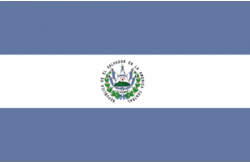 Salvadoran national flag (Flag of El Salvador)
 El Salvador country profile
 Travel advice for El Salvador
As for the Salvadoran climate; tropical; rainy season (May to October); dry season (November to April); tropical on coast; temperate in uplands.
Salvadoran(s) speak Spanish, Nahua (among some Amerindians).
Places of note in El Salvador
- San Salvador
- Soyapango
- Santa Ana
- San Miquel
- Mejicanos
- Nueva San Salvador
- Apopa
- Delgado
- Sonsonate
- San Marcos
- Usulután
- Cojutepeque
- Cuscatancingo
- Zacatecoluca
- San Martín
- Ilopango
- San Vicente
- Ahuachapán
- Antiguo Cuscatlán
- Chalchuapa
- Quezaltepeque
- La Unión
- Ayutuxtepeque
- Acajutla
- Aguilares
- Sensuntepeque
- Chalatenango
- Izalco
- Metapán
- San Rafael Oriente
- Puerto El Triunfo
- La Libertad
- San Francisco
- Sonzacate
- Santiago de María
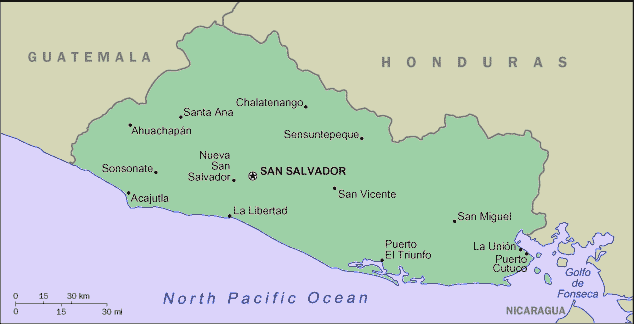 Salvadoran map
Regions of El Salvador
El Salvador achieved independence from Spain in 1821 and from the Central American Federation in 1839. A 12-year civil war, which cost about 75,000 lives, was brought to a close in 1992 when the government and leftist rebels signed a treaty that provided for military and political reforms.
The smallest country in Central America, El Salvador has the third largest economy, but growth has been minimal in recent years. Hoping to stimulate the sluggish economy, the government is striving to open new export markets, encourage foreign investment, and modernize the tax and healthcare systems. Implementation in 2006 of the Central America-Dominican Republic Free Trade Agreement, which El Salvador was the first to ratify, is viewed as a key policy to help achieve these objectives. The trade deficit has been offset by annual remittances from Salvadorans living abroad - 16.6% of GDP in 2005 - and external aid. With the adoption of the US dollar as its currency in 2001, El Salvador has lost control over monetary policy and must concentrate on maintaining a disciplined fiscal policy.
Salvadoran natural resources include hydropower, geothermal power, petroleum, arable land
smallest Central American country and only one without a coastline on Caribbean Sea
Salvadoran religion is Roman Catholic 83%, other 17%.
Natural hazards in El Salvador include known as the Land of Volcanoes; frequent and sometimes destructive earthquakes and volcanic activity; extremely susceptible to hurricanes.
Travel Advice for El Salvador
El SalvadorSUMMARY
- There is no British Embassy in El Salvador. For emergency consular assistance, contact the Honorary Consul in San Salvador or the British Embassy in Guatemala. Please see the General section of this travel advice for details.
- The threat from terrorism is low. But you should be aware of the global risk of indiscriminate terrorist attacks, which could be against civilian targets, including places frequented by foreigners.
- The rainy season in El Salvador normally runs from June to November, coinciding with the hurricane season in the Caribbean. Please see the Natural Disasters section of this Travel Advice.
- On 12 October 2006, the local authorities issued a yellow alert warning for persons within a four kilometer radius of the Chaparrastique volcano, located approximately 12 kilometers southwest of the city of San Miguel. You are advised to avoid the volcano and monitor local media reporting for further updates on the latest volcanic activity.
- The main type of incident for which British nationals require consular assistance in El Salvador are for victims of pickpocketing and replacing lost and stolen passports. There are very high crime rates in El Salvador. You should take great care if travelling alone or at night.
- We strongly recommend that you obtain comprehensive travel and medical insurance before travelling. You should check any exclusions, and that your policy covers you for the activities you want to undertake. Please see: Travel Insurance.
SAFETY AND SECURITY
There are very high levels of violent crime throughout the country. This includes robberies, assaults and car-jackings, which are fairly common and can occur anywhere. The National police have had some successes in tackling the problem of kidnapping but you should be aware that a risk still remains. Kidnap gangs generally target rich Salvadoreans rather than visitors.
You should take great care when travelling alone or at night. Up-market areas of San Salvador, such as Escalón, San Benito, Zona Rosa and Maquilishuat, are generally trouble-free but you should still be careful at night. Downtown San Salvador is particularly dangerous especially at night. At all times avoid wearing jewellery, carrying large amounts of cash and using expensive cameras or video recorders.
Travelling on the roads outside San Salvador at night is dangerous. There have been incidents of violent attacks on motorists travelling between El Salvador and Guatemala, on the Guatemalan side of the border.
Take photocopies of your passport and, even more importantly, of your airline tickets, which can be difficult to replace if stolen. Keep these copies separate, together with the numbers of travellers’ cheques, credit cards and contact details. It is permissible to show a photocopy of your passport, should identification be requested by local authorities.
If attacked, do not resist your attackers as they will probably be armed. If your passport is stolen inform the local police in El Salvador and inform the British Honorary Consul or British Embassy in Guatemala City. See guidance under “General” for passport and visa services.
Political Situation
El Salvador Country Profile.
Demonstrations occur in El Salvador from time to time and can do so with little warning. They can become violent and disrupt movement. You are advised to avoid large gatherings or demonstrations.
Local Travel
As a result of past conflicts, there remains unexploded ordnance such as landmines in the countryside. Those going off-road (backpackers, campers etc) should be aware of these potential dangers when visiting the more remote locations. You should take local advice, avoiding travel to such areas if advised to do so.
The highway from the airport to San Salvador has been blocked on occasion by demonstrations demanding repairs to the water supply damaged by Hurricane Stan in 2005. This has caused some delays to travel.
Road Safety
The main highway through El Salvador is being brought up to international standard. The other main routes connecting with Honduras are in good condition. Some roads, however, are in poor condition and can be dangerous to drive on. Care should be taken whatever road is used as the standard of driving is low.
ENTRY REQUIREMENTS
Single parents or other adults travelling alone with children should be aware that some countries required documentary evidence of parental responsibility before allowing lone parents to enter the country or, in some cases, before permitting the children to leave the country. For further information on exactly what will be required at immigration please contact the Embassy of El Salvador: Salvadorean representation in the UK.
HEALTH
GENERAL
Money