Nicaragua, one of the Western Hemisphere's poorest countries, has low per capita income, widespread underemployment, and a heavy external debt burden. Distribution of income is one of the most unequal on the globe. While the country has progressed toward macroeconomic stability in the past few years, GDP annual growth has been far too low to meet the country's needs, forcing the country to rely on international economic assistance to meet fiscal and debt financing obligations. Nicaragua qualified in early 2004 for some $45 billion in foreign debt reduction under the Heavily Indebted Poor Countries (HIPC) initiative because of its earlier successful performances under its International Monetary Fund policy program and other efforts. In October 2005, Nicaragua ratified the US-Central America Free Trade Agreement (CAFTA), which will provide an opportunity for Nicaragua to attract investment, create jobs, and deepen economic development. High oil prices helped drive inflation to 9.6% in 2005, leading to a fall in real GDP growth to 4% from over 5% in 2004.
Nicaraguan natural resources include gold, silver, copper, tungsten, lead, zinc, timber, fish
largest country in Central America; contains the largest freshwater body in Central America, Lago de Nicaragua
Nicaraguan religion is Roman Catholic 72.9%, Evangelical 15.1%, Moravian 1.5%, Episcopal 0.1%, other 1.9%, none 8.5% (1995 census).
Natural hazards in Nicaragua include destructive earthquakes, volcanoes, landslides; extremely susceptible to hurricanes.
Travel Advice for Nicaragua
NicaraguaThis advice has been reviewed and reissued with amendments throughout. The overall level of the advice has not changed.
SUMMARY
- There is no British Embassy in Nicaragua. For emergency consular assistance, contact the Honorary Consul in Managua or the British Embassy in Costa Rica. Please see the Contact Details of this travel advice for details.
- We advise travelling with caution in the North Atlantic Autonomous Region (RAAN) due to the remoteness of this area. There have been occasional incidents of violent crime in Bonanza, La Rosita, Siuna and Little Corn Island. It is not recommended to walk alone after dark.
- Managua is prone to strikes and demonstrations. You should to avoid all public gatherings or demonstrations, which have occasionally turned violent. You should also be aware that road blocks may occur on main roads during strikes, affecting access to and from the airport.
- The main type of incident for which British nationals require consular assistance in Nicaragua is for replacing lost or stolen passports and travel documents. You should carry a photocopy of the personal details page from your passport with you at all times for identification purposes.
- Road safety, or lack of it, is probably the biggest single hazard to travellers in Nicaragua.
- You should not hike without an experienced guide on volcanoes or in remote areas.
- The hurricane season in Nicaragua normally runs from June to November. Please see the Natural Disasters section of this Travel Advice and Hurricanes for more information.
- The threat from terrorism is low but you should be aware of the global risk of indiscriminate terrorist attacks, which could be against civilian targets, including places frequented by foreigners.
- We strongly recommend that you obtain comprehensive travel and medical insurance before travelling. You should check any exclusions, and that your policy covers you for the activities you want to undertake. Please see: Travel Insurance.
SAFETY AND SECURITY
Political Situation
Nicaragua Country Profile.
You are advised to avoid large public gatherings or demonstrations as previous demonstrations have, on occasion, turned violent and affected access to and from the airport. Roadblocks may occur on main roads disrupting movement around the city as well as at other points around the country.
Local Travel
We advise travelling with caution in the North Atlantic Autonomous Region (RAAN) due to the remoteness of this area. There have been occasional incidents of violent crime in Bonanza, La Rosita, Siuna and Little Corn Island. You should not walk alone after dark.
Highway travel in the middle of the night is not recommended due to the presence of armed bands that operate in various parts of the country.
Although extensive de-mining operations have been conducted to clear rural areas of northern Nicaragua of landmines left from the war, you should exercise caution if you venture off the main roads.
You should not hike on volcanoes or in other remote areas without an experienced guide. Three tourists including a British national died when hiking on Ometepe Island’s volcanoes in 2004.
Road Safety
Road safety, or lack of it, is probably the biggest single hazard to travellers in Nicaragua.
Road conditions are generally poor, particularly during the wet season when large potholes can appear overnight. There is no street lighting on the main highways between major cities and only minimal street lighting in urban areas. Driving standards and the conditions of vehicles are poor, particularly those of taxis and buses. Many vehicles do not have rear, brake or indicator lights. Running traffic lights whilst at red is common practice. Drink driving is a severe problem.
Air Safety
During the wet season (April to October) you are advised to fly to and from the Atlantic coast of Nicaragua on early morning flights, because of the risk of severe storms later in the day.
Sea Safety
You should exercise caution if contemplating any swimming or other water activities. Strong currents off sections of Nicaragua's Pacific coast have resulted in a number of drownings. Warning signs are not posted and lifeguards and rescue equipment are not readily available in Nicaragua.
LOCAL LAWS AND CUSTOMS
You should not become involved with drugs of any kind. Possession of even very small quantities can lead to imprisonment.
ENTRY REQUIREMENTS
British nationals can visit Nicaragua for up to three months without needing a visa. However, entry into Nicaragua may be refused and airlines may not carry you ifyou hold a passport with less than six months validity or do not have an onward ticket out of Nicaragua. There is a 5 American Dollars entry fee and 32 American Dollars departure tax.
For information on entry requirements for purposes other than business visits or tourism, youare advised to contact the Nicaraguan Representation in the UK.
Nicaragua is party to the Central America Border Control Agreement (CA-4). Under the terms of this agreement, British tourists may travel within any of the CA-4 countries (Honduras, Nicaragua, El Salvador and Guatemala) for a period of up to 90 day, without completing entry and exit formalities at border Immigration checkpoints. This period begins at the first point of entry of any of the CA-4 countries. Fines are applied for travellers who exceed this 90-day limit, although a request for an extension can be made for up to 30 days by paying a fee before the 90 days limit expires. If you are expelled from any of the four countries you are also excluded from the entire CA-4 region.
Single parents or other adults travelling alone with children should be aware that some countries required documentary evidence of parental responsibility before allowing lone parents to enter the country or, in some cases, before permitting the children to leave the country. For further information on exactly what will be required at immigration please contact the Nicaraguan Embassy, Suite 31, Vicarage House, 58-60 Kensington Church Street, London, W8 4DP; (Tel: 020 7938 2373).
HEALTH
We strongly recommend that you obtain comprehensive travel and medical insurance before travelling. You should check any exclusions, and that your policy covers you for the activities you want to undertake. You should check any exclusions and that your policy covers you for the activities you want to undertake. This includes cover for medical treatment and accidents and for unexpected losses such as cancelled flights, stolen cash, cards, passport or luggage. Please see:Travel Insurance.
Public hospitals are not well equipped and although they do not charge for emergency services, they do charge for all supplies and medicines which would normally need to be bought from outside as stocks are not maintained in hospitals. Each department of the country has its own public hospital.
Many doctors and hospitals require payment in cash prior to providing service although a few private hospitals will accept major credit cards for payment. There are about 10 private hospitals/clinics in Managua.
Tap water in Managua has been tested and found safe for drinking. But you are advised to drink bottled water when travelling outside the capital.
Dengue fever and malaria are endemic to Nicaragua. You should take adequate precautions against being bitten by mosquitoes. More than three-quarters of British travellers who contacted malaria in 2005 did not take preventive measures, such as malaria prevention tablets. However, malaria can occur despite appropriate prevention, and therefore you should promptly seek medical care in the event of a fever or flu-like illness in the first year following your return from travelling to a malaria risk country. Before travelling you should seek medical advice about the malaria risk in Nicaragua.
In September 2006 there was a serious incident involving methanol poisoning in some guaro-based liquor products in north western Nicaragua. Over 700 hundred people were hospitalised and 44 people died in the departments of Leon and Chinandega. The poisoned guaro did not have a specific brand. You are strongly advised against drinking locally produced alcohol products, which are sold in stores and bars in plastic bags and used bottles. The Nicaraguan government has now banned the sale of these products but one must still be vigilant when purchasing alcoholic products. You should check the seal of all alcohol products before purchasing them.
There are occasional cases of cholera and Leptospirosis. If you are arriving from a country where Yellow Fever is endemic, you must have a valid vaccination certificate to enter Nicaragua.
You should seek medical advice before travelling and ensure that all appropriate vaccinations are up to date. For further information on health, check the Department of Health’s website at www.dh.gov.uk.
NATURAL DISASTERS
Nicaragua is prone to seismic and volcanic activity, hurricanes, severe storms and flooding. See advice on hiking under "Local Travel". The wet season from April to October brings heavy rains and severe storms (see "Local Travel" section for advice on flying to the Atlantic Coast). Flooding is common and widespread.
The hurricane season in Nicaragua normally runs from June to November. You should monitor the local and international weather updates from World Meteorological Organisation. You can also access National Hurricane Centre for updates. Please also see Hurricanes for more detailed information about what to do if you are caught up in a hurricane.
The last serious earthquake in 1972, destroyed the centre of Managua. Regular small tremors (most of which go unnoticed) release pressures that could otherwise trigger a larger earthquake.
A spine of volcanoes stretches the length of the country, several of which are active, in particular San Cristobal and Cerro Negro. The San Cristobal volcano, 60 miles west of the capital of Managua, has been emitting gas and ash since early 2006. You should follow media reports and keep in touch with the local authorities if intending to visit the area.
GENERAL
If things go wrong when overseas please see: What We Can Do To Help.
There is no British Embassy in Nicaragua. The British Embassy in Costa Rica has overall responsibility for Nicaragua but you can contact the British Honorary Consul in Managua in the event of an emergency (details below).
Applications for British passports should be made to the UK Diplomatic Representation in Costa Rica, which can also be contacted about emergency passports.
Passports should be left in a hotel safe/security box. A photocopy of the personal details page should be carried for identification purposes.
Since many trips to Nicaragua are made via the United States, it is important to note that since 26 October 2004, all passport holders who wish to enter the US under the Visa Waiver Programme (See Entry Requirements in the United States Travel Advice) must present an individual machine-readable passport. If you do not have a machine-readable passport you must obtain a non-immigrant visa from the nearest US Embassy prior to travel. Should you need to replace your passport in Nicaragua, you should apply via the British Embassy in Costa Rica. For further details, in particular concerning children travelling on a parent's passport, please contact the American Representation in the UK.
Money
The American Dollar, either in cash or travellers cheques, is the only foreign currency, which is freely exchangeable in Nicaragua. Banks do not exchange sterling.
OTHER
Contact details for British Honorary Consul
Dr Jose Evenor Taboada
British Honorary Consul
Managua
Apartado Postal (P O Box) 2382
Tel (00)(505) 254 5454/3839
Fax (00)(505) 254 5295
E-mail: taboada@taboadalaw.com
Office hours: Local: 09:00 to 13:00 and 15:00 to 18:00 Monday to Friday
GMT: 15:00 to 19:00 and 21:00 to 00:00 Monday to Friday

 Search
 Nicaraguan national flag (Flag of Nicaragua)
 Nicaragua country profile
 Travel advice for Nicaragua
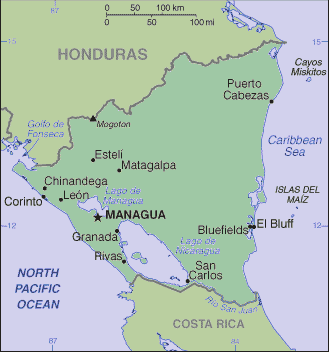 Nicaraguan map