
 Search
Traveling Luck for Haiti. Haiti, North America
Haiti is located in Caribbean, western one-third of the island of Hispaniola, between the Caribbean Sea and the North Atlantic Ocean, west of the Dominican Republic.
Land in Haiti is mostly rough and mountainous.
Haitian land covers an area of 27750 square kilometers which is slightly smaller than Maryland
Haiti has borders with Dominican Republic for 360km.
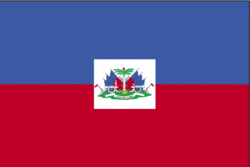 Haitian national flag (Flag of Haiti)
 Haiti country profile
 Travel advice for Haiti
As for the Haitian climate; tropical; semiarid where mountains in east cut off trade winds.
Haitian(s) speak French (official), Creole (official).
Places of note in Haiti
- Port-au-Prince
- Carrefour
- Delmas
- Cap-Haïtien
- Pétionville
- Gonaïves
- Saint-Marc
- Les Cayes
- Verrettes
- Ti Port-de-Paix
- Jacmel
- Limbé
- Jérémie
- Hinche
- Fond Parisien
- Désarmes
- Petit Goâve
- Dessalines
- Saint-Louis du Nord
- Léogâne
- Fort Liberté
- Trou du Nord
- Ouanaminthe
- Mirebalais
- Grande Rivière du Nord
- Croix des Bouquets
- Les Anglais
- Lascahobas
- Cornillon
- Gros Morne
- Anse à Galets
- Pignon
- Miragoâne
- Dame-Marie
- Saint-Raphaël
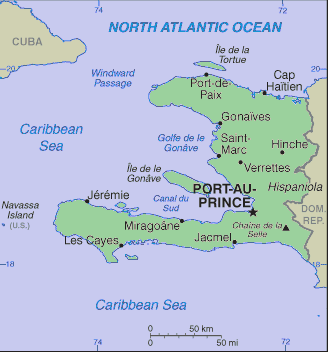 Haitian map
Regions of Haiti
The native Arawak Amerindians - who inhabited the island of Hispaniola when it was discovered by Columbus in 1492 - were virtually annihilated by Spanish settlers within 25 years. In the early 17th century, the French established a presence on Hispaniola, and in 1697, Spain ceded to the French the western third of the island, which later became Haiti. The French colony, based on forestry and sugar-related industries, became one of the wealthiest in the Caribbean, but only through the heavy importation of African slaves and considerable environmental degradation. In the late 18th century, Haiti's nearly half million slaves revolted under Toussaint L'OUVERTURE. After a prolonged struggle, Haiti became the first black republic to declare its independence in 1804. The poorest country in the Western Hemisphere, Haiti has been plagued by political violence for most of its history. After an armed rebellion led to the departure of President Jean-Betrand ARISTIDE in February 2004, an interim government took office to organize new elections under the auspices of the United Nations Stabilization Mission in Haiti (MINUSTAH). Continued violence and technical delays have prompted repeated postponements, and Haiti missed the constitutionally-mandated presidential inauguration date of 7 February 2006.
In this poorest country in the Western Hemisphere, 80% of the population lives in abject poverty. Two-thirds of all Haitians depend on the agriculture sector, mainly small-scale subsistence farming, and remain vulnerable to damage from frequent natural disasters, exacerbated by the country's widespread deforestation. The economy grew 1.5% in 2005, the highest growth rate since 1999. Haiti suffers from rampant inflation, a lack of investment, and a severe trade deficit. In early 2005, Haiti paid its arrears to the World Bank, paving the way for reengagement with the Bank. The government is reliant on formal international economic assistance for fiscal sustainability. Remittances are the primary source of foreign exchange, equaling nearly a quarter of GDP in 2005.
Haitian natural resources include bauxite, copper, calcium carbonate, gold, marble, hydropower
shares island of Hispaniola with Dominican Republic (western one-third is Haiti, eastern two-thirds is the Dominican Republic)
Haitian religion is Roman Catholic 80%, Protestant 16% (Baptist 10%, Pentecostal 4%, Adventist 1%, other 1%), none 1%, other 3%.
Natural hazards in Haiti include lies in the middle of the hurricane belt and subject to severe storms from June to October; occasional flooding and earthquakes; periodic droughts.
Travel Advice for Haiti
HaitiSUMMARY
- We advise against all but essential travel to Haiti, because of the threat to personal security. There are incidences of violence and kidnappings for ransom, with kidnappings taking place mainly in Port-au-Prince.
- There is no British Embassy in Haiti and public operations at the British Consulate office in Port-au-Prince have been suspended since July 2005, due to the security situation. Visa and consular enquiries should be directed to the British Embassy in the Dominican Republic - see details below.
- The hurricane season in Haiti normally runs from June to November. Please see the Natural Disasters section of this Travel Advice and Hurricanes for more information.
- The threat from external terrorism is low.
- We strongly recommend that you obtain comprehensive travel and medical insurance before travelling. You should check any exclusions, and that your policy covers you for the activities you want to undertake. Please see: Travel Insurance
SAFETY AND SECURITY
Kidnapping for ransom money is increasingly common, along with random shootings of civilians, with robbery usually being the motive. Four foreign nationals were kidnapped in three separate incidents in December 2005.
Foreigners are at risk from violence. There have been a number of attacks on the vehicles of aid agencies and diplomatic staff. The French Honorary Consul in Cap Haitian was shot dead on 31 May 2005 after being caught in the crossfire of gang violence.
Crime is widespread and often violent. Pickpockets and theft of valuables are commonplace. You are advised not to walk in the streets during the day and especially at night, not to leave property in vehicles and always to travel with doors locked and windows up. Armed hold-ups of vehicles take place, even in daylight, in busy parts of Port-au-Prince.
Some areas of Port-au-Prince should be avoided at all times such as Cite Soleil. You should avoid going out after dark in the capital and do not travel outside the city during the hours of darkness.
Security guards are recommended for long-term foreign residents.
Political Situation
Haiti Country Profile
Following the resignation of President Aristide on 29 February 2004, a Multination Interim Force (MIF), authorised by the UN Security Council, was deployed in Haiti to restore order after months of considerable turmoil and violence. On 1 June 2004, the MIF was replaced by a UN Stabilisation Force and a transitional government was put in place between 2004 and May 2006.
On 7 February 2006, elections for a new government took place, and on 17 February 2006 the Provisional Electoral Council declared Rene Preval the winner with 51.15% of the vote. He was inaugurated on 14 May 2006. The elections themselves were conducted peacefully, but there were outbreaks of violence following the election, due mainly to the time taken for the Provisional Electoral Commission publicly to announce the result. The disturbances linked to the elections have since died down, but kidnappings, shootings and petty crime may occur anywhere and at any time. You are advised to remain highly vigilant and avoid all demonstrations and civil disturbances.
Local Travel
We advise against all but essential travel to Haiti, because of the deteriorating general security situation and the increasing threat to personal security, particularly in the capital, Port-au-Prince, where even the main airport road is proving vulnerable.
Because of the unpredictable nature of the kidnap attempts, you are strongly advised to use a reliable guide when travelling in the country. Avoid using public transport. You should only use rented cars with a local driver from a reliable agency (Dynamic Car Rentals, Budget, etc). Internal flights between the capital and some major provincial towns are available.
Road Safety
The standard of both roads and driving is very poor in Haiti. Many of the tarmac roads are in a state of disrepair whilst other roads, particularly in the countryside are little more than dirt tracks. Roads are often unlit and it is not uncommon after dark to encounter cars, trucks or motorcycles driving without lights. Drivers pay little regard to the laws of the road and you should drive therefore drive with extreme caution at all times. Standards of car maintenance are also low.
A UK driving licence is only valid for two months in Haiti.
LOCAL LAWS AND CUSTOMS
ENTRY REQUIREMENTS
HEALTH
Medical facilities are very limited and offer a poor standard of care. You should bring adequate supplies of essential medicines, especially for specific medical conditions such as diabetes, etc.
You should be aware of the high prevalence of HIV/AIDS; Haiti is the most affected country in the world outside Sub-Saharan Africa.
In November 2005, there were outbreaks of malaria and dengue fever in Port au Prince and the Cotes des Arcadins area. Dengue fever is contracted from daytime biting mosquitos, which are common throughout Haiti. More than three-quarters of British travellers who contracted malaria in 2005 did not take preventive measures, such as malaria prevention tablets. However, malaria can occur despite appropriate prevention, and therefore you should promptly seek medical care in the event of a fever or flu-like illness in the first year following your return from travelling to a malaria risk country. Before travelling you should seek medical advice about the malaria risk in Haiti.
Parasitic infections, other intestinal problems and hepatitis are also common.
You should drink only treated or bottled water and only use ice if you are sure it was made with drinkable water.
You should seek medical advice before travelling and ensure that all appropriate vaccinations are up to date. For further information on health, check the Department of Health’s website at www.dh.gov.uk
NATURAL DISASTERS
The hurricane season in Haiti normally runs from June to November. You should monitor local and international weather updates from the World Meteorological Organisation. You can also access the National Hurricane Centre at: World Meteorological Organisation for updates. Please also see Hurricanes for more detailed information about what to do if you are caught up in a hurricane.
There have been several hurricanes in recent decades causing loss of life, major damage and severe flooding. You can access the National Hurricane Centre for information. Please also see Hurricanes. If you are staying in Haiti when a hurricane occurs you should listen to information given on the television/radio stations and follow the advice of hosts or hotel management.
Emergency services are ill equipped to cope with a major disaster. Should a hurricane strike Haiti, basic services -transport and communications - could be severely disrupted.
The Caribbean plate runs off the north coast of Haiti and slight earth tremors occur occasionally. There have been no major earthquakes in recent times.
GENERAL