
 Search
Traveling Luck for Dominican Republic. Dominican Republic, North America
Dominican Republic is located in Caribbean, eastern two-thirds of the island of Hispaniola, between the Caribbean Sea and the North Atlantic Ocean, east of Haiti.
Land in Dominican Republic is rugged highlands and mountains with fertile valleys interspersed.
Dominican land covers an area of 48730 square kilometers which is slightly more than twice the size of New Hampshire
Dominican Republic has borders with Haiti for 360km.
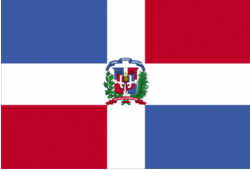 Dominican national flag (Flag of Dominican Republic)
 Dominican Republic country profile
 Travel advice for Dominican Republic
As for the Dominican climate; tropical maritime; little seasonal temperature variation; seasonal variation in rainfall.
Dominican(s) speak Spanish.
Places of note in Dominican Republic
- Santo Domingo
- Santiago de los Caballeros
- San Pedro de Macorís
- La Romana
- Benemérita de San Cristóbal
- San Francisco de Macorís
- Salvaleón de Higüey
- San Felipe de Puerto Plata
- Concepción de La Vega
- Santa Cruz de Barahona
- Bonao
- San Juan de la Maguana
- Bajos de Haina
- Baní
- Moca
- Azua de Compostela
- Mao
- Esperanza
- Cotuí
- Villa Altagracia
- Hato Mayor del Rey
- Nagua
- Villa Bisonó
- Jarabacoa
- Constanza
- Santa Cruz de El Seibo
- Tamboril
- Las Matas de Farfán
- San José de Ocoa
- Bayaguana
- Neiba
- Quisqueya
- San Fernando de Monte Cristi
- Sabana Grande de Boyá
- Dajabón
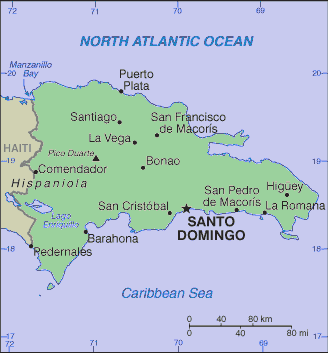 Dominican map
Regions of Dominican Republic
- Azua
- Baoruco
- Barahona
- Dajabón
- Distrito Nacional
- Dominican Republic (general)
- Duarte
- Elías Piña
- El Seíbo
- Espaillat
- Hato Mayor
- Independencia
- La Altagracia
- La Romana
- La Vega
- María Trinidad Sánchez
- Monseñor Nouel
- Monte Cristi
- Monte Plata
- Pedernales
- Peravia
- Puerto Plata
- Salcedo
- Samaná
- Sánchez Ramírez
- San Cristóbal
- San Juan
- San Pedro de Macorís
- Santiago
- Santiago Rodríguez
- Valverde
Explored and claimed by Christopher COLUMBUS on his first voyage in 1492, the island of Hispaniola became a springboard for Spanish conquest of the Caribbean and the American mainland. In 1697, Spain recognized French dominion over the western third of the island, which in 1804 became Haiti. The remainder of the island, by then known as Santo Domingo, sought to gain its own independence in 1821, but was conquered and ruled by the Haitians for 22 years; it finally attained independence as the Dominican Republic in 1844. In 1861, the Dominicans voluntarily returned to the Spanish Empire, but two years later they launched a war that restored independence in 1865. A legacy of unsettled, mostly non-representative rule followed, capped by the dictatorship of Rafael Leonidas TRUJILLO from 1930-1961. Juan BOSCH was elected president in 1962, but was deposed in a military coup in 1963. In 1965, the United States led an intervention in the midst of a civil war sparked by an uprising to restore BOSCH. In 1966, Joaquin BALAGUER defeated BOSCH in an election to become president. BALAGUER maintained a tight grip on power for most of the next 30 years when international reaction to flawed elections forced him to curtail his term in 1996. Since then, regular competitive elections have been held in which opposition candidates have won the presidency. Former President (1996-2000) Leonel FERNANDEZ Reyna won election to a second term in 2004 following a constitutional amendment allowing presidents to serve more than one term.
The Dominican Republic is a Caribbean representative democracy that enjoyed strong GDP growth until 2003. Although the country has long been viewed primarily as an exporter of sugar, coffee, and tobacco, in recent years the service sector has overtaken agriculture as the economy's largest employer due to growth in tourism and free trade zones. Growth turned negative in 2003 with reduced tourism, a major bank fraud, and limited growth in the US economy (the source of about 80% of export revenues), but recovered in 2004 and 2005. With the help of strict fiscal targets agreed in the 2004 renegotiation of an IMF standby loan, President FERNANDEZ has stabilized the country's financial situation. Although the economy continues to grow at a respectable rate, unemployment remains an important challenge. The country suffers from marked income inequality; the poorest half of the population receives less than one-fifth of GNP, while the richest 10% enjoys nearly 40% of national income. The Dominican Republic's development prospects improved with the ratification of the Central America-Dominican Republic Free Trade Agreement (CAFTA-DR) in September 2005.
Dominican natural resources include nickel, bauxite, gold, silver
shares island of Hispaniola with Haiti
Dominican religion is Roman Catholic 95%.
Natural hazards in Dominican Republic include lies in the middle of the hurricane belt and subject to severe storms from June to October; occasional flooding; periodic droughts.
Travel Advice for Dominican Republic
Dominican RepublicSUMMARY
- Most visits to the Dominican Republic are trouble-free. The main type of incident for which British nationals require consular assistance is for replacing lost passports. You should also be aware that there has been an increase in violent crime against the local population.
- There are reports of an increase in the number of cases of dengue fever in the Dominican Republic. Santo Domingo and the city of Santiago are most affected. See the Health section below for further details.
- The hurricane season in the Dominican Republic normally runs from June to November. Please see the Natural Disasters section of this Travel Advice and Hurricanes for more information.
- The threat from terrorism is low.
- We strongly recommend that you obtain comprehensive travel and medical insurance before travelling. You should check any exclusions, and that your policy covers you for the activities you want to undertake. Please see: Travel Insurance
SAFETY AND SECURITY
Although roads are reasonably good, the standard of driving is erratic. Drivers weave from lane to lane and seldom signal. Many vehicles are in a very poor state, often as a result of numerous collisions. Motorcyclists are numerous and a real danger. Road accidents are common. If you are involved in any accident you are liable to be detained by police until the circumstances of the accident have been investigated. It is worth bearing in mind that police tend to favour the motorcyclist in the event of an accident between a motorcycle and another vehicle. If you are detained as a result of a road accident, you are strongly advised to contact the British Embassy in Santo Domingo or Honorary Consulate in Puerto Plata.
LOCAL LAWS AND CUSTOMS
ENTRY REQUIREMENTS
HEALTH
There are occasional outbreaks of malaria mainly in the border regions with Haiti. However, in 2005 there were reports of a small number of tourists contracting malaria in the La Altagracia province in the east of the country. In the majority of cases the visitors were staying in the Bavaro and Punta Cana resorts. The resort of Bayahibe is also within the same province. Before travelling, you are advised to contact your doctor for up-to-date advice on anti-malarial medication and on arrival, ensure that you take adequate precautions against being bitten by mosquitoes. More than three-quarters of British travellers who contracted malaria in 2005 did not take preventive measures, such as malaria prevention tablets. However, malaria can occur despite appropriate prevention, and therefore you should promptly seek medical care in the event of a fever or flu-like illness in the first year following your return from travelling to a malaria risk country. Before travelling you should seek medical advice about the malaria risk in the Dominican Republic.
GENERAL