
 Search
Traveling Luck for Slovenia. Slovenia, Europe
Slovenia is located in Central Europe, eastern Alps bordering the Adriatic Sea, between Austria and Croatia.
Land in Slovenia is a short coastal strip on the Adriatic, an alpine mountain region adjacent to Italy and Austria, mixed mountains and valleys with numerous rivers to the east.
Slovenian land covers an area of 20273 square kilometers which is slightly smaller than New Jersey
Slovenia has borders with Austria for 330km, Croatia for 670km, Hungary for 102km and Italy for 232km.
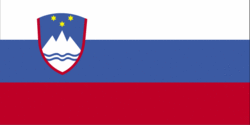 Slovenian national flag (Flag of Slovenia)
 Slovenia country profile
 Travel advice for Slovenia
As for the Slovenian climate; Mediterranean climate on the coast, continental climate with mild to hot summers and cold winters in the plateaus and valleys to the east.
Slovene(s) speak Slovenian 91.1%, Serbo-Croatian 4.5%, other or unspecified 4.4% (2002 census).
Places of note in Slovenia
- Ljubljana
- Maribor
- Celje
- Kranj
- Velenje
- Koper
- Novo Mesto
- Ptuj
- Trbovlje
- Nova Gorica
- Kamnik
- Jesenice
- Murska Sobota
- Škofja Loka
- Domžale
- Izola
- Kočevje
- Postojna
- Logatec
- Slovenj Gradec
- Ravne
- Vrhnika
- Krško
- Zagorje ob Savi
- Slovenska Bistrica
- Ajdovščina
- Litija
- Brežice
- Grosuplje
- Lucija
- Radovljica
- Črnomelj
- Hrastnik
- Idrija
- Mengeš
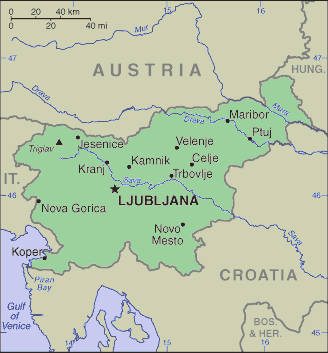 Slovenian map
Regions of Slovenia
- Ajdovščina
- Beltinci
- Benedikt
- Bistrica ob Sotli
- Bled
- Bloke
- Bohinj
- Borovnica
- Bovec
- Braslovče
- Brda
- Brežice
- Brezovica
- Cankova
- Celje
- Cerklje na Gorenjskem
- Cerknica
- Cerkno
- Cerkvenjak
- Črenšovci
- Črna na Koroškem
- Črnomelj
- Destrnik
- Divača
- Dobje
- Dobrepolje
- Dobrna
- Dobrova-Horjul-Polhov Gradec
- Dobrovnik-Dobronak
- Dolenjske Toplice
- Dol pri Ljubljani
- Domžale
- Dornava
- Dravograd
- Duplek
- Gorenja Vas-Poljane
- Gorišnica
- Gornja Radgona
- Gornji Grad
- Gornji Petrovci
- Grad
- Grosuplje
- Hajdina
- Hoče-Slivnica
- Hodoš-Hodos
- Horjul
- Hrastnik
- Hrpelje-Kozina
- Idrija
- Ig
- Ilirska Bistrica
- Ivančna Gorica
- Izola-Isola
- Jesenice
- Jezersko
- Juršinci
- Kamnik
- Kanal
- Kidričevo
- Kobarid
- Kobilje
- Kočevje
- Komen
- Komenda
- Koper-Capodistria
- Kostel
- Kozje
- Kranj
- Kranjska Gora
- Križevci
- Krško
- Kungota
- Kuzma
- Laško
- Lenart
- Lendava-Lendva
- Litija
- Ljubljana
- Ljubno
- Ljutomer
- Logatec
- Loška Dolina
- Loški Potok
- Lovrenc na Pohorju
- Luče
- Lukovica
- Majšperk
- Maribor
- Markovci
- Medvode
- Mengeš
- Metlika
- Mežica
- Miklavž na Dravskem Polju
- Miren-Kostanjevica
- Mirna Peč
- Mislinja
- Moravče
- Moravske Toplice
- Mozirje
- Murska Sobota
- Muta
- Naklo
- Nazarje
- Nova Gorica
- Novo Mesto
- Odranci
- Oplotnica
- Ormož
- Osilnica
- Pesnica
- Piran-Pirano
- Pivka
- Podčetrtek
- Podlehnik
- Podvelka
- Polzela
- Postojna
- Prebold
- Preddvor
- Prevalje
- Ptuj
- Puconci
- Rače-Fram
- Radeče
- Radenci
- Radlje ob Dravi
- Radovljica
- Ravne na Koroškem
- Razkrižje
- Ribnica
- Ribnica na Pohorju
- Rogaška Slatina
- Rogašovci
- Rogatec
- Ruše
- Šalovci
- Selnica ob Dravi
- Semič
- Šempeter-Vrtojba
- Šenčur
- Šentilj
- Šentjernej
- Šentjur pri Celju
- Sevnica
- Sežana
- Škocjan
- Škofja Loka
- Škofljica
- Slovenia (general)
- Slovenj Gradec
- Slovenska Bistrica
- Slovenska Konjice
- Šmarje pri Jelšah
- Šmartno ob Paki
- Šmartno pri Litiji
- Sodražica
- Solčava
- Šoštanj
- Starše
- Štore
- Sveta Ana
- Sveti Andraž v Slovenskih Goricah
- Sveti Jurij
- Tabor
- Tišina
- Tolmin
- Trbovlje
- Trebnje
- Trnovska Vas
- Tržič
- Trzin
- Turnišče
- Velenje
- Velika Polana
- Velike Lašče
- Veržej
- Videm
- Vipava
- Vitanje
- Vodice
- Vojnik
- Vransko
- Vrhnika
- Vuzenica
- Zagorje ob Savi
- Žalec
- Zavrč
- Železniki
- Žetale
- Žiri
- Žirovnica
- Zreče
- Žužemberk
The Slovene lands were part of the Austro-Hungarian Empire until the latter's dissolution at the end of World War I. In 1918, the Slovenes joined the Serbs and Croats in forming a new multinational state, which was named Yugoslavia in 1929. After World War II, Slovenia became a republic of the renewed Yugoslavia, which though Communist, distanced itself from Moscow's rule. Dissatisfied with the exercise of power by the majority Serbs, the Slovenes succeeded in establishing their independence in 1991 after a short 10-day war. Historical ties to Western Europe, a strong economy, and a stable democracy have assisted in Slovenia's transformation to a modern state. Slovenia acceded to both NATO and the EU in the spring of 2004.
With its small transition economy and population of approximately two million, Slovenia is a model of economic success and stability for its neighbors in the former Yugoslavia. The country, which joined the EU in 2004, has excellent infrastructure, a well-educated work force, and an excellent central location. It enjoys a GDP per capita substantially higher than any of the other transitioning economies of Central Europe. In March 2004, Slovenia became the first transition country to graduate from borrower status to donor partner at the World Bank. Slovenia plans to adopt the euro by 2007 and has met the EU's Maastricht criteria for inflation. Despite its economic success, Slovenia faces growing challenges. Much of the economy remains in state hands and foreign direct investment (FDI) in Slovenia is one of the lowest in the EU on a per capita basis. Taxes are relatively high, the labor market is often seen as inflexible, and legacy industries are losing sales to more competitive firms in China, India, and elsewhere. The current center-right government, elected in October 2004, has pledged to accelerate privatization of a number of large state holdings and is interested in increasing FDI in Slovenia. In late 2005, the government's new Committee for Economic Reforms was elevated to cabinet-level status. The Committee's program includes plans for lowering the tax burden, privatizing state-controlled firms, improving the flexibility of the labor market, and increasing the government's efficiency.
Slovenian natural resources include lignite coal, lead, zinc, mercury, uranium, silver, hydropower, forests
despite its small size, this eastern Alpine country controls some of Europe's major transit routes
Slovenian religion is Catholic 57.8%, Orthodox 2.3%, other Christian 0.9%, Muslim 2.4%, unaffiliated 3.5%, other or unspecified 23%, none 10.1% (2002 census).
Natural hazards in Slovenia include flooding and earthquakes.
Travel Advice for Slovenia
SloveniaSUMMARY
- The threat from terrorism is low. But you should be aware of the global risk of indiscriminate terrorist attacks which could be against civilian targets, including places frequented by foreigners.
- Around 91,000 British tourists visit Slovenia every year. The main type of incident for which British nationals require consular assistance in Slovenia is for replacing lost and stolen passports.
- We strongly recommend that you obtain comprehensive travel and medical insurance before travelling. You should check any exclusions, and that your policy covers you for the activities you want to undertake. Please see: Travel Insurance
SAFETY AND SECURITY
Sensible precautions should be taken when carrying money in busy tourist areas.
Political Situation
Slovenia Country Profile.
Road Safety
If you plan to drive, you will need a driving licence with a photo on it, which means that if you do not have the new style EU driving licence you will need an International Driving Permit.
If you are driving to Slovenia during the winter period, you should be aware that winter equipment is mandatory between 15 November and 15 March. This means that your car must be equipped with either winter tyres, or have snow chains and radial tyres with at least 4mm tread depth. You can be fined 125 Euros for not having this equipment, or 417 Euros if you cause a delay on the road for the same reason.
If you intend to hire a car and drive it into Slovenia you must declare this to the car hire company first, as you must have adequate car insurance cover.
Heavy on-the-spot fines are in place for traffic offences and jaywalking. A new Road Safety Act came into effect on 1 January 2005. This gives the police greater powers to stop drivers and levy on the spot fines, including greater penalties for speeding, driving under the influence of alcohol and for using mobile phones without properly installed wireless headsets (bluetooth).
LOCAL LAWS AND CUSTOMS
ENTRY REQUIREMENTS
HEALTH
The Slovene Government confirmed on 12 February 2006, that the H5N1 form of Avian Influenza had been found in a swan in north east Slovenia. Tests are being done on eight other wild birds found dead in the same region. On 6 June 2006, the Slovene authorities announced that these tests were negative.
The risk to humans from Avian Influenza is believed to be very low. As a precaution you should avoid visiting live animal markets, poultry farms and other places where you may come into close contact with domestic, caged or wild birds; and ensure that poultry and egg dishes are thoroughly cooked.
You should read this advice in conjunction with the FCO’s Avian and Pandemic Influenza Factsheet, which gives more detailed advice and information.
NATURAL DISASTERS
GENERAL
Money