
 Search
Traveling Luck for Croatia. Croatia, Europe
Croatia is located in Southeastern Europe, bordering the Adriatic Sea, between Bosnia and Herzegovina and Slovenia.
Land in Croatia is geographically diverse; flat plains along Hungarian border, low mountains and highlands near Adriatic coastline and islands.
Croatian land covers an area of 56542 square kilometers which is slightly smaller than West Virginia
Croatia has borders with Bosnia and Herzegovina for 932km, Hungary for 329km, Montenegro for 25km and Slovenia for 670km.
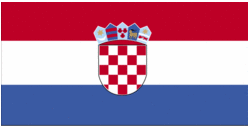 Croatian national flag (Flag of Croatia)
 Croatia country profile
 Travel advice for Croatia
As for the Croatian climate; Mediterranean and continental; continental climate predominant with hot summers and cold winters; mild winters, dry summers along coast.
Croat(s), Croatian(s) speak Croatian 96.1%, Serbian 1%, other and undesignated 2.9% (including Italian, Hungarian, Czech, Slovak, and German) (2001 census).
Places of note in Croatia
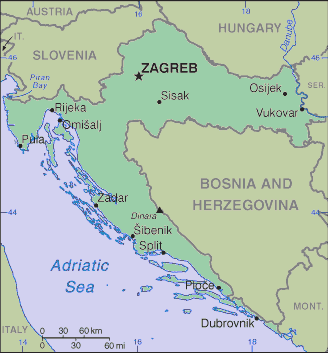 Croatian map
Regions of Croatia
- Bjelovarsko-Bilogorska
- Brodsko-Posavska
- Croatia (general)
- Dubrovačko-Neretvanska
- Istarska
- Karlovačka
- Koprivničko-Križevačka
- Krapinsko-Zagorska
- Ličko-Senjska
- Međimurska
- Osječko-Baranjska
- Požeško-Slavonska
- Primorsko-Goranska
- Šibensko-Kniniska
- Sisačko-Moslavačka
- Splitsko-Dalmatinska
- Varaždinska
- Virovitičk-Podravska
- Vukovarsko-Srijemska
- Zadarska
- Zagrebačka
- Zagreb, Grad
The lands that today comprise Croatia were part of the Austro-Hungarian Empire until the close of World War I. In 1918, the Croats, Serbs, and Slovenes formed a kingdom known after 1929 as Yugoslavia. Following World War II, Yugoslavia became a federal independent Communist state under the strong hand of Marshal TITO. Although Croatia declared its independence from Yugoslavia in 1991, it took four years of sporadic, but often bitter, fighting before occupying Serb armies were mostly cleared from Croatian lands. Under UN supervision, the last Serb-held enclave in eastern Slavonia was returned to Croatia in 1998.
Before the dissolution of Yugoslavia, the Republic of Croatia, after Slovenia, was the most prosperous and industrialized area with a per capita output perhaps one-third above the Yugoslav average. The economy emerged from a mild recession in 2000 with tourism, banking, and public investments leading the way. Unemployment remains high, at about 18%, with structural factors slowing its decline. While macroeconomic stabilization has largely been achieved, structural reforms lag because of deep resistance on the part of the public and lack of strong support from politicians. Growth, while impressive at about 3% to 4% for the last several years, has been stimulated, in part, through high fiscal deficits and rapid credit growth. The EU accession process should accelerate fiscal and structural reform.
Croatian natural resources include oil, some coal, bauxite, low-grade iron ore, calcium, gypsum, natural asphalt, silica, mica, clays, salt, hydropower
controls most land routes from Western Europe to Aegean Sea and Turkish Straits
Croatian religion is Roman Catholic 87.8%, Orthodox 4.4%, other Christian 0.4%, Muslim 1.3%, other and unspecified 0.9%, none 5.2% (2001 census).
Natural hazards in Croatia include destructive earthquakes.
Travel Advice for Croatia
CroatiaSUMMARY
- Croatia shares with the rest of the Europe a threat from international terrorism. Attacks could be indiscriminate and against civilian targets, including places frequented by foreigners.
- Unexploded land mines are still a danger. Highly populated areas and major routes are now clear of mines and are safe to visit. However, isolated areas in the mountains and countryside have not all been cleared. You should therefore be careful not to stray from roads and paved areas without an experienced guide.
- Around 250,000 British nationals visit Croatia each year. Most visits to Croatia are trouble-free. The main type of incident for which British nationals require consular assistance in Croatia is for replacing lost and stolen passports.
- Carry your passport at all times. You must be able to show some form of identification if required.
- We strongly recommend that you obtain comprehensive travel and medical insurance before travelling. You should check any exclusions, and that your policy covers you for the activities you want to undertake. Please see: Travel Insurance
SAFETY AND SECURITY
You should take sensible precautions when carrying money in busy tourist areas, where pickpockets are known to operate.
You should report all incidents of crime to the local police station and obtain a report.
Political Situation
Croatia Country Profile.
Local Travel
If you are planning to travel outside the normal tourist resorts you should be aware that there are areas affected by the war, which ended in 1995, where unexploded mines remain. These areas include the Danube region (Eastern Slavonia) and the former Krajina.
You should be wary about leaving cultivated land or marked paths. If in doubt seek local advice.
If you are planning to cross into the Republics of Serbia or Montenegro please contact the nearest Serbian or Montenegron embassies or look at the travel advice for the Republics of Serbia or Montenegro.
Please note that the Serbia and Montenegro government does not recognise border crossings with Kosovo and those between Kosovo and Albania or Macedonia.
For more information contact the nearest Serbia and Montenegro Embassy or see the Serbia and Montenegro travel advice.
Road Safety
Your UK driving license is valid for up to six months from entry into Croatia. If you are staying longer, you need to apply for a Croatian licence. International Driving Licences are not valid in Croatia.
If travelling by car you should ensure, before setting out, that your green card covers Croatia. Insurance can normally be purchased at the main border crossings, however some of the smaller crossings may not have this facility or have limited hours when the service is available. If you are driving to or through Bosnia and Herzegovina, including the 20km strip of coastline at Neum on the Dalmatian coastal highway, you should ensure that your Green Card includes cover for Bosnia and Herzegovina. If this is not the case, temporary third-party insurance can be purchased at the main border posts, or in Split and other large Croatian cities. Insurance cannot be obtained at the Neum border.
Road conditions in and around Zagreb and the larger towns are of a generally good standard. However, you should take care when overtaking and use caution around other road users who may unexpectedly overtake repeatedly in slower traffic. Minor roads are usually unlit at night.
Croatia has laws stating that it is illegal:-
There have been a number of reported incidents of gangs robbing car occupants after either indicating that they are in trouble and require assistance, or pulling alongside a car and indicating that there seems to be something wrong and they should pull over. You should therefore be extremely cautious should something similar to the above actions occur.
Sea Safety
Croatia has also adopted a law expressing zero tolerance on alcohol consumption by those in charge of yachts and other boats. If you intend to take charge of a boat in Croatia you should not consume alcohol. The penalties for being caught drunk in charge of a boat are likely to be heavy.
LOCAL LAWS AND CUSTOMS
ENTRY REQUIREMENTS
Unless staying at a hotel or official tourist accommodation, all foreign nationals are required to register with the local police within 24 hours of arrival (in Zagreb you should register at the Police Station at Petrinjska 30, if outside Zagreb, you should register at the nearest main Police Station). Failure to do so may result in a fine or possible removal from Croatia (which may include a restriction on your ability to return to Croatia for a certain period).
HEALTH
Croatia has a reciprocal health agreement with the UK where no charge is made for ‘emergency’ treatment. However, only basic health care facilities are available in outlying areas and islands. This could result in a delay if you require urgent medical care.
You should seek medical advice on immunisations before travelling about immunisations, in particular against tick-borne encephalitis (TBE) in the summer months.
GENERAL