World index ... Asia ... Malaysia
Travelers word index

Malaysia

Continents
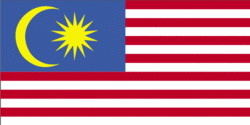
Malaysian flag

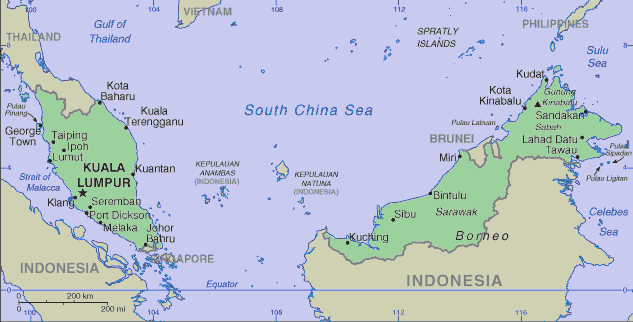
Malaysia is located in Southeastern Asia, peninsula bordering Thailand and northern one-third of the island of Borneo, bordering Indonesia, Brunei, and the South China Sea, south of Vietnam.

Malaysia has borders with Brunei for 381km, Indonesia for 1782km and Thailand for 506km.
Land in Malaysia is coastal plains rising to hills and mountains.

Malaysian land covers an area of 329750 square kilometers which is slightly larger than New Mexico

As for the Malaysian climate; tropical; annual southwest (April to October) and northeast (October to February) monsoons.

Malaysian(s) speak Bahasa Melayu (official), English, Chinese (Cantonese, Mandarin, Hokkien, Hakka, Hainan, Foochow), Tamil, Telugu, Malayalam, Panjabi, Thai
note: in East Malaysia there are several indigenous languages; most widely spoken are Iban and Kadazan.

Malaysia country profile, Travel advice for Malaysia

Malaysian Map
Places of note in Malaysia
Kuala Lumpur
Klang
Kampong Baru Subang
Johor Bahru
Ipoh
Kuching
Petaling Jaya
Shah Alam
Kota Kinabalu
Sandakan
Seremban
Kuantan
Tawau
Kuala Terengganu
Kota Baharu
Sungai Petani
Miri
Taiping
Alor Setar
Bukit Mertajam
Sibu
Melaka
George Town
Kulim
Keluang
Sekudai
Batu Pahat
Bintulu
Kampung Pasir Gudang
Kampong Sungai Ara
Tasek Gelugur
Muar
Rawang
Butterworth
Lahad Datu
Regions of Malaysia
Johor
Kedah
Kelantan
Kuala Lumpur
Labuan
Malaysia (general)
Melaka
Negeri Sembilan
Pahang
Perak
Perlis
Pulau Pinang
Putrajaya
Sabah
Sarawak
Selangor
Terengganu

During the late 18th and 19th centuries, Great Britain established colonies and protectorates in the area of current Malaysia; these were occupied by Japan from 1942 to 1945. In 1948, the British-ruled territories on the Malay Peninsula formed the Federation of Malaya, which became independent in 1957. Malaysia was formed in 1963 when the former British colonies of Singapore and the East Malaysian states of Sabah and Sarawak on the northern coast of Borneo joined the Federation. The first several years of the country's history were marred by Indonesian efforts to control Malaysia, Philippine claims to Sabah, and Singapore's secession from the Federation in 1965.

Country profile: Malaysia

Map of MalaysiaMalaysia boasts one of south-east Asia's most vibrant economies, the fruit of decades of industrial growth and political stability.

Its multi-ethnic, multi-religious society encompasses a majority Muslim population in most of its states and an economically-powerful Chinese community.

Consisting of two regions separated by some 640 miles of the South China Sea, Malaysia is a federation of 13 states and three federal territories. It is one of the region's key tourist destinations, offering excellent beaches and brilliant scenery. Dense rainforests in the eastern states of Sarawak and Sabah, on the island of Borneo, are a refuge for wildlife and tribal traditions.

Downtown area and Petronas towers, Kuala Lumpur Ethnic Malays comprise some 60% of the population. Chinese constitute around 26%; Indians and indigenous peoples make up the rest. The communities coexist in relative harmony, although there is little racial interaction.

Although since 1971 Malays have benefited from positive discrimination in business, education and the civil service, ethnic Chinese continue to hold economic power and are the wealthiest community. The Malays remain the dominant group in politics while the Indians are among the poorest.

Malaysia's economic prospects remain healthy, although it faces fierce competition from its neighbours, and from China and India. Free trade talks with the US are under way.

The country is among the world's biggest producers of computer disk drives, palm oil, rubber and timber. It has a state-owned car maker, Proton, and tourism has considerable room for expansion.

But it also faces serious challenges - politically, in the form of sustaining stability in the face of religious differences and the ethnic wealth gap, and, environmentally, in preserving its valuable forests.

Malaysia's human rights record has come in for international criticism. Internal security laws allow suspects to be detained without charge or trial.

Head of state: Sultan Mizan Zainal Abidin

Sultan Mizan Zainal Abidin was installed as Malaysia's 13th king in December 2006.

Malaysian king, Sultan Mizan Zainal Abidin The sultan is a former ruler of oil-rich Terengganu state. He was 44 when he was sworn in.

The king's role is largely ceremonial, although he is nominal head of the armed forces and all laws and the appointment of every cabinet minister require his assent.

Under Malaysia's constitutional monarchy, the position of king is rotated every five years between each of the nine hereditary state rulers.

Malaysia's first prime minister, Tunku Abdul Rahman, himself a prince, devised the system after independence in 1957 to spread power among the sultans and rajas who had ruled over fiefdoms on the Malay peninsula for hundreds of years.

Prime minister: Abdullah Ahmad Badawi

Mr Abdullah began a new, five-year term in March 2004 after his coalition government won a landslide victory in parliamentary and regional elections.

Correspondents said the victory boosted his chances of pushing through reforms, including a promise to stamp out corruption. But his critics say the pace of change has been slow. Malaysian Prime Minister Abdullah Ahmad Badawi

In 2006 his government unveiled a multi-billion-dollar plan intended to tackle rural poverty and promote growth. Its goal is to help Malaysia achieve developed nation status by 2020.

Abdullah Ahmad Badawi succeeded Mahathir Mohamad as prime minister in October 2003, when Asia's longest-serving elected leader retired after 22 years in power.

He is a former deputy premier who held defence, foreign affairs and education portfolios under Dr Mahathir.

On taking office he faced a strong political challenge from opposition Islamic fundamentalists and inherited the task of overseeing one of the region's most vibrant economies.

In contrast to his predecessor, Mr Abdullah has been described as self-effacing. He has been called the "Mr Nice Guy" of Malaysian politics.

Mr Abdullah was born in 1939 in Penang. His father was a founding member of United Malays National Organisation (Umno), Malaysia's ruling party. After gaining a degree in Islamic studies he worked in the civil service before being elected to parliament in 1978.

Malaysia has been ruled by a coalition, the National Front, since independence. Umno is the biggest grouping in the alliance, which includes Chinese and Indian parties.

  • Deputy prime minister, defence minister: Najib Razak
  • Finance minister: Abdullah Ahmad Badawi
  • Foreign minister: Syed Hamid Albar

    Malaysia has some of the toughest censorship laws in the world. The authorities exert substantial control over the media and restrictions may be imposed in the name of national security.

    The government is keen to insulate the largely-Muslim population from what it considers harmful foreign influences on TV. News is subject to censorship, entertainment shows and music videos regularly fall foul of the censors, and scenes featuring swearing and kissing are routinely removed from TV programmes and films.

    The TV sector comprises commercial networks and pay-TV operations. Around a quarter of TV households subscribe to the Astro multichannel service. Two more pay-TV operators, MiTV and Fine TV, entered the market in 2005. TV3 is a leading national private, terrestrial broadcaster.

    State-owned Radio Television Malaysia (RTM) operates two TV networks and many of the country's radio services. Private stations are on the air, broadcasting in Malay, Tamil, Chinese and English.

    Newspapers must renew their publication licences annually, and the home minister can suspend or revoke publishing permits.

    Some web sites, such as Laman Reformasi, close to former deputy prime minister Anwar Ibrahim, freeMalaysia and Malaysiakini, have attracted official criticism.

    The press

  • New Straits Times - English-language daily
  • The Star - English-language daily
  • Business Times - English-language daily
  • The Malay Mail - English-language daily
  • Malaysiakini - English-language, online news service

    Television

  • Radio Television Malaysia (RTM) - state-run, operates TV1 and TV2 networks
  • TV3 - commercial network
  • ntv7 - commercial network
  • 8TV - commercial network

    Radio

  • Radio Television Malaysia (RTM) - state-run, operates some 30 radio stations across the country and external service Voice of Malaysia
  • Time Highway Radio - private Kuala Lumpur FM station
  • Era FM - private FM station

    News agency

  • Bernama - state-run

    Malaysia, a middle-income country, transformed itself from 1971 through the late 1990s from a producer of raw materials into an emerging multi-sector economy. Growth was almost exclusively driven by exports - particularly of electronics. As a result, Malaysia was hard hit by the global economic downturn and the slump in the information technology (IT) sector in 2001 and 2002. GDP in 2001 grew only 0.5% because of an estimated 11% contraction in exports, but a substantial fiscal stimulus package equal to US $1.9 billion mitigated the worst of the recession, and the economy rebounded in 2002 with a 4.1% increase. The economy grew 4.9% in 2003, notwithstanding a difficult first half, when external pressures from Severe Acute Respiratory Syndrome (SARS) and the Iraq War led to caution in the business community. Growth topped 7% in 2004 and 5% in 2005. As an oil and gas exporter, Malaysia has profited from higher world energy prices, although the cost of government subsidies for domestic gasoline and diesel fuel has risen and offset some of the benefit. Malaysia "unpegged" the ringgit from the US dollar in 2005, but so far there has been little movement in the exchange rate. Healthy foreign exchange reserves, low inflation, and a small external debt are all strengths that make it unlikely that Malaysia will experience a financial crisis over the near term similar to the one in 1997. The economy remains dependent on continued growth in the US, China, and Japan - top export destinations and key sources of foreign investment.

    Malaysian natural resources include tin, petroleum, timber, copper, iron ore, natural gas, bauxite

    strategic location along Strait of Malacca and southern South China Sea

    Malaysian religion is Muslim, Buddhist, Daoist, Hindu, Christian, Sikh; note - in addition, Shamanism is practiced in East Malaysia.

    Natural hazards in Malaysia include flooding, landslides, forest fires.

    Travel Advice on Malaysia

    Malaysia

    This advice has been reviewed and reissued with amendments to the Summary and Terrorism section (action taken by Philippines Armed Forces).  The overall level of the advice has not changed.

    SUMMARY

    • Malaysia shares with the rest of South East Asia a threat from terrorism.  Attacks could be indiscriminate and against civilian targets, including places frequented by foreigners.

    • We believe that terrorists and criminal elements are continuing with plans to kidnap foreign tourists from the islands and coastal areas of Eastern Sabah.  Action taken by the Philippines Armed Forces in January 2007 against terrorist groups in the southern Philippines may heighten this risk.  Boats travelling to and from offshore islands and dive sites are possible targets.  If you wish to visit resorts on, and islands off, Eastern Sabah, you should exercise extreme caution.

    • If you plan to travel over the border to Thailand you should be aware that there has been a resurgence of terrorism in southern Thailand, particularly in the far southern provinces of Pattani, Yala, Narathiwat and Songkhla.  We recommend against all but essential travel to these Thai provinces.

    • You should not become involved with drugs of any kind: possession of even very small quantities can lead to imprisonment or the death penalty.

    • Heavy rains in December 2006 and January 2007 have caused extensive flooding in Johor.  You should take local advice before travelling around rural areas of Johor.  The main rail and road links from Kuala Lumpur to Singapore are currently still operating.  See the Natural Disasters section for more details.

    • Around 240,000 British nationals visit Malaysia each year.  Most visits are trouble-free.  The majority of incidents for which British nationals require consular assistance are for bag snatches, gambling scams and drink spiking.

    • Malaysia is a multicultural but predominantly Muslim country, and as such you should respect local social conventions at all times.  See the Local Laws and Customs section for more details.

    • We strongly recommend that you obtain comprehensive travel and medical insurance before travelling.  You should check any exclusions, and that your policy covers you for the activities you want to undertake.  Please see:  Travel Insurance.


    SAFETY AND SECURITY

    Road Safety
    A UK driving licence can be used in Malaysia for three months only.  We therefore advice British nationals staying in Malaysia for longer than three months to get a Malaysian driving licence or an annually renewable International Driving Permit.
    Road conditions in Peninsular Malaysia are generally good.  Traffic (particularly motor cyclists) will not always stop at traffic lights or on pedestrian crossings.  Visitors should take care when crossing the street to avoid accidents.  If you are involved in a road accident as a driver, you should not leave the scene until the police have attended.
    Sea Safety
    There have been a number of attacks against ships in and around Malaysian waters.  Mariners should be vigilant and take appropriate precautions; reduce opportunities for theft; establish secure areas onboard; and report all incidents to the coastal and flag state authorities.  Vessels which encounter problems at sea should contact the Martime Rescue Co-ordinating Centre on the standard distress channel.


    LOCAL LAWS AND CUSTOMS

    Drugs
    There are severe penalties for all drug offences in Malaysia, including in cases of trafficking (defined here as the possession of a certain quantity of drugs) a mandatory death penalty, or, in the case of possession, a custodial sentence imposed and possible whipping.  This also includes the possession of or trafficking in Amphetamine-type stimulants.  You could be asked to take a urine test on arrival in Malaysia if you are suspected of having used drugs before your visit.  Should the test prove positive, you could be referred for rehabilitation treatment or be deported.
    Alcohol
    Driving under the influence of alcohol is a serious offence in Malaysia and the traffic police regularly carry out breath tests.  Anyone over the legal limit can face a heavy fine or a jail sentence.
    Firearms
    The importation of unlicensed firearms and ammunition into Malaysia is prohibited.  Possession can carry the death penalty.
    Local Customs
    Malaysia is a multicultural but predominantly Muslim country, and as such, visitors should respect local social conventions.  During the fasting month of Ramadan, eating, drinking and smoking between sunrise and sunset is forbidden for Muslims.  You should be particularly aware of offending Muslim sensitivities during this period.  You should also dress modestly in conservative and rural areas, and when visiting places of worship.  Homosexual acts are illegal.

    Muslim tourists should be aware that they may be subject to local Shari’a law.


    ENTRY REQUIREMENTS

    The Malaysian authorities are currently running a vigorous campaign against illegal immigration and are therefore inspecting immigration documents, such as work permits, very closely.
    British nationals do not need a visa to enter Malaysia as a visitor.  You will normally be given permission to stay for three months on arrival.  Visas for longer stays or for non-tourist purposes must be obtained from the nearest Malaysian diplomatic mission before travel.  Please contact Malaysian representation in the UK.  It is important that you neither overstay your visa, nor infringe the terms of entry.  Persons doing so (even overstaying for just a few days) will incur a fine and possibly detention and deportation.  Entry to Malaysia is normally refused to visitors holding passports with less than six months' validity.  Dual nationals should also be aware that the Malaysian Government do not recognise dual nationality, so technically you can be refused entry if you are found to be holding two passports of different nationality.  If you are a dual national it is advisable to enter Malaysia on the passport on which you exited your last country of departure.
    Under current Malaysian exchange control rules, you may import or export up to 1,000 Malaysian Ringgit per person without prior approval.  There are no limits on the amount of foreign currency (notes and or travellers' cheques) you may import.  Non-residents may export foreign currency (notes and or travellers' cheques) up to the amount they previously imported, provided they have documentary evidence of the amount they imported.  All travellers must complete travellers' declaration forms on entering Malaysia.  Penalties for offences under the Exchange Control Act 1953 are a fine of up to 10,000 Malaysian Ringgit, three years' imprisonment or both.
    Single parents or other adults travelling alone with children should be aware that some countries require documentary evidence of parental responsibility before allowing lone parents to enter the country or, in some cases, before permitting the children to leave the country.  They may want to see birth certificates, a letter of consent from the other parent or some evidence as to your responsibility for the child.  Malaysian authorities do not normally require such evidence but if you have any concerns please check with Malaysian representation in the UK.


    HEALTH

    You should take out comprehensive medical/travel insurance covering all eventualities.  You should check any exclusions, and that your policy covers you for the activities you want to undertake.  Please see:  Travel Insurance.
    Medical care in private hospitals can be very expensive.
    Malaysia has periodic problems with air quality reaching hazardous levels because of smoke haze.  For more information on the air quality in Malaysia please visit the Malaysian Department for the Environment’s website at: http://www.jas.sains.my/jas/Air+Pollutant+Index.
    Since the beginning of July 2006, there have been renewed outbreaks of Hand, Foot and Mouth Disease (HFMD) across Sarawak.  Large-scale outbreaks of HFMD across Sarawak in early 2006 resulted in schools and kindergartens being closed.  HFMD is a communicable disease, which affects all age groups, but children are particularly vulnerable.  The disease usually causes mild illness but may occasionally take a more serious form, sometimes resulting in death.  If you experience the following symptoms - fever, blisters on the hands, feet, buttocks and in the mouth, a sore throat and headaches – you should seek medical advice.  For further information on HFMD please visit the NaTHNaC website..

    Some tropical illnesses are prevalent in Malaysia.  Tuberculosis and Hepatitis A and B are common.

    There are periodic outbreaks of Dengue Fever for which there is no vaccination or immunisation.  You should be aware of the risk and take preventive measures to avoid being bitten by mosquitoes, which transmit the dengue virus.  If you suffer from a fever whilst (or shortly after) visiting Malaysia, you should consult a doctor urgently.

    You should seek medical advice before travelling and ensure that all appropriate vaccinations are up to date.  For further information on health, check the DoH website at: www.dh.gov.uk.
    Avian Influenza (Bird Flu)
    In June 2006 Malaysia was declared free of Avian Flu following outbreaks across Peninsular Malaysia in February and March 2006.  No human infections or deaths were reported.
    The risk to humans from Avian Influenza is believed to be very low.  As a precaution, you should avoid visiting live animal markets, poultry farms and other places where you may come into close contact with domestic, caged or wild birds; and ensure poultry and egg dishes are thoroughly cooked.
    You should read this advice in conjunction with the Avian and Pandemic Influenza Factsheet, which gives more detailed advice and information.

    NATURAL DISASTERS

    Heavy seasonal rains have caused extensive flooding in mainly rural parts of Johor.  This has resulted in the evacuation of some areas.  Some roads and communications have been affected.  Travellers should seek local advice before travelling in Johor, especially in rural areas.  The main rail and road links from Kuala Lumpur to Singapore are currently still operating.  You should call (60) (1) 800 88 0000 for further information on Malaysian Highways and (60) (3) 2267 1200 for further information on travel by rail.

    Between the months of October to February Malaysia is affected by seasonal storms, which occasionally result in heavy flooding.


    GENERAL

    If things go wrong when overseas, please see:  What We Can Do To Help.
    Airport departure tax is included in the ticket price.
    Registration
    British nationals should register with the Consular Section of the High Commission if they are staying in the country for more than a short period.  This can be done online at: British High Commission, Kuala Lumpur


    OTHER

    Malaysia Country Profile


  • What is this world index all about?