
 Search
Traveling Luck for Indonesia. Indonesia, Asia
Indonesia is located in Southeastern Asia, archipelago between the Indian Ocean and the Pacific Ocean.
Land in Indonesia is mostly coastal lowlands; larger islands have interior mountains.
Indonesian land covers an area of 1919440 square kilometers which is slightly less than three times the size of Texas
Indonesia has borders with Malaysia for 1782km, Papua New Guinea for 820km and East Timor for 228km.
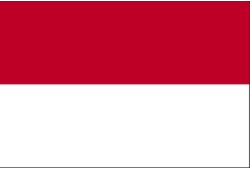 Indonesian national flag (Flag of Indonesia)
 Indonesia country profile
 Travel advice for Indonesia
As for the Indonesian climate; tropical; hot, humid; more moderate in highlands.
Indonesian(s) speak Bahasa Indonesia (official, modified form of Malay), English, Dutch, local dialects, the most widely spoken of which is Javanese.
Places of note in Indonesia
- Jakarta
- Surabaya
- Medan
- Bandung
- Bekasi
- Tangerang
- Makassar
- Semarang
- Depok
- Padang
- Tanjungkarang-Telukbetung
- Malang
- Yogyakarta
- Banjarmasin
- Surakarta
- Pontianak
- Manado
- Balikpapan
- Jambi
- Denpasar
- Ambon
- Samarinda
- Mataram
- Percut
- Bengkulu
- Jember
- Palu
- Kupang
- Sukabumi
- Tasikmalaya
- Pekalongan
- Cirebon
- Banda Aceh
- Tegal
- Kediri
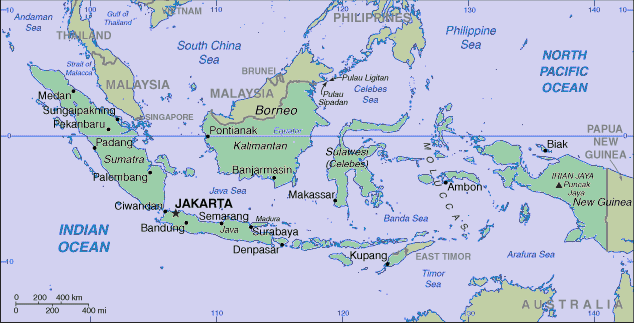 Indonesian map
Regions of Indonesia
- Aceh
- Bali
- Banten
- Bengkulu
- Gorontalo
- (ID06)
- (ID16)
- (ID23)
- (ID25)
- Indonesia (general)
- Irian Jaya Barat
- Jakarta Raya
- Jambi
- Jawa Barat
- Jawa Tengah
- Jawa Timur
- Kalimantan Barat
- Kalimantan Selatan
- Kalimantan Tengah
- Kalimantan Timur
- Kepulauan Bangka Belitung
- Kepulauan Riau
- Lampung
- Maluku
- Maluku Utara
- Nusa Tenggara Barat
- Nusa Tenggara Timur
- Papua
- Riau
- Sulawesi Barat
- Sulawesi Selatan
- Sulawesi Tengah
- Sulawesi Tenggara
- Sulawesi Utara
- Sumatera Barat
- Sumatera Selatan
- Sumatera Utara
- Yogyakarta
The Dutch began to colonize Indonesia in the early 17th century; the islands were occupied by Japan from 1942 to 1945. Indonesia declared its independence after Japan's surrender, but it required four years of intermittent negotiations, recurring hostilities, and UN mediation before the Netherlands agreed to relinquish its colony. Indonesia is the world's largest archipelagic state and home to the world's largest Muslim population. Current issues include: alleviating poverty, preventing terrorism, consolidating democracy after four decades of authoritarianism, implementing financial sector reforms, stemming corruption, and holding the military and police accountable for human rights violations. Indonesia was the nation worst hit by the December 2004 tsunami, which particularly affected Aceh province causing over 100,000 deaths and over $4 billion in damage. An additional earthquake in March 2005 created heavy destruction on the island of Nias. Reconstruction in these areas may take up to a decade. In 2005, Indonesia reached a historic peace agreement with armed separatists in Aceh, but it continues to face a low intensity separatist guerilla movement in Papua.
Indonesia, a vast polyglot nation, has struggled to overcome the Asian financial crisis, and still grapples with high unemployment, a fragile banking sector, endemic corruption, inadequate infrastructure, a poor investment climate, and unequal resource distribution among regions. Indonesia became a net oil importer in 2004 because of declining production and lack of new exploration investment. The cost of subsidizing domestic fuel placed increasing strain on the budget in 2005, and combined with indecisive monetary policy, contributed to a run on the currency in August, prompting the government to enact a 126% average fuel price hike in October. The resulting inflation and interest rate hikes will dampen growth prospects in 2006. Keys to future growth remain internal reform, building up the confidence of international and domestic investors, and strong global economic growth. In late December 2004, the Indian Ocean tsunami took 131,000 lives with another 37,000 missing, left some 570,000 displaced persons, and caused an estimated $4.5 billion in damages and losses. Terrorist incidents in 2005 have slowed tourist arrivals. Indonesia experienced several human cases of avian influenza in late 2005, sparking concerns of a pandemic.
Indonesian natural resources include petroleum, tin, natural gas, nickel, timber, bauxite, copper, fertile soils, coal, gold, silver
archipelago of 17,508 islands (6,000 inhabited); straddles equator; strategic location astride or along major sea lanes from Indian Ocean to Pacific Ocean
Indonesian religion is Muslim 88%, Protestant 5%, Roman Catholic 3%, Hindu 2%, Buddhist 1%, other 1% (1998).
Natural hazards in Indonesia include occasional floods, severe droughts, tsunamis, earthquakes, volcanoes, forest fires.
Travel Advice for Indonesia
Indonesia>>
SUMMARY
- We advise against all travel to Central Sulawesi Province and Maluku Province, especially Ambon. Both provinces have been subject to outbreaks of internal violence and the security situation continues to remain unsettled.
- We advise against all but essential travel to Aceh which is emerging from a long-running internal conflict. You should exercise caution if travelling to remote areas. You should also monitor all available information on the local situation.
- There remains a high threat from terrorism in Indonesia. We continue to receive reports that terrorists in Indonesia are planning further attacks, including attacks against Westerners and Western interests. These attacks could occur anywhere and at any time. Foreigners, and locations and buildings frequented by foreigners, continue to remain attractive potential targets to terrorists.
- The attacks in Bali in October 2005 and October 2002, and those in Jakarta on the Australian Embassy in September 2004 and the Marriott Hotel in August 2003, show that terrorists have the means and the motivation to carry out successful attacks.
- If you are visiting or are resident in Indonesia, you should exercise caution at all times. We strongly advise you to ensure that you are comfortable with, and regularly review your own and your family’s security arrangements.
- Developments in Iraq and on the Middle East Peace Process do affect Indonesia. You should follow news reports and be alert to developments which might trigger public disturbances. You should take sensible precautions for your personal safety and avoid large crowds, political gatherings and demonstrations.
- Following the onset of heavy rains on 31 January 2007, Jakarta is currently experiencing extensive flooding. There have been at least twenty deaths among the local civilian population, mainly from electrocutions or drowning. The central business district and expatriate residential areas are not among the worst affected areas, but many roads remain impassable. The Jakarta Sukarno-Hatta airport is currently open but flights may be subject to long delays. You are advised to monitor news reports for the latest information.
- Outbreaks of Avian Influenza (Bird Flu) in Indonesia have resulted in a number of human fatalities. As a precaution, you should avoid live animal markets, poultry farms and other places where you may come into close contact with domestic, caged or wild birds; and ensure poultry and egg dishes are thoroughly cooked. For further information see Health section below and also read the FCO’s Avian and Pandemic Influenza Factsheet.
- Penalties for illegal drug importation and use are severe and can include the death penalty.
- You must carry some form of identification with you at all times. A photocopy of the relevant pages from your passport is sufficient.
- The main types of incident for which British nationals require consular assistance in Indonesia are: theft/ loss of passport and belongings; overstaying visas; drug possession; and deaths, mostly from natural causes, water sports and road accidents. The majority of consular cases occur in Jakarta and Bali.
- We strongly recommend that you obtain comprehensive travel and medical insurance before travelling. You should check any exclusions, and that your policy covers you for the activities you want to undertake. Please see: Travel Insurance.
SAFETY AND SECURITY
You should beware of street crime and pickpockets. Take personal security measures such as:
Taking particular care to safeguard your passport and credit/ATM cards. We receive regular reports of credit card theft after shop employees copied card details. You are advised not to lose sight of your credit card during transactions;
Beware of thieves while travelling on public transport. We receive regular reports of extortionate fares or robberies by unlicensed airport taxi drivers. Their vehicles are usually in poor condition, are unmetered, and do not have a dashboard identity licence. When taking a taxi, use one from a reputable firm, preferably booked by phone or arranged by your hotel, or booked by a registered taxi firm inside the airport.
For longer journeys it is a sensible precaution to notify friends of travel plans, contact them on arrival and where possible travel in convoy.
We receive occasional reports of tourists who have been robbed after bringing visitors to their hotel rooms. In some cases their drinks were drugged. Ensure your passport and wallet and other valuables are secure at all times.
Political Situation
Developments in Iraq and on the Middle East Peace Process do affect Indonesia. You should follow news reports and be alert to developments, which might trigger public disturbances. You should take sensible precautions for your personal safety and avoid large crowds, political gatherings and demonstrations.
Indonesia Country Profile
Local Travel
Our additional advice for British nationals in Indonesia who are travelling outside Jakarta is as follows:
Central Sulawesi Province
You should avoid all travel to Maluku, particularly Ambon. Violence in Ambon has resulted in a number of deaths and serious injuries. The situation in Maluku and North Maluku remains unsettled.
Aceh
Papua and Irian Jaya Barat
Political tensions in Papua, including the Provinces of Papua and Irian Jaya Barat, have given rise to outbursts of dissent and sporadic violence. If you are visiting Papua, you should exercise caution and seek local advice on your travel plans. You should avoid large crowds and demonstrations, as elsewhere in Indonesia.
Permits are required to travel to Papua Regulations for entry into and permission to remain in Papua can change at any time. You should seek the latest information on entry requirements and registration procedures from the: Indonesian Embassy in London.
Road Safety
If you plan to hire a car, you should note that traffic discipline is poor and city streets are congested. There is considerable advantage in hiring a car with a driver and this is not especially expensive. If you break down or have a minor accident you should stay with your vehicle with the car doors locked until the police arrive. Motorcyclists can be particularly dangerous.
Air Safety
There are a number of domestic airlines in Indonesia, although there are concerns about the reliability of some of them. You should be aware that there have been a number of major aircraft crashes in Indonesia over the last ten years, for reasons including bad weather, poor maintenance and mechanical failure. If you intend to use a domestic airline, you should check first with your travel agent that the airline has a good safety record.
Sea Safety
Inter-island travel by small boats can be dangerous as storms appear quickly and navigational equipment is often limited. There have been attacks against ships in and around the waters of Indonesia. Mariners are advised to be vigilant; reduce opportunities for theft; establish secure areas onboard; and report all incidents to the coastal and flag state authorities.
LOCAL LAWS AND CUSTOMS
Do not get involved with illegal drugs. Possession, trafficking and manufacture of such drugs are serious offences in Indonesia. Those caught face lengthy prison sentences or the death penalty, usually after a protracted and expensive legal process. Even the possession of small amounts of drugs such as marijuana or ecstasy can lead to prison sentences longer than four years. Convicted traffickers or users of hard drugs such as cocaine or heroin face the death penalty in Indonesia. In August 2005, the Indonesian police launched a campaign against illegal drug use. This included raids of popular nightclubs across Indonesia, including Bali and Jakarta, and urine tests of suspected drug users. A number of foreigners were arrested in these raids.
Gambling
Gambling is illegal in Indonesia. There have been cases where tourists have fallen victim to organised gambling gangs, resulting in the loss of large amounts of money.
Overstayers
Visa overstayers or those in violation of their visa conditions face large fines and/or detention followed by deportation at their own expense.
Private Accommodation
Foreigners in Indonesia who are staying in private accommodation (not hotels) must register their presence with the local police or face a fine of Rp 5 million (£290).
ENTRY REQUIREMENTS
All British nationals in Indonesia should ensure that their passport is valid. You are required to retain your arrival card for presentation to Immigration on departure.
All passports must be valid for a minimum period of six months upon arrival. Entry to Indonesia may be refused and airlines may not carry passengers holding passports with less than six months validity. Overstaying without the proper authority is a serious matter and visitors can be held in detention or refused permission to leave the country until a fine is paid.
Single parents or other adults travelling alone with children should be aware that some countries require documentary evidence of parental responsibility before allowing lone parents to enter the country or, in some cases, before permitting the children to leave the country. They may want to see birth certificates, a letter of consent from the other parent or some evidence as to your responsibility for the child. Indonesian authorities do not normally require such evidence, but if you have concerns please check with the: Indonesian Embassy in London.
HEALTH
Indonesia suffers from periodic problems with air quality reaching hazardous levels because of seasonal smoke haze from forest fires. In October and November 2006, seasonal smoke haze resulted in air quality reaching "unhealthy" levels across the islands of Sumatra and Kalimantan (Indonesia Borneo). Other areas of Indonesia are also periodically affected. You are advised to check news reports and follow local advice.
Poor sanitation and eating contaminated food can increase the risk of contracting cholera, diphtheria, typhoid and other diseases. Do not drink tap water or water that is not bottled and sealed. Hygiene standards in restaurants vary. Beware of food from streetside vendors, which might be contaminated. If you feel unwell, you should see a good doctor.
Polio
The Indonesian authorities have reported outbreaks of polio across Java, including Jakarta, and Sumatra, including Aceh province, and have instituted local vaccination programmes.
For the latest information, including the number of confirmed human fatalities, prevention and other FAQs, you should visit WHO South East Asia.
Malaria exists in parts of Indonesia. Before travelling to Indonesia, you should seek medical advice about suitable anti-malarial medication.
Avian Influenza (Bird Flu)
There have been outbreaks of Avian Influenza (Bird Flu) in poultry and a small number of pig farms in Indonesia. Infected birds have been found in 30 of Indonesia's 33 provinces. This has led to a number of human fatalities, believed to have arisen through close contact with infected poultry. The WHO have confirmed that the deaths of seven members of one family in the TanaKaro district of North Sumatra in May 2006, were likely to be the result of limited, non-sustained human-to-human transmission of the virus. However, to date, there has been no evidence of widespread or sustained human-to-human transmission in Indonesia.
Since the end of 2003, a number of human deaths have also occurred in Azerbaijan, Cambodia, China, Egypt, Iraq, Thailand, Turkey and Vietnam.
The risk to humans from Avian Influenza is believed to be very low. However, as a precaution, you should avoid visiting live animal markets, poultry farms and other places where you may come into close contact with domestic, caged or wild birds; and ensure poultry and egg dishes are thoroughly cooked.
The World Health Organisation (WHO) has warned of the possibility that the Avian Influenza outbreaks could lead at some point to a human flu pandemic, if the virus mutates to a form, which is easily transmissible between people.
British nationals living longer term in an Avian-Influenza affected region should take personal responsibility for their own safety in the event of a future pandemic, including considering their access to adequate healthcare and ensuring travel documents are up to date.
You should read this advice in conjunction with the: Avian and Pandemic Influenza Factsheet.
NATURAL DISASTERS
Earthquakes
Indonesia is located in an active earthquake zone, and major earthquakes can occur at any time.
On 21 January 2007, an earthquake measuring 7.3 on the Richter scale struck 80 miles off the coast of Maluku in north east Indonesia. One person was killed and four others injured.
On 17 July 2006, an underwater earthquake measuring 7.7 on the Richter scale was recorded off the south west coast of Java. This caused a tsunami, measuring between two and five metres in height, to hit the southern coastal districts of Ciamis (Pangandaran), Cilacap, Kebumen and Tasikmalaya in Java. Over 500 people were killed and over 50,000 people were displaced from their homes.
Floods
Flash floods and more widespread flooding occur regularly during the rainy season from December to March. A flash flood at an orang-utan reserve popular with backpackers in Bohorok, Sumatra, killed over 100 people in late 2003. Landslides, sometimes exacerbated by deforestation, occur in rural areas during the wet season.
Following the onset of heavy rains on 31 January 2007, Jakarta is currently experiencing extensive flooding. There have been at least twenty deaths among the local civilian population, mainly from electrocutions or drowning. The central business district and expatriate residential areas are not among the worst affected areas, but many roads remain impassable. The Jakarta Sukarno-Hatta airport is currently open but flights may be subject to long delays. You are advised to monitor news reports for the latest information
Volcanoes
There are numerous volcanoes in Indonesia, any of which can erupt without warning. You are advised to exercise caution, check news reports and follow local advice before travelling to volcanic areas. The capacity of the Indonesian emergency and rescue services to deal with large natural disasters is limited.
For further information, you should visit the Indonesian Centre for Vulcanology's website.
GENERAL
Foreigners in Indonesia must show evidence of their identity if requested by, for example, the Police. You should carry photocopies of the relevant pages of your passport and your arrival card to avoid losing the original, which should be kept in a safe place.
When leaving the country by plane, you will need to pay an Airport Tax of 100,000 Rupiah.
It is important that all resident British nationals register with the Embassy either through the Embassy's web site, by fax or by mail. Please inform the Embassy if you are leaving Indonesia for more than ten days. It is also very important that you notify the Embassy upon return.