
 Search
Traveling Luck for Uruguay. Uruguay, South America
Uruguay is located in Southern South America, bordering the South Atlantic Ocean, between Argentina and Brazil.
Land in Uruguay is mostly rolling plains and low hills; fertile coastal lowland.
Uruguayan land covers an area of 176220 square kilometers which is slightly smaller than the state of Washington
Uruguay has borders with Argentina for 579km and Brazil for 985km.
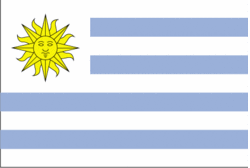 Uruguayan national flag (Flag of Uruguay)
 Uruguay country profile
 Travel advice for Uruguay
As for the Uruguayan climate; warm temperate; freezing temperatures almost unknown.
Uruguayan(s) speak Spanish, Portunol, or Brazilero (Portuguese-Spanish mix on the Brazilian frontier).
Places of note in Uruguay
- Montevideo
- Salto
- Paysandú
- Las Piedras
- Rivera
- Maldonado
- Tacuarembó
- Melo
- Mercedes
- Artigas
- Minas
- San José de Mayo
- Durazno
- Florida
- Treinta y Tres
- Rocha
- San Carlos
- Pando
- Fray Bentos
- Colonia del Sacramento
- Trinidad
- La Paz
- Canelones
- Delta del Tigre
- Carmelo
- Santa Lucía
- Progreso
- Young
- Dolores
- Paso de Carrasco
- Río Branco
- Juan L. Lacaze
- Paso de los Toros
- Bella Unión
- Chuy
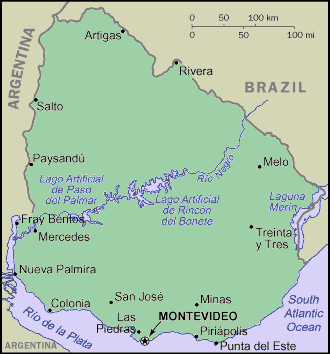 Uruguayan map
Regions of Uruguay
Montevideo, founded by the Spanish in 1726 as a military stronghold, soon took advantage of its natural harbor to become an important commercial center. Annexed by Brazil as a separate province in 1821, Uruguay declared its independence four years later and secured its freedom in 1828 after a three-year struggle. The administrations of President BATLLE in the early 20th century established widespread political, social, and economic reforms. A violent Marxist urban guerrilla movement named the Tupamaros, launched in the late 1960s, led Uruguay's president to agree to military control of his administration in 1973. By yearend, the rebels had been crushed, but the military continued to expand its hold throughout the government. Civilian rule was not restored until 1985. In 2004, the left-of-center EP-FA Coalition won national elections that effectively ended 170 years of political control previously held by the Colorado and Blanco parties. Uruguay's political and labor conditions are among the freest on the continent.
Uruguay's well-to-do economy is characterized by an export-oriented agricultural sector, a well-educated work force, and high levels of social spending. After averaging growth of 5% annually during 1996-98, in 1999-2002 the economy suffered a major downturn, stemming largely from the spillover effects of the economic problems of its large neighbors, Argentina and Brazil. For instance, in 2001-02 Argentina made massive withdrawals of dollars deposited in Uruguayan banks, which led to a plunge in the Uruguayan peso and a massive rise in unemployment. Total GDP in these four years dropped by nearly 20%, with 2002 the worst year due to the banking crisis. The unemployment rate rose to nearly 20% in 2002, inflation surged, and the burden of external debt doubled. Cooperation with the IMF helped stem the damage. A debt swap with private-sector creditors in 2003 extended the maturity dates on nearly half of Uruguay's then $11.3 billion of public debt and helped restore public confidence. The economy grew about 10% in 2004 as a result of high commodity prices for Uruguayan exports, a competitive peso, growth in the region, and low international interest rates, but slowed to 6.1% in 2005.
Uruguayan natural resources include arable land, hydropower, minor minerals, fisheries
second-smallest South American country (after Suriname); most of the low-lying landscape (three-quarters of the country) is grassland, ideal for cattle and sheep raising
Uruguayan religion is Roman Catholic 66% (less than half of the adult population attends church regularly), Protestant 2%, Jewish 1%, nonprofessing or other 31%.
Natural hazards in Uruguay include seasonally high winds (the pampero is a chilly and occasional violent wind that blows north from the Argentine pampas), droughts, floods; because of the absence of mountains, which act as weather barriers, all locations are particularly vulnerable to rapid changes from weather fronts.
Travel Advice for Uruguay
UruguaySUMMARY
- The risk of crime is generally low throughout Uruguay, but you should show greater awareness in and around Montevideo.
- The threat from terrorism is low. But you should be aware of the global risk of indiscriminate terrorist attacks which could be against civilian targets, including places frequented by foreigners.
- Around 13,000 British nationals visit Uruguay every year. Most visits are trouble-free. The main type of incident for which British nationals require consular assistance in Uruguay is the theft or loss of passports and other personal documents such as credit cards. You should carry photocopies of your passport and ensure that original documents are kept in a safe place. The majority of incidents occur in Montevideo.
- We strongly recommend that you obtain comprehensive travel and medical insurance before travelling. You should check any exclusions, and that your policy covers you for the activities you want to undertake. Please see: Travel Insurance
SAFETY AND SECURITY
Street crime exists in Montevideo, but is usually restricted to handbag snatching and pick-pocketing. Muggings and robberies (occasionally armed) do sometimes occur, but increased police patrols in Montevideo’s port and old town areas have helped reduce street crime. Where possible, you should consider keeping valuables in a hotel safe, and exercise caution when withdrawing money from ATMs.
Other parts of Uruguay, including Punta del Este, are considered relatively safe, but you are nevertheless advised to remain alert and take sensible precautions.
Political Situation
Uruguay is a stable multi-party democracy. There are no current, active threats to political stability.
Uruguay Country Profile
Road Safety
The standard of roads in Uruguay varies. The main toll road to Punta del Este is good and well marked. Elsewhere many roads are in reasonable condition while some are in poor condition and require drivers to take extra care.
Driving standards in Uruguay are not high. You should be aware that traffic is disorganised. Drivers often change lane and make unexpected turns without indicating. Stop signs, traffic lights and speed limits are frequently ignored.
If you are intending to drive in Uruguay you will require a valid UK or international driving license to hire a car.
Car crime is common in Montevideo. You should try to park in a well-lit area, always remembering to lock your car and avoid leaving luggage, personal documents and cash in the vehicle.
It is obligatory to use dipped headlights during the day when travelling on major roads outside cities. Extra care should be taken when driving at night.
ENTRY REQUIREMENTS
HEALTH
GENERAL