
 Search
Traveling Luck for Martinique. Martinique, North America
Martinique is located in Caribbean, island between the Caribbean Sea and North Atlantic Ocean, north of Trinidad and Tobago.
Land in Martinique is mountainous with indented coastline; dormant volcano.
Martiniquais land covers an area of 1100 square kilometers which is slightly more than six times the size of Washington, DC
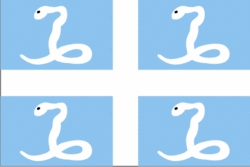 Martiniquais national flag (Flag of Martinique)
 Martinique country profile
 Travel advice for Martinique
As for the Martiniquais climate; tropical; moderated by trade winds; rainy season (June to October); vulnerable to devastating cyclones (hurricanes) every eight years on average; average temperature 17.3 degrees C; humid.
Martiniquais (singular and plural) speak French, Creole patois.
Places of note in Martinique
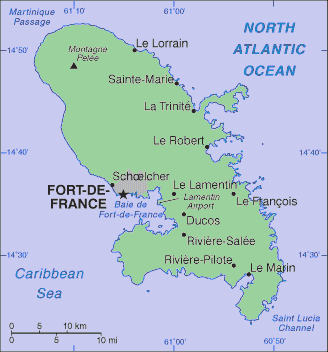 Martiniquais map
Regions of Martinique
Colonized by France in 1635, the island has subsequently remained a French possession except for three brief periods of foreign occupation.
The economy is based on sugarcane, bananas, tourism, and light industry. Agriculture accounts for about 6% of GDP and the small industrial sector for 11%. Sugar production has declined, with most of the sugarcane now used for the production of rum. Banana exports are increasing, going mostly to France. The bulk of meat, vegetable, and grain requirements must be imported, contributing to a chronic trade deficit that requires large annual transfers of aid from France. Tourism, which employs more than 11,000 people, has become more important than agricultural exports as a source of foreign exchange.
Martiniquais natural resources include coastal scenery and beaches, cultivable land
the island is dominated by Mount Pelee, which on 8 May 1902 erupted and completely destroyed the city of Saint Pierre, killing 30,000 inhabitants
Martiniquais religion is Roman Catholic 85%, Protestant 10.5%, Muslim 0.5%, Hindu 0.5%, other 3.5% (1997).
Natural hazards in Martinique include hurricanes, flooding, and volcanic activity (an average of one major natural disaster every five years).
Travel Advice for Martinique
MartiniqueSUMMARY
- Although the risk from crime is also low, it does exist and you should take normal commonsense precautions.
- Several thousand British nationals visit Martinique each year. Most visits to Martinique are trouble-free. The main type of incident for which British nationals require consular assistance in Martinique is for replacing lost passports and medical problems. The latter often involves British nationals being disembarked from cruise ships, or airlifted to Martinique from other islands. Please see the Health Section of this travel advice for more information.
- The hurricane season in Martinique normally runs from June to November. Occasional earth tremors also occur. Please see the Natural Disasters section of this Travel Advice and the Hurricanes for more information.
- The threat from terrorism is low. But you should be aware of the global risk of indiscriminate terrorist attacks which could be against civilian targets, including places frequented by foreigners.
- We strongly recommend that you obtain comprehensive travel and medical insurance before travelling to Martinique. You should check any exclusions, and that your policy covers you for the activities you want to undertake. Please see: Travel Insurance.
SAFETY AND SECURITY
You should take sensible precautions and avoid isolated areas, including beaches, after dark. Do not carry large amounts of cash or jewellery. Valuables and travel documents should, where possible, be left in safety deposit boxes and hotel safes.
ENTRY REQUIREMENTS
Single parents or other adults travelling alone with children should be aware that some countries require documentary evidence of parental responsibility before allowing lone parents to enter the country or, in some cases, before permitting the children to leave the country. For further information on exactly what will be required at immigration please contact the French Embassy in London, 58 Knightsbridge, London, SW1X 7JT; tel: 020 7073 1000; fax: 020 7073 1004; Website: http://www.ambafrance-uk.org.
HEALTH
The Form E111 is no longer valid. You should obtain a European Health Insurance Card (EHIC) before leaving the UK. The EHIC is not a substitute for medical and travel insurance, but entitles you to emergency medical treatment on the same terms as nationals of Martinique. You will not be covered for medical repatriation, on-going medical treatment or treatment of a non-urgent nature. For more information about how to obtain the EHIC please see: Europe and the EHIC
General health care facilities, including emergency services in health service general hospitals, and the availability of doctors (GPs) in Martinique, are very good andof an equivalent standard to those found in mainland France. Specialist treatment is also available.
You should seek medical advice before travelling and ensure that all appropriate vaccinations are up-to-date. For further information on health, check the Department of Health website at: www.dh.gov.uk
You should be aware that if you are coming from other islands (or being airlifted in an emergency) to Martinique for treatment that such treatment will not necessarily be covered.
NATURAL DISASTERS
The hurricane season in Martinique normally runs from June to November. You should monitor local and international weather updates from the World Meteorological Organisation. You can also access the National Hurricane Centre website at: http://www.nhc.noaa.gov/ for updates. Please also see Hurricanes for more detailed information and what to do if you are caught up in a hurricane.
Martinique also has occasional earth tremors, but they rarely result in any damage. The Montagne Pelée volcano is dormant; it is monitored by a local observatory and there would be warning well in advance from the local authorities of any imminent volcanic activity.
GENERAL
There is no resident British Diplomatic Mission in Martinique. Routine consular matters are covered by the British Embassy in Paris. In case of emergency, contact the Honorary British Consul in Martinique, 96 Route du Phare, 97200 Fort-de-France, Martinique; (tel: +596 618892; fax: +596 613389).