
 Search
Traveling Luck for Jamaica. Jamaica, North America
Jamaica is located in Caribbean, island in the Caribbean Sea, south of Cuba.
Land in Jamaica is mostly mountains, with narrow, discontinuous coastal plain.
Jamaican land covers an area of 10991 square kilometers which is slightly smaller than Connecticut
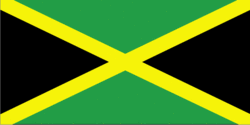 Jamaican national flag (Flag of Jamaica)
 Jamaica country profile
 Travel advice for Jamaica
As for the Jamaican climate; tropical; hot, humid; temperate interior.
Jamaican(s) speak English, patois English.
Places of note in Jamaica
- Kingston
- New Kingston
- Spanish Town
- Portmore
- Montego Bay
- Mandeville
- May Pen
- Old Harbour
- Linstead
- Half Way Tree
- Bog Walk
- Constant Spring
- Ewarton
- Hayes
- Ocho Rios
- Morant Bay
- Stony Hill
- Santa Cruz
- Old Harbour Bay
- Port Maria
- Falmouth
- Yallahs
- Bull Savanna
- Runaway Bay
- Lucea
- Porus
- Lionel Town
- Point Hill
- Seaforth
- Sandy Bay
- Chapelton
- Bamboo
- Black River
- Anchovy
- Riversdale
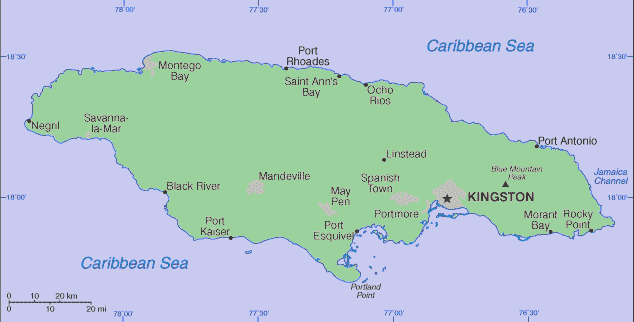 Jamaican map
Regions of Jamaica
Jamaica gained full independence within the British Commonwealth in 1962. Deteriorating economic conditions during the 1970s led to recurrent violence and a drop off in tourism. Elections in 1980 saw the democratic socialists voted out of office. Political violence marred elections during the 1990s.
The Jamaican economy is heavily dependent on services, which now account for 60% of GDP. The country continues to derive most of its foreign exchange from remittances, tourism, and bauxite/alumina. The global economic slowdown, particularly after the terrorist attacks in the US on 11 September 2001, stunted economic growth; the economy rebounded moderately in 2003-04, with brisk tourist seasons. But the economy faces serious long-term problems: high interest rates, increased foreign competition, exchange rate instability, a sizable merchandise trade deficit, large-scale unemployment and underemployment, and a growing stock of internal debt - the result of government bailouts to ailing sectors of the economy, most notably the financial sector in the mid-1990s. The ratio of debt to GDP is 135%. Inflation, previously a bright spot, is expected to remain in the double digits. Uncertain economic conditions have led to increased civil unrest, including gang violence fueled by the drug trade. In 2004, the government faced the difficult prospect of having to achieve fiscal discipline in order to maintain debt payments while simultaneously attacking a serious and growing crime problem that is hampering economic growth. Attempts at deficit control were derailed by Hurricane Ivan in September 2004, which required substantial government spending to repair the damage. Despite the hurricane, tourism looks set to enjoy solid growth for the foreseeable future.
Jamaican natural resources include bauxite, gypsum, limestone
strategic location between Cayman Trench and Jamaica Channel, the main sea lanes for the Panama Canal
Jamaican religion is Protestant 61.3% (Church of God 21.2%, Seventh-Day Adventist 9%, Baptist 8.8%, Pentecostal 7.6%, Anglican 5.5%, Methodist 2.7%, United Church 2.7%, Jehovah's Witness 1.6%, Brethren 1.1%, Moravian 1.1%), Roman Catholic 4%, other including some spiritual cults 34.7%.
Natural hazards in Jamaica include hurricanes (especially July to November).
Travel Advice for Jamaica
JamaicaSUMMARY
- You should be aware that there are high levels of crime and violence, particularly in the Kingston area and tourists should avoid certain routes.
- The threat from terrorism is low. But you should be aware of the global risk of indiscriminate attacks which could be against civilian targets, including places frequented by foreigners.
- Most visits to Jamaica are trouble-free. However, the main types of incident for which British nationals require consular assistance are for replacing lost and stolen passports and arrests for drugs-related offences.
- Since December 2006, over 200 malaria cases have been confirmed in Kingston and St Catherine. Cases have been notified in the Denham Town, Trench Town, Tivoli Gardens and Delacree Park districts of Kingston. Before travelling you should seek medical advice about the malaria risk in Jamaica and take precautions to avoid being bitten whilst there. More information can be found on the National Travel Health Network and Centre website at http://www.nathnac.org.
- The hurricane season in Jamaica normally runs from June to November. Please see the Natural Disasters section of this Travel Advice and Hurricanes.
- If you are travelling to Jamaica for the ICC Cricket World Cup, which runs from 11 March to 28 April 2007, with warm-up games in the region beginning on 5 March 2007, you should see ICC Cricket World Cup 2007 for general advice you may need before you travel. The General section of this travel advice also gives you more details.
- If you intend to remain in Jamaica for more than three months you are encouraged to register with the British High Commission.
- We strongly recommend that you obtain comprehensive travel and medical insurance before travelling. You should check any exclusions, and that your policy covers you for the activities you want to undertake. Please see: Travel Insurance.
SAFETY AND SECURITY
In view of the high levels of crime and violence including kidnapping, you should follow these common sense guidelines:
Some of those returning to resettle permanently in Jamaica have been the target of particular criminal attention. Incidents of violence, including murder have resulted. It is therefore particularly important to seek the advice and assurance of the Jamaican authorities, through: Jamaican Representation in London. For Jamaicans returning to live in Jamaica, there is a local Returning Residents Association that offers advice.
You should still maintain vigilance even when staying with family or friends.
In the event of an emergency, call 119 for police and 110 for an ambulance.
Political Situation
Jamaica Country Profile
Road Safety
Tourists are advised to use Jamaica Tourist Board (JTB) approved taxis or minibuses for excursions, airport transfers and sightseeing. Do not hail taxis in the street. Most hotels and resorts have assigned JTB drivers who carry photo ID and display a prominent blue JTB sticker on the front windscreen.
LOCAL LAWS AND CUSTOMS
Contrary to popular myth, it is illegal to smoke ganja in Jamaica. The local police have stepped up their efforts to clamp down on the practice. Several British Nationals have been arrested, fined and even imprisoned for this offence.
Jamaica has a number of laws which make certain homosexual acts illegal. The attitude of many Jamaicans to homosexuality is hostile.
ENTRY REQUIREMENTS
HEALTH
Medical treatment can be expensive. Private medical facilities are of a reasonable standard but can vary throughout the island.
HIV/AIDs is prevalent in Jamaica and you should take precautions to avoid exposure.
For further information on health, check the Department of Health’s website at: www.dh.gov.uk.
NATURAL DISASTERS
The hurricane season in Jamaica normally runs from June to November. You should monitor local and international weather updates from the World Meteorological Organisation. You can also access the US National Hurricane Centre for updates. Please also see: Hurricanes for more detailed information about what to do if you are caught up in a hurricane.
GENERAL