
 Search
Traveling Luck for Grenada. Grenada, North America
Grenada is located in Caribbean, island between the Caribbean Sea and Atlantic Ocean, north of Trinidad and Tobago.
Land in Grenada is volcanic in origin with central mountains.
Grenadian land covers an area of 344 square kilometers which is twice the size of Washington, DC
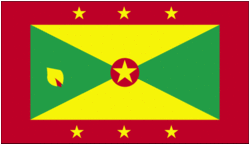 Grenadian national flag (Flag of Grenada)
 Grenada country profile
 Travel advice for Grenada
As for the Grenadian climate; tropical; tempered by northeast trade winds.
Grenadian(s) speak English (official), French patois.
Places of note in Grenada
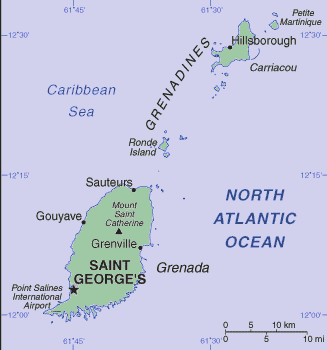 Grenadian map
Regions of Grenada
Carib Indians inhabited Grenada when Columbus discovered the island in 1498, but it remained uncolonized for more than a century. The French settled Grenada in the 17th century, established sugar estates, and imported large numbers of African slaves. Britain took the island in 1762 and vigorously expanded sugar production. In the 19th century, cacao eventually surpassed sugar as the main export crop; in the 20th century, nutmeg became the leading export. In 1967, Britain gave Grenada full autonomy over its internal affairs. Full independence was attained in 1974 making Grenada one of the smallest independent countries in the Western Hemisphere. Grenada was seized by a Marxist military council on 19 October 1983. Six days later the island was invaded by US forces and those of six other Caribbean nations, which quickly captured the ringleaders and their hundreds of Cuban advisers. Free elections were reinstituted the following year and have continued since that time. On 7 September 2004, Hurricane Ivan struck Grenada directly causing damage to over 85% of the structures on the island and at least 39 deaths.
Grenada relies on tourism as its main source of foreign exchange, especially since the construction of an international airport in 1985. Strong performances in construction and manufacturing, together with the development of an offshore financial industry, have also contributed to growth in national output.
Grenadian natural resources include timber, tropical fruit, deepwater harbors
the administration of the islands of the Grenadines group is divided between Saint Vincent and the Grenadines and Grenada
Grenadian religion is Roman Catholic 53%, Anglican 13.8%, other Protestant 33.2%.
Natural hazards in Grenada include lies on edge of hurricane belt; hurricane season lasts from June to November.
Travel Advice for Grenada
GrenadaSUMMARY
- Hurricanes Ivan and Emily caused considerable damage to Grenada in 2004 and 2005 respectively. Some reconstruction of private homes, official buildings and other facilities are still to be completed. Most hotels are now fully operational but you should check with your tour operator/hotelier/host before travelling to see if their facilities remain affected.
- The hurricane season in Grenada normally runs from June to November. Please see the Natural Disasters section of this Travel Advice and the Hurricanes for more information.
- The threat from terrorism is low. But you should be aware of the global risk of indiscriminate terrorist attacks, which could be against civilian targets, including places frequented by foreigners.
- Most visits to Grenada, Carriacou and Petite Martinique are trouble-free. The main type of incident for which British nationals require consular assistance is for replacing lost and stolen passports. You should not become complacent about safety and security. Cases of robbery and other crimes against people occur.
- If you are travelling to Grenada for the ICC Cricket World Cup, which runs from 11 March to 28 April 2007, with warm-up games in the region beginning on 5 March 2007, you should see the FCO’s ICC Cricket World Cup 2007 for general advice you may need before you travel.
- We strongly recommend that you obtain comprehensive travel and medical insurance before travelling. You should check any exclusions, and that your policy covers you for activities you want to undertake. Please see: Travel Insurance
SAFETY AND SECURITY
You should take sensible precautions and be vigilant at all times. Avoid isolated areas, including beaches, after dark. Do not carry large amounts of cash or jewellery. Valuables and travel documents should be left, where possible, in safety deposit boxes and hotel safes.
Political Situation
Local Travel
Mini-bus, water taxi and ferry services are operating.
Carriacou & Petite Martinique
The islands of Carriacou and Petite Martinique were affected by Hurricane Emily in 2005 but life on these islands has largely returned to normal; hotels and guesthouses are open for business. Diving schools and marine facilities are all operating normally. You are advised to check with your hosts or hotel management for details of the facilities available. Ferry and air services to Carriacou and Petite Martinique are operating normally.
Road Safety
Motorists drive on the left in Grenada. Driving standards in Grenada are not as high as in the UK and you need to be tolerant of the more relaxed attitude to the rules of the road of many Grenadian drivers. In some areas, there is debris at the side of roads; extra care is needed to negotiate potential hazards to tyres and bodywork. Take particular care at pedestrian crossings, traffic lights and roundabouts even if you think you have the right of way. Use only designated bus stops to ride the local mini buses; the practice of flagging down buses on busy roads is responsible for many accidents. Many roads are steep, with hairpin bends and potholes in places; drive slowly and vigilantly.
Mini bus services are operating throughout the island, which provide relatively cheap and fast (often dangerously so) travel within Grenada. Standard taxi fares exist for most destinations but it is sensible to clarify the fare with the driver before beginning a journey. Self-drive cars can be hired locally. Given the steepness of many roads in the mountainous hinterland, automatic four-wheel drive vehicles are popular, particularly following the damage to many roads caused by the Hurricanes. You are required to purchase a local driving permit (East Caribbean Dollars 30 for a three-month permit) and will need to produce a full UK driving licence to obtain one.
LOCAL LAWS AND CUSTOMS
ENTRY REQUIREMENTS
HEALTH
The dengue mosquito is found throughout Grenada. You should take normal precautions against mosquito bites, including the use of insect repellent during daylight hours and after sunset.
You should be aware of the high prevalence of the HIV/AIDS virus and take precautions to avoid exposure to it in the Caribbean region.
You should seek medical advice before travelling and ensure that all appropriate vaccinations are up to date. For further information on health, check the Department of Health’s website at www.dh.gov.uk.
NATURAL DISASTERS
The hurricane season in Grenada normally runs from June to November. You should monitor local and international weather updates from the World Meteorological Organisation. You can also access the National Hurricane Centre for updates. Please also see Hurricanes for more detailed information about what to do if you are caught up in a hurricane.
Hurricane Emily caused some damage in 2005, particularly in the northern half of Grenada and on the islands of Carriacou and Petite Martinique. Tourist facilities are fully functioning on all islands; hotels and guesthouses are open for business. You are advised to check with your hosts or hotel management for details of the facilities available.
Hurricane Ivan, which passed directly over Grenada in 2004, caused serious damage across the island. Many facilities are operating normally but not all infrastructure has been fully rebuilt. If you are travelling to Grenada you should check before departure with your airline/travel agent/host/tour operator or hotelier for current advice on travel and the facilities available to visitors. Cruise ship operators are visiting Grenada as normal.
You are advised to follow the advice of hosts or hotel management during your stay.
GENERAL
Keep a copy of the photopage of your passport and relevant entry stamp in case your documents are lost or stolen.
If you are on a package holiday, you must travel on the specified return date. If you fail to do so it is likely that you will have to pay the cost of a return ticket yourself.
You will have to pay a departure tax when leaving Grenada. In June 2005 this tax stood at East Caribbean Dollars 50 per person (can be paid in US$20).
In the event of loss of your passport, you will need to apply to the Passport Office at the British High Commission, Barbados for a replacement. The Office of the British High Commission in Grenada can advise you how to do this. Urgent applications can be speeded up if you pay courier costs, but even so, the issue of a replacement passport could still take up to ten working days.
In cases of genuine emergency, the Office of the British High Commission in Grenada may be able to issue an Emergency Passport valid for a single journey back to the UK.