
 Search
Traveling Luck for Greenland. Greenland, North America
Greenland is located in Northern North America, island between the Arctic Ocean and the North Atlantic Ocean, northeast of Canada.
Land in Greenland is flat to gradually sloping icecap covers all but a narrow, mountainous, barren, rocky coast.
Greenlandic land covers an area of 2166086 square kilometers which is slightly more than three times the size of Texas
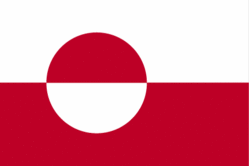 Greenlandic national flag (Flag of Greenland)
 Greenland country profile
As for the Greenlandic climate; arctic to subarctic; cool summers, cold winters.
Greenlander(s) speak Greenlandic (East Inuit), Danish, English.
Places of note in Greenland
- Godthåb
- Holsteinsborg
- Ilulissat
- Julianehåb
- Egedesminde
- Sukkertoppen
- Frederikshåb
- Tasiilaq
- Narsaq
- Nanortalik
- Christianshåb
- Upernavik
- Qeqertarsuaq
- Kangaatsiaq
- Qaanaaq
- Scoresbysund
- Kullorsuaq
- Kangaamiut
- Sydprøven
- Niaqornaarsuk
- Kulusuk
- Dundas
- Ikerasak
- Attu
- Qeqertarsuatsiaat
- Atammik
- Tasiusaq
- Kangersuatsiaq
- Pituffik
- Sermiligaaq
- Saattut
- Aappilattoq
- Søndre Upernavik
- Qaarsut
- Ukkusissat
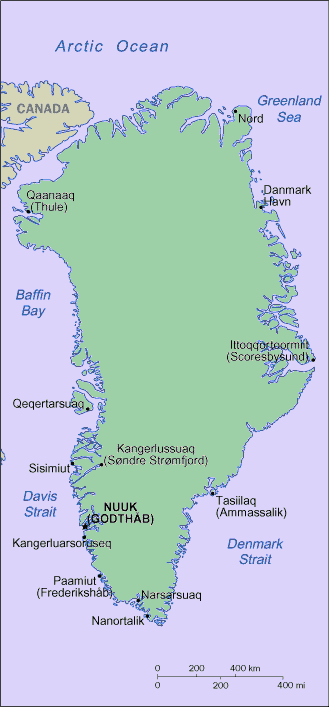 Greenlandic map
Regions of Greenland
Greenland, the world's largest island, is about 81% ice-capped. Vikings reached the island in the 10th century from Iceland; Danish colonization began in the 18th century, and Greenland was made an integral part of Denmark in 1953. It joined the European Community (now the EU) with Denmark in 1973 but withdrew in 1985 over a dispute over stringent fishing quotas. Greenland was granted self-government in 1979 by the Danish parliament. The law went into effect the following year. Denmark continues to exercise control of Greenland's foreign affairs.
The economy remains critically dependent on exports of fish and substantial support from the Danish Government, which supplies about half of government revenues. The public sector, including publicly-owned enterprises and the municipalities, plays the dominant role in the economy. Despite several interesting hydrocarbon and mineral exploration activities, it will take a number of years before production can materialize. Tourism is the only sector offering any near-term potential, and even this is limited due to a short season and high costs.
Greenlandic natural resources include coal, iron ore, lead, zinc, molybdenum, gold, platinum, uranium, fish, seals, whales, hydropower, possible oil and gas
dominates North Atlantic Ocean between North America and Europe; sparse population confined to small settlements along coast, but close to one-quarter of the population lives in the capital, Nuuk; world's second largest ice cap
Greenlandic religion is Evangelical Lutheran.
Natural hazards in Greenland include continuous permafrost over northern two-thirds of the island.