The native Amerindian population of Cuba began to decline after the European discovery of the island by Christopher COLUMBUS in 1492 and following its development as a Spanish colony during the next several centuries. Large numbers of African slaves were imported to work the coffee and sugar plantations, and Havana became the launching point for the annual treasure fleets bound for Spain from Mexico and Peru. Spanish rule, marked initially by neglect, became increasingly repressive, provoking an independence movement and occasional rebellions that were harshly suppressed. It was US intervention during the Spanish-American War in 1898 that finally overthrew Spanish rule. The subsequent Treaty of Paris established Cuban independence, which was granted in 1902 after a three-year transition period. Fidel CASTRO led a rebel army to victory in 1959; his iron rule has held the regime together since then. Cuba's Communist revolution, with Soviet support, was exported throughout Latin America and Africa during the 1960s, 1970s, and 1980s. The country is now slowly recovering from a severe economic recession in 1990, following the withdrawal of former Soviet subsidies, worth $4 billion to $6 billion annually. Cuba portrays its difficulties as the result of the US embargo in place since 1961. Illicit migration to the US - using homemade rafts, alien smugglers, air flights, or via the southwest border - is a continuing problem. The US Coast Guard intercepted 2,712 individuals attempting to cross the Straits of Florida in fiscal year 2005.
The government continues to balance the need for economic loosening against a desire for firm political control. It has rolled back limited reforms undertaken in the 1990s to increase enterprise efficiency and alleviate serious shortages of food, consumer goods, and services. The average Cuban's standard of living remains at a lower level than before the downturn of the 1990s, which was caused by the loss of Soviet aid and domestic inefficiencies. The government in 2005 strengthened its controls over dollars coming into the economy from tourism, remittances, and trade. External financing has helped growth in the mining, oil, construction, and tourism sectors.
Cuban natural resources include cobalt, nickel, iron ore, chromium, copper, salt, timber, silica, petroleum, arable land
largest country in Caribbean and westernmost island of the Greater Antilles
Cuban religion is nominally 85% Roman Catholic prior to CASTRO assuming power; Protestants, Jehovah's Witnesses, Jews, and Santeria are also represented.
Natural hazards in Cuba include the east coast is subject to hurricanes from August to November (in general, the country averages about one hurricane every other year); droughts are common.
Travel Advice for Cuba
CubaThis advice has been reviewed and reissued with amendments to the Summary, Crime section (stabbing in Havana), Road Safety section (insurance), Health, General and Contact details sections. The overall level of the advice has not changed.
SUMMARY
- Most visits to Cuba are trouble free, but crime is on the increase. The most common problems are from opportunist theft and loss of travel bags, handbags, etc containing passports and funds. It is advisable not to keep all your funds in the same place and to have a photocopy of your passport.
- The majority of requests for consular assistance from the British Embassy arise from difficulties using debit/credit/cashpoint cards and exchanging certain currencies. The simplest way to avoid this is by taking Sterling or Euro travellers’ cheques as US dollars are no longer legal tender in Cuba. Please see the General section of this travel advice for more details.
- You must pay an airport departure tax of 25 Convertible Pesos (CUCs) per person when leaving Cuba. This must be paid in local currency.
- The hurricane season in Cuba normally runs from June to November. Please see Natural Disasters section of this Travel Advice and Hurricanes.
- In view of serious accidents that have involved tourists, you should not use mopeds or three-wheel Coco-Taxis for travel around Cuba.
- The threat from terrorism is low. But you should be aware of the global risk of indiscriminate terrorist attacks, which could be against civilian targets, including places frequented by foreigners.
- We strongly recommend that you obtain comprehensive travel and medical insurance before travelling. You should check any exclusions, and that your policy covers you for the activities you want to undertake. Please see: Travel Insurance.
SAFETY AND SECURITY
The threat from terrorism is low. But you should be aware of the global risk of indiscriminate terrorist attacks, which could be against civilian targets, including places frequented by foreigners. In 1997, Miami-based Cuban exiles launched a short-lived bombing campaign against the Cuban tourist industry. An Italian tourist was killed and other tourists injured, following a bomb that exploded in one of Havana's main hotels. The Cuban authorities say they arrested Miami-based Cuban exiles entering Cuba with intent to attack tourist sites in early 2001.
Please read "Security and General Tips" and "Risk of Terrorism when Travelling Overseas" pages" for further information and advice.
Crime
In December 2006, a British tourist was stabbed in Havana. The non-fatal stabbing took place as the victim was being mugged in the early evening in the Vedado area of Havana. In October 2005 in Havana there were two incidents of robberies from foreign nationals by violence and stabbing. One stabbing was fatal the other was superficial. These attacks took place in the early hours in Centro Havana. You should take all necessary precautions if you are in Centro Havana at night. You should take a taxi to your accommodation rather than walk, even if your accommodation is only a few blocks away.
Crime is on the increase. Theft from luggage during baggage handling, both on arrival and departure, is common. You should remove all valuables, lock suitcases and have them shrink-wrapped before check-in.
There are a small number of bogus tour agents/taxis operating at the airports and around old Havana. You should not travel with anyone other than your recognised tour operator. If you need to take a taxi, ensure it is a registered one and not a private vehicle. There have been a number of attempted robberies from vehicles on the Havana airport road; keep doors and boots locked and do not stop other than at traffic lights.
Car-related crime and mugging incidents are increasing, not only in Havana but Santiago and other areas less frequented by tourists. There have been attacks on foreigners using hire cars after staged punctures and by bogus hitch-hikers. Do not pick people up; if you get a puncture in a lonely spot, drive on several kilometres preferably to a town, before stopping.
Beware of pickpockets and bag-snatchers, especially in the area of Old Havana, on buses/trains, at major tourist sites and in nightclubs. Don’t carry large amounts of cash when away from your hotel; avoid wearing ostentatious/expensive jewellery; leave travellers' cheques, credit cards, passports and other important documents in a safe deposit or similar at your hotel. If you pick up hitchhikers, ensure you have no valuables or important documentation temptingly within reach. You should carry a copy of your passport and not the original, which should be locked away with other valuables.
Beware of thefts from rooms, particularly in private guesthouses (‘casas particulares’).
Political Situation
Cuba Country Profile
On 31 July 2006, President Fidel Castro underwent surgery and handed over provisional power to his brother Raul Castro. The political situation remains calm at present but you should take extra care and avoid political gatherings.
Cuba is a one-party state. There is a high level of social control and a strong police presence. There are widespread restrictions on freedom of speech, association and assembly for Cuban nationals. Political demonstrations or gatherings not sanctioned by the government may be broken up and should be avoided. The Cuban government discourages Cubans working in the tourist industry from developing personal relationships or accepting gifts from foreign nationals. The Government is however clear that it continues to welcome British tourists, and there has been no hostility shown to individual British visitors.
Road Safety
A valid UK driving licence is required to drive and/or rent a car in Cuba. If you decide to rent a car in Cuba, you should ensure that the insurance which is provided with the car includes local third party insurance cover. All drivers and passengers of motorcycles and scooters are required by law to wear a crash helmet.
In view of serious accidents that have involved tourists, you should not use mopeds or three wheel Coco-Taxis for travel around Cuba.
Driving standards are variable. Many vehicles, including public transport, suffer from lack of maintenance and roads are poorly lit and sign-posted. Beware of cyclists, potholes and cars that stop without warning to pick up hitchhikers.
You should avoid driving by night; animals, unlit vehicles and other hazards are a real danger.
The Cuban police are cracking down on drink driving.
If you have a traffic accident where someone is killed or injured, the police investigation may take several months during which time the driver will normally not be allowed to leave Cuba. There is no guarantee that criminal compensation payments will be made. If convicted of killing someone in a road traffic accident, the standard punishment is at least 2 years in jail. If the worst happens and you do have a serious accident, you should contact the British Embassy as soon as possible.
Air Safety
There were attempts in 2003 to leave the country by hijacking internal passenger transport. The Cuban Authorities are known to restrict the amount of fuel on aircraft on internal flights to prevent such incidents.
There was a fatal air crash involving tourists in 2002; taken with concerns about standards of maintenance of public transport we recommend against internal air travel unless on flights recommended by or operated on behalf of recognised international tour operators.
LOCAL LAWS AND CUSTOMS
Cuba is increasingly being used as a transit country for drugs destined for Europe. Cuban law allows for the death penalty and courts are handing out very severe penalties (in excess of twenty years) for all drugs related offences. Pack all your luggage yourself and don’t carry any items that do not belong to you.
Cuba prohibits the import of all meat products. The import of fruit is normally banned too. If you arrive in Cuba with any of the above you will have your goods confiscated and destroyed on arrival.
Electrical items with heavy power consumption such as travel irons and kettles may also be confiscated and returned upon departure.
Avoid military zones and other restricted areas that are not always well sign-posted. Be particularly careful when taking photographs or video film.
The Cuban Authorities take a serious view of any breach of their immigration rules, in some cases those who overstay are detained by Immigration on departure and held in custody until reports are received on their activities whilst in the country.
Acceptance of gay relationships is more widespread than in the past. However, there are few places where gays can socialise openly and same-sex couples - particularly if one partner is Cuban - should be careful about public displays of affection, which can lead to unwelcome attention from the police and local authorities.
ENTRY REQUIREMENTS
All British nationals require a visa to enter Cuba. You need a visa before you travel and you should contact the Cuban Embassy in London for further information on entry requirements in good time the Cuban Embassy in London: Cuban diplomatic representation in the UK. You should get the correct visa for the purpose of your visit. As well as tourist visas, there are other visa categories for different types of visitors.
Dual nationals must contact the Cuban Embassy in London Cuban diplomatic representation in the UK for advice on entry requirements before travelling.
HEALTH
We strongly recommend that you obtain comprehensive travel and medical insurance before travelling. This should cover medical evacuation by air ambulance. You should check any exclusions, and that your policy covers you for the activities you want to undertake. Please see: Travel Insurance.
The medical facilities in Havana are better than those elsewhere in the country, but it is sometimes necessary for those requiring urgent specialist care to be medically evacuated at significant cost. If you require medical treatment you will be expected to pay in hard currency; a basic hospital stay can cost as much as £200 per day plus medical expenses.
Many medicines are unavailable in Cuba so you should bring any prescription drugs you take regularly. A copy of the prescription and a letter from your doctor explaining your condition can be helpful at customs.
Though most of the more serious tropical diseases are rare in Cuba, viral meningitis and dengue fever do occasionally break out both in Havana and in other provinces of Cuba. In August and September 2006, there was an increase in the number of dengue fever cases reported in Cuba. The Cuban authorities are taking measures to eradicate the Aedes aegypti mosquito which transmits the disease to humans. There is no vaccine to protect against dengue fever and you should therefore use mosquito repellent regularly and cover up with suitable clothing to avoid being bitten. Symptoms of dengue fever usually begin 7 to 10 days after being bitten and include high fever with aching joints and bones and a headache. If you develop these symptoms you should consult a doctor.
The HIV/AIDS virus is less acutely prevalent in Cuba than in other parts of the Caribbean. Nonetheless, you should continue to take sensible precautions to avoid exposure to it.
You should seek medical advice before travelling and ensure that all appropriate vaccinations are up to date. For further information on health, check the Department of Health’s website at: www.dh.gov.uk
NATURAL DISASTERS
Visitors to Cuba should keep in close touch with their travel operators and should also follow the advice of the Cuban authorities who are actively monitoring the situation.
The hurricane season in Cuba normally runs from June to November. You should monitor local and international weather updates from the World Meteorological Organisation. You can also access the National Hurricane Centre at: http://www.nhc.noaa.gov/ for updates. Please also see Hurricanes for more detailed information about what to do if you are caught up in a hurricane.
Good warning is given and due precautions must be taken but in the aftermath power, communications and water supplies can be disrupted for a week or more. Even in holiday resorts, utility services cannot be constantly guaranteed. Damage to infrastructure in affected areas can take some time to be repaired. In the event of extreme weather conditions flights to and from Cuba could be delayed or cancelled.
2005 was a record year for the number of hurricanes in the region. Two hurricanes caused severe damage to parts of Cuba during 2005. Hurricane Dennis passed over Cuba on 9 July 2005, causing damage across much of the island and in October 2005, Hurricane Wilma brought severe flooding to the streets of Havana and other areas on the northern coastline of the island.
GENERAL
If things go wrong when overseas, please see: What We Can Do To Help
Baby food, disposable nappies etc are patchily available in Havana and normally unavailable in the rest of Cuba; if you are bringing a baby it is best to come self-sufficient.
Keep a copy of the photo page of your passport in case your documents are stolen.
Money
You should check with your bank before you leave the UK to confirm that your debit/credit/cashpoint cards will work and will be accepted in Cuba. If your bank cannot confirm this then you should bring suitable Sterling or Euro alternatives, preferably in the form of travellers’ cheques. You should also be aware that there are virtually no cash-points available for drawing cash against Cirrus or Switch cards in Cuba. You should also be aware that Scottish and Northern Irish bank notes/coins cannot be exchanged in Cuba.
US Dollars are no longer accepted in Cuba, and you will be charged 10% commission to exchange them. The central bank re-valued the Cuban Convertible Peso (CUC) in March 2005. This no longer operates at 1-1 with the US dollar and has its own exchange rate. Following this revaluation, credit card transactions, including cash withdrawals from ATM machines, are subject to local commission charges of between 11%-13%.
American Express travellers' cheques are no longer accepted in Cuba. Travellers' cheques and/or credit cards drawn on all other American banks are also not accepted in Cuba.
An airport departure tax (per person) of 25 convertible pesos (CUCs) must be paid on departure for all international flights and must be paid in local currency.
The wider use of the convertible pesos (CUC) to include the tourist industry has inevitably meant an increase in the number of forged CUC banknotes of all denominations but in particular $100.00. You are strongly advised not to change money anywhere than at the airport Cadecas, hotel exchange bureaux or banks. Individuals offering exchange facilities to avoid queues should be avoided, and where possible small denomination bills should be requested.

 Search
 Cuban national flag (Flag of Cuba)
 Cuba country profile
 Travel advice for Cuba
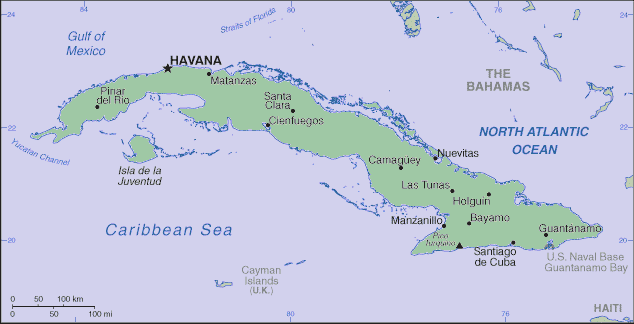 Cuban map