
 Search
Traveling Luck for Bahamas. Bahamas, North America
The Bahamas is located in Caribbean, chain of islands in the North Atlantic Ocean, southeast of Florida, northeast of Cuba.
Land in The Bahamas is long, flat coral formations with some low rounded hills.
Bahamian land covers an area of 13940 square kilometers which is slightly smaller than Connecticut
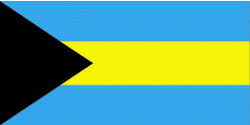 Bahamian national flag (Flag of Bahamas)
 Bahamas country profile
 Travel advice for Bahamas
As for the Bahamian climate; tropical marine; moderated by warm waters of Gulf Stream.
Bahamian(s) speak English (official), Creole (among Haitian immigrants).
Places of note in Bahamas
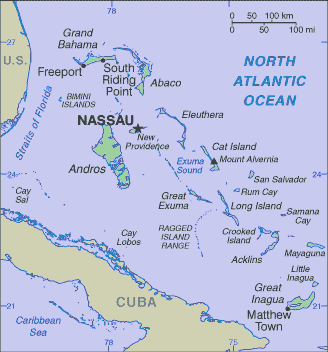 Bahamian map
Regions of Bahamas
- Acklins and Crooked Islands
- Bahamas, The (general)
- Bimini
- Cat Island
- Exuma
- Freeport
- Fresh Creek
- Governorʼs Harbour
- Green Turtle Cay
- Harbour Island
- High Rock
- Inagua
- Kemps Bay
- Long Island
- Marsh Harbour
- Mayaguana
- New Providence
- Nichollstown and Berry Islands
- Ragged Island
- Rock Sound
- Sandy Point
- San Salvador and Rum Cay
Arawak Indians inhabited the islands when Christopher Columbus first set foot in the New World on San Salvador in 1492. British settlement of the islands began in 1647; the islands became a colony in 1783. Since attaining independence from the UK in 1973, The Bahamas have prospered through tourism and international banking and investment management. Because of its geography, the country is a major transshipment point for illegal drugs, particularly shipments to the US, and its territory is used for smuggling illegal migrants into the US.
The Bahamas is a stable, developing nation with an economy heavily dependent on tourism and offshore banking. Tourism together with tourism-driven construction and manufacturing accounts for approximately 60% of GDP and directly or indirectly employs half of the archipelago's labor force. Steady growth in tourism receipts and a boom in construction of new hotels, resorts, and residences had led to solid GDP growth in recent years, but the slowdown in the US economy and the attacks of 11 September 2001 held back growth in these sectors in 2001-03. The current government has presided over a period of economic recovery and an upturn in large-scale private sector investments in tourism. Financial services constitute the second-most important sector of the Bahamian economy, accounting for about 15% of GDP. However, since December 2000, when the government enacted new regulations on the financial sector, many international businesses have left The Bahamas. Manufacturing and agriculture together contribute approximately a tenth of GDP and show little growth, despite government incentives aimed at those sectors. Overall growth prospects in the short run rest heavily on the fortunes of the tourism sector, which depends on growth in the US, the source of more than 80% of the visitors.
Bahamian natural resources include salt, aragonite, timber, arable land
strategic location adjacent to US and Cuba; extensive island chain of which 30 are inhabited
Bahamian religion is Baptist 35.4%, Anglican 15.1%, Roman Catholic 13.5%, Pentecostal 8.1%, Church of God 4.8%, Methodist 4.2%, other Christian 15.2%, none or unspecified 2.9%, other 0.8% (2000 census).
Natural hazards in The Bahamas include hurricanes and other tropical storms cause extensive flood and wind damage.
Travel Advice for Bahamas
BahamasSUMMARY
- There is no British High Commission in The Bahamas. For emergency consular assistance, please telephone (+1 242) 327 5309 or (+1 242) 357 9005. Alternatively contact the British High Commission in Kingston, Jamaica (details below).
- The hurricane season in the Bahamas normally runs from June to November. Please see the Natural Disasters section of this Travel Advice and Hurricanes for more information.
- Violent crime can be a problem. Much of this is within the local community, but tourists have been the victims of robbery, sometimes armed, particularly when alone or in isolated locations.
- Most visits to the Bahamas are trouble-free. However, the main type of incident for which British nationals require consular assistance is for replacing lost and stolen passports.
- The water sports industry in The Bahamas is very poorly regulated. In view of this and a number of fatal accidents, we advise you not to rent jet-skis in New Providence and Paradise Island unless you are experienced jet-ski users.
- The threat from terrorism is low. But you should be aware of the global risk of indiscriminate terrorist attacks which could be against civilian targets, including places frequented by foreigners.
- We strongly recommend that you obtain comprehensive travel and medical insurance before travelling. You should check any exclusions, and that your policy covers you for the activities you want to undertake. Please see: Travel Insurance.
SAFETY AND SECURITY
LOCAL LAWS AND CUSTOMS
ENTRY REQUIREMENTS
HEALTH
Medical treatment is of a good standard but can be expensive. Emergency medical facilities are limited on all the Family Islands and serious cases are transferred to Nassau, Freeport or Miami by air ambulance. You should ensure that your medical insurance covers the cost of air ambulance.
Before travelling you should seek medical advice about the malaria risk in The Bahamas and take precautions to avoid being bitten whilst there. You should promptly seek medical care in the event of a fever or flu-like illness in country or in the first year following your return from travelling to a malaria risk country. More information can be found on the National Travel Health Network and Centre NaTHNaC website..
You should also be aware of the prevalence of the HIV/AIDS virus in The Bahamas and take precautions to avoid exposure.
You should seek medical advice before travelling and ensure that all appropriate vaccinations are up to date. For further information on health, check the Department of Health's website at: www.dh.gov.uk.
NATURAL DISASTERS
The hurricane season in the Bahamas normally runs from June to November. You should monitor local and international weather updates from the World Meteorological Organisation. You can also access the National Hurricane Centre for updates. Please also see Hurricanes for more detailed information about what to do if you are caught up in a hurricane.
GENERAL
You should carry photocopies of your passport and travel insurance documents and keep the originals in a safe place.