World index ... Europe ... Vatican
Travelers word index

Vatican

Continents
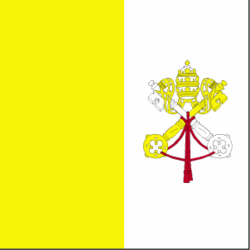
none flag

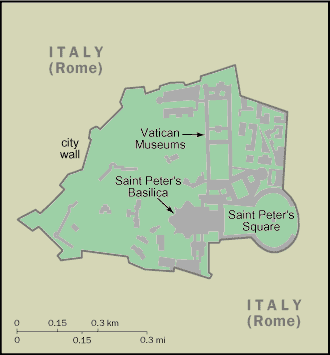
Holy See is located in Southern Europe, an enclave of Rome (Italy).

Vatican has borders with Italy for 3.2km.

Land in Holy See is urban; low hill.

none land covers an area of 0.44 square kilometers which is about 0.7 times the size of The Mall in Washington, DC

As for the none climate; temperate; mild, rainy winters (September to May) with hot, dry summers (May to September).

none speak Italian, Latin, French, various other languages.
Vatican country profile

none Map
Regions of Vatican
Vatican City (general)

Popes in their secular role ruled portions of the Italian peninsula for more than a thousand years until the mid 19th century, when many of the Papal States were seized by the newly united Kingdom of Italy. In 1870, the pope's holdings were further circumscribed when Rome itself was annexed. Disputes between a series of "prisoner" popes and Italy were resolved in 1929 by three Lateran Treaties, which established the independent state of Vatican City and granted Roman Catholicism special status in Italy. In 1984, a concordat between the Holy See and Italy modified certain of the earlier treaty provisions, including the primacy of Roman Catholicism as the Italian state religion. Present concerns of the Holy See include religious freedom, international development, the Middle East, terrorism, interreligious dialogue and reconciliation, and the application of church doctrine in an era of rapid change and globalization. About 1 billion people worldwide profess the Catholic faith.

Country profile: Vatican

Map of VaticanThe Vatican is the smallest independent state in the world and the residence of the spiritual leadership of the Roman Catholic church.

Pope John Paul II, who died in April 2005 after a 26-year pontificate, is succeeded by Pope Benedict XVI.

Pope John Paul II was in office at a time of tremendous upheaval in Eastern Europe, including his homeland of Poland.

St Peter's Square

He preached dialogue and reconciliation, between former political opponents and also between different religions. During a visit to Israel the Pope expressed sorrow for the history of anti-Semitism within the Catholic church.

He also sought to heal rifts with other churches within the Christian faith. Some of these moves have been successful, others not so.

But critics accused the Vatican's social policy of being out-of-step with modern reality.

They said Pope John Paul's strict conservative teaching on issues such as abortion and contraception - both of which he absolutely rejected - failed a sizeable majority of Catholics worldwide. They argued that his views disqualified the church from having any role in solutions to the problems facing hundreds of millions of believers.

Head of state: Pope Benedict XVI

Formerly Cardinal Joseph Ratzinger, Benedict XVI was elected pope in April 2005.

Pope Benedict XVI Already one of the Vatican's most powerful men, he presided over the funeral of his predecessor, Pope John Paul II, and was said to be among the late pontiff's closest friends.

He is regarded as an ultraconservative intellectual with rigorously uncompromising views on birth control, sexuality and euthanasia.

Pope Benedict was born in Bavaria in 1927 and is the oldest man to become pope in more than 100 years. He is the first German pope since the eleventh century.

Drafted into the German armed forces during World War II, he deserted as it drew to a close and was a prisoner of war in 1945. He has said that the brutality of the Nazis later helped lead him to the priesthood and in one of his first papal addresses he condemned the Holocaust.

He became cardinal of Munich in 1977.

  • Secretary of state: Cardinal Tarcisio Bertone
  • Secretary for relations with states: Bishop Dominique Mamberti

    Powerful transmitters beam Vatican Radio - "The Pope's Voice" - to a global audience. But the station has faced allegations that its transmissions have been putting lives at risk in a Rome suburb by exceeding Italy's electromagnetic radiation standards - claims the Vatican denies.

    The press

  • L'Osservatore Romano
  • Vatican Information Service

    Radio

  • Vatican Radio - inaugurated in 1931, broadcasts in many languages

    News agencies

  • Agenzia Fides
  • Missionary Service News Agency

    This unique, noncommercial economy is supported financially by an annual contribution from Roman Catholic dioceses throughout the world (known as Peter's Pence); by the sale of postage stamps, coins, medals, and tourist mementos; by fees for admission to museums; and by the sale of publications. Investments and real estate income also account for a sizable portion of revenue. The incomes and living standards of lay workers are comparable to those of counterparts who work in the city of Rome.

    none natural resources include none

    landlocked; enclave in Rome, Italy; world's smallest state; beyond the territorial boundary of Vatican City, the Lateran Treaty of 1929 grants the Holy See extraterritorial authority over 23 sites in Rome and five outside of Rome, including the Pontifical Palace at Castel Gandolfo (the Pope's summer residence)

    none religion is Roman Catholic.

    Natural hazards in Holy See include NA.


  • What is this world index all about?