World index ... Europe ... Ukraine
Travelers word index

Ukraine

Continents
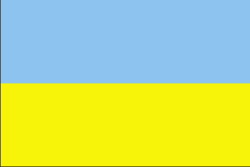
Ukrainian flag

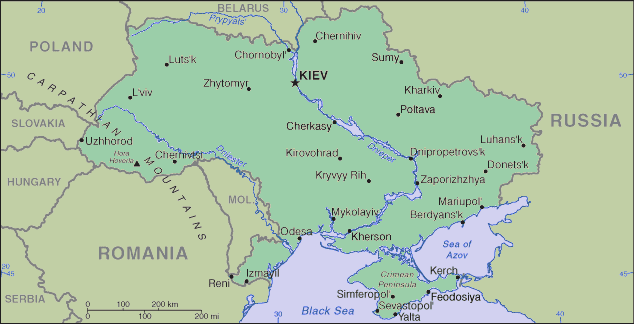
Ukraine is located in Eastern Europe, bordering the Black Sea, between Poland, Romania, and Moldova in the west and Russia in the east.

Ukraine has borders with Belarus for 891km, Hungary for 103km, Moldova for 939km, Poland for 526km, Romania for 531km, Russia for 1576km and Slovakia for 97km.
Land in Ukraine is most of Ukraine consists of fertile plains (steppes) and plateaus, mountains being found only in the west (the Carpathians), and in the Crimean Peninsula in the extreme south.

Ukrainian land covers an area of 603700 square kilometers which is slightly smaller than Texas

As for the Ukrainian climate; temperate continental; Mediterranean only on the southern Crimean coast; precipitation disproportionately distributed, highest in west and north, lesser in east and southeast; winters vary from cool along the Black Sea to cold farther inland; summers are warm across the greater part of the country, hot in the south.

Ukrainian(s) speak Ukrainian (official) 67%, Russian 24%, small Romanian-, Polish-, and Hungarian-speaking minorities.

Ukraine country profile, Travel advice for Ukraine

Ukrainian Map
Places of note in Ukraine
Київ
Kharkiv
Dnipropetrovs'k
Odesa
Zaporizhzhya
L'viv
Kryvyy Rih
Mykolayiv
Mariupol'-Port
Luhans'k
Makiyivka
Vinnytsya
Kherson
Poltava
Chernihiv
Cherkasy
Sumy
Zhytomyr
Horlivka
Rivne
Kirovohrad
Dniprodzerzhyns'k
Chernivtsi
Ternopil'
Kremenchuk
Luts'k
Bila Tserkva
Kerch
Berdyans'k
Uzhhorod
Pavlohrad
Lisichansk
Yevpatoriya
Konotop
Kostyantynivka
Regions of Ukraine
Cherkas'ka Oblast'
Chernihivs'ka Oblast'
Chernivets'ka Oblast'
Dnipropetrovs'ka Oblast'
Donets'ka Oblast'
Ivano-Frankivs'ka Oblast'
Kharkivs'ka Oblast'
Khersons'ka Oblast'
Khmel'nyts'ka Oblast'
Kirovohrads'ka Oblast'
Krym, Avtonomna Respublika
Kyyiv, Misto
Kyyivs'ka Oblast'
Luhans'ka Oblast'
L'vivs'ka Oblast'
Mykolayivs'ka Oblast'
Odes'ka Oblast
Poltavs'ka Oblast'
Rivnens'ka Oblast'
Sevastopol', Misto
Sums'ka Oblast'
Ternopil's'ka Oblast'
Ukraine (general)
Vinnyts'ka Oblast'
Volyns'ka Oblast'
Zakarpats'ka Oblast'
Zaporiz'ka Oblast'
Zhytomyrs'ka Oblast'

Ukraine was the center of the first Slavic state, Kievan Rus, which during the 10th and 11th centuries was the largest and most powerful state in Europe. Weakened by internecine quarrels and Mongol invasions, Kievan Rus was incorporated into the Grand Duchy of Lithuania and eventually into the Polish-Lithuanian Commonwealth. The cultural and religious legacy of Kievan Rus laid the foundation for Ukrainian nationalism through subsequent centuries. A new Ukrainian state, the Cossack Hetmanate, was established during the mid-17th century after an uprising against the Poles. Despite continuous Muscovite pressure, the Hetmanate managed to remain autonomous for well over 100 years. During the latter part of the 18th century, most Ukrainian ethnographic territory was absorbed by the Russian Empire. Following the collapse of czarist Russia in 1917, Ukraine was able to bring about a short-lived period of independence (1917-20), but was reconquered and forced to endure a brutal Soviet rule that engineered two artificial famines (1921-22 and 1932-33) in which over 8 million died. In World War II, German and Soviet armies were responsible for some 7 to 8 million more deaths. Although final independence for Ukraine was achieved in 1991 with the dissolution of the USSR, democracy remained elusive as the legacy of state control and endemic corruption stalled efforts at economic reform, privatization, and civil liberties. A peaceful mass protest "Orange Revolution" in the closing months of 2004 forced the authorities to overturn a rigged presidential election and to allow a new internationally monitored vote that swept into power a reformist slate under Viktor YUSHCHENKO. The new government presents its citizens with hope that the country may at last attain true freedom and prosperity.

Country profile: Ukraine

Map of UkraineUkraine gained independence after the collapse of the Soviet Union in 1991 and is bidding to consolidate its European credentials. Russia keeps a watchful eye on that process.

Western Ukraine has close historical ties with Europe, particularly Poland. Both Orthodoxy and the Uniate (Greek Catholic) faith have many followers there. Ukrainian nationalist sentiment is traditionally strongest in the westernmost parts of the country which became part of Ukraine only when the Soviet Union expanded after World War II.

A significant minority of the population of Ukraine are Russians or use Russian as their first language. Russian influence is particularly strong in the industrialised east of the country, where the Orthodox religion is predominant, as well as in Crimea, an autonomous republic on the Black Sea which was part of Russia until 1954. The Russian Black Sea Fleet has its base there.

Crimea is also the homeland of the Crimean Tatars whom Stalin accused of collaborating with the Nazis and deported to Central Asia in 1944. Over 250,000 have returned since the late 1980s.

Monument to victims of 1932-33 famine, Mykhailov Square, Kiev

In 1932-1933 Stalin's programme of enforced agricultural collectivisation brought famine and death to millions in Ukraine, the bread basket of the USSR. Not until the twilight years of the Soviet Union did details of the extent of the suffering begin fully to emerge.

News of another Soviet-era calamity, the 1986 accident at the Chernobyl nuclear power station, rang alarm bells around the world immediately. About 8% of Ukraine's territory was contaminated as were large areas in neighbouring Belarus. Millions have suffered as a result.

Independence

The country's first president after independence, former Communist Party official Leonid Kravchuk, presided over a period of economic decline and runaway inflation.

After Leonid Kuchma won the presidency in 1994, the economy at first continued to fare badly as the president became embroiled in a series of stand-offs with parliament and failed to push ahead with economic reforms. Corruption was a major problem and investors were wary. The new millennium brought economic growth for the first time, with rising industrial output, improving exports and falling inflation.

Although the amount of trade with EU countries overall now exceeds that with Russia, Russia remains the country's largest individual trading partner. Ukraine is heavily dependent on Russia for its gas supplies and forms an important part of the pipeline transit route for Russian gas exports to Europe. A dispute over price rises prompted Russia briefly to cut supplies for use by Ukraine in January 2006 and raised concerns across Europe too.

Since Viktor Yushchenko became president, Ukraine has made clear its aspiration towards EU membership. Foreign Minister Tarasyuk has mentioned 2015 as a possible target entry date.

In May 2002 Ukraine announced the intention to seek Nato membership. There were Ukrainian peacekeepers in the stabilisation force in Iraq and the country also contributed troops to peacekeeping operations in Kosovo.

President: Viktor Yushchenko

Viktor Yushchenko was sworn in in early 2005. Neither his path to the presidency nor his time in office so far have been smooth.

Ukrainian president

When he was declared to have lost presidential elections in late 2004 to Viktor Yanukovych, the candidate backed by outgoing president Leonid Kuchma and also by Russia, Mr Yushchenko and his supporters took to the streets in huge numbers to protest that the vote had been rigged. After 10 days of peaceful but dramatic demonstrations, dubbed the Orange Revolution, a rerun was ordered. Mr Yushchenko won.

The optimism that followed the Orange Revolution has faded for many Ukrainians. Economic growth has slowed and prices have risen.

One of Mr Yushchenko's key pledges was to fight corruption. In a country where business and politics remain closely entwined this has turned out to be tricky. Mr Yushchenko himself has faced allegations of cronyism.

Viktor Yushchenko is regarded as a pro-Western liberal reformer. He was born in north-east Ukraine in 1954 and is an economist and banker by training. He served as prime minister under Leonid Kuchma between 1999 and 2001 when he was credited with steering through successful economic reforms.

Both the president and the prime minister exercise executive power. However, the president has the right to choose some key ministers and to dissolve parliament.

Prime minister: Viktor Yanukovych

Prime Minister Viktor Yanukovych Within two years of the Orange Revolution, Viktor Yushchenko's rival for the presidency took office as prime minister.

The development came after months of wrangling following March 2006 parliamentary elections in which Mr Yanukovych's Party of Regions topped the poll. President Yushchenko's party was third and that of former Prime Minister Yulia Tymoshenko second.

The deadlock was ended when the Party of Regions formed a coalition including the Socialists, formerly the president's Orange Revolution allies, and the Communist Party. The coalition proposed Mr Yanukovych as prime minister and Mr Yushchenko approved the nomination, saying it offered a chance to unite the country.

Although known for his pro-Russian stance, on becoming prime minister Mr Yanukovych undertook to pursue reform and back EU and NATO membership for the country. Controversially, he has since said that support in Ukraine for Nato membership is limited and backed cooperation rather than full integration.

A former governor of Donetsk Region in eastern Ukraine, Viktor Yanukovych was born in 1950. He was prime minister during Leonid Kuchma's presidency between 2002 and 2004.

  • Finance minister: Mykola Azarov

    In the turmoil that followed disputed presidential elections in November 2004, journalists at the state-run TV rejected the network's usual pro-government line. For the first time in years, opposition views were aired in a balanced way.

    After his election win, Viktor Yushchenko told a Kiev TV station that he saw press freedom as being key to Ukraine's development.

    Many Ukrainian media outlets are privately-owned. Commercial TV networks, particularly Inter TV and Studio 1+1, attract the lion's share of the viewing audience. The FM radio band in Kiev is busy, with more than 20 stations competing for listeners.

    The Kuchma years saw the closure of a number of opposition papers. Moreover, several journalists investigating high-profile crimes died in mysterious circumstances. Prominent journalist Georgiy Gongadze disappeared in September 2000; his body was found two months later.

    A parliamentary commission set up to investigate the case says it believes that Mr Kuchma was one of the organisers of the abduction. The former president denies this.

    The press

  • Fakty i Kommentarii - mass-circulation daily
  • Silski Visti - daily, popular among rural readership
  • Vecherniye Vesti - mass-circulation daily
  • Segodnya - mass-circulation daily
  • Kievskiye Vedomosti - daily
  • Kyiv Post - English-language daily
  • Den - daily, English-language pages
  • Ukrayina Moloda - daily
  • Zerkalo Nedeli - political weekly
  • Holos Ukrayiny - parliamentary newspaper
  • Ukrayinska Pravda - online news, English-language pages

    Television

  • National TV Company of Ukraine - state-run, operates UT1, UT2, UT3 networks
  • Inter TV - national, commercial
  • Studio 1+1 - national, commercial
  • STB - commercial
  • Novy Kanal - commercial
  • ICTV - commercial
  • 5 Kanal - commercial, news-based

    Radio

  • National Radio Company of Ukraine - state-run, operates three networks and external service
  • Russkoye Radio - commercial
  • Europa Plus - commercial
  • Hit FM - commercial
  • Nashe FM - commercial
  • Radio Era - commercial

    News agencies

  • UNIAN - private, English-language pages
  • Interfax-Ukraine - private, English-language pages

    After Russia, the Ukrainian republic was far and away the most important economic component of the former Soviet Union, producing about four times the output of the next-ranking republic. Its fertile black soil generated more than one-fourth of Soviet agricultural output, and its farms provided substantial quantities of meat, milk, grain, and vegetables to other republics. Likewise, its diversified heavy industry supplied the unique equipment (for example, large diameter pipes) and raw materials to industrial and mining sites (vertical drilling apparatus) in other regions of the former USSR. Ukraine depends on imports of energy, especially natural gas, to meet some 85% of its annual energy requirements. Shortly after independence was ratified in December 1991, the Ukrainian Government liberalized most prices and erected a legal framework for privatization, but widespread resistance to reform within the government and the legislature soon stalled reform efforts and led to some backtracking. Output by 1999 had fallen to less than 40% of the 1991 level. Loose monetary policies pushed inflation to hyperinflationary levels in late 1993. Ukraine's dependence on Russia for energy supplies and the lack of significant structural reform have made the Ukrainian economy vulnerable to external shocks. A dispute with Russia over pricing led to a temporary gas cut-off; Ukraine concluded a deal with Russia in January 2006, which almost doubled the price Ukraine pays for Russian gas, and could cost the Ukrainian economy $1.4-2.2 billion and cause GDP growth to fall 3-4%. Ukrainian government officials eliminated most tax and customs privileges in a March 2005 budget law, bringing more economic activity out of Ukraine's large shadow economy, but more improvements are needed, including fighting corruption, developing capital markets, and improving the legislative framework for businesses. Reforms in the more politically sensitive areas of structural reform and land privatization are still lagging. Outside institutions - particularly the IMF - have encouraged Ukraine to quicken the pace and scope of reforms. GDP growth was 2.4% in 2005, down from 12.4% in 2004. The current account surplus reached $2.2 billion in 2005. The privatization of the Kryvoryzhstal steelworks in late 2005 produced $4.8 billion in windfall revenue for the government. Some of the proceeds were used to finance the budget deficit, some to recapitalize two state banks, some to retire public debt, and the rest may be used to finance future deficits.

    Ukrainian natural resources include iron ore, coal, manganese, natural gas, oil, salt, sulfur, graphite, titanium, magnesium, kaolin, nickel, mercury, timber, arable land

    strategic position at the crossroads between Europe and Asia; second-largest country in Europe

    Ukrainian religion is Ukrainian Orthodox - Kiev Patriarchate 19%, Orthodox (no particular jurisdiction) 16%, Ukrainian Orthodox - Moscow Patriarchate 9%, Ukrainian Greek Catholic 6%, Ukrainian Autocephalous Orthodox 1.7%, Protestant, Jewish, none 38% (2004 est.).

    Natural hazards in Ukraine include NA.

    Travel Advice on Ukraine

    Ukraine

    This advice has been reviewed and reissued with amendments to the Summary and Crime section (muggings & other attacks). The overall level of the advice has not changed.

    SUMMARY

    • Around 61,000 British nationals visited Ukraine in 2006.  Most visits are trouble-free.  The main type of incident for which British nationals require consular assistance in Ukraine is for replacing lost and stolen passports.  You should carry a photocopy of your passport with you at all times for ID purposes and keep the original in a safe place.  You should be aware of petty crime, especially in crowded areas and tourist spots or when using public transport.

    • The threat from terrorism is low.  But you should be aware of the global risk of indiscriminate terrorist attacks which could be against civilian targets, including places frequented by foreigners.

    • You do not require a visa for ordinary visits of up to 90 days.

    • We strongly recommend that you obtain comprehensive travel and medical insurance before travelling.  You should check any exclusions, and that your policy covers you for the activities you want to undertake.  Please see: Travel Insurance


    SAFETY AND SECURITY

    Crime

    Although the great majority of visitors experience no difficulties, there has been an increase in the number of muggings and other attacks on foreign nationals.  In some cases these appear to be racially motivated.  Travellers of Asian or Afro-Caribbean descent should take extra care, but all travellers should exercise caution.  You are encouraged to report any security incidents or problems to the Consular section of the British Embassy.

    You should be alert to the possibility of street crime and petty theft and aware that foreigners offer lucrative targets.  You should keep valuables and cash out of sight, especially in crowded areas and tourist spots, where pickpockets and bag snatchers operate.

    A common scam is to drop a wallet or bundle of money in front of a tourist.  The criminal then "finds" the money and asks if it is the tourist's or offers to share the money with them.  If you are approached in this way, you should walk away without engaging in conversation.

    You should also beware of accepting drinks in bars from casual acquaintances, as they could be spiked.

    Political Situation

    The political situation is generally calm.  There are occasional political demonstrations in Kiev and in the regions.  You are best advised to keep clear of them.
    Road Safety

    You must possess a valid International Driving Licence to drive legally in Ukraine.  There is a zero tolerance policy on drink driving.  You should avoid driving outside urban areas.

    Rail Safety

    You should take particular care on public transport.  If you take the overnight train you should, if possible, travel accompanied and you should secure your compartment from the inside.


    LOCAL LAWS AND CUSTOMS

    Don’t get involved with drugs.  Penalties are severe.
    Homosexuality is legal and generally tolerated.
    Don’t take photographs in the vicinity of government or military establishments.


    ENTRY REQUIREMENTS

    Visas may be required to enter Ukraine.  Citizens of the European Union (including the UK) visiting Ukraine no longer require a visa for ordinary visits of up to 90 days.
    But if you are visiting Ukraine for longer, or for other purposes (eg work, study, family reunion), you will still need a visa.  Information about applying for a visa and an application form are available on the Ukrainian Embassy website at:  www.ukremb.org.uk/eng/cvs/
    If you plan to stay more than six months, you must register with the Ministry of Internal Affairs following your arrival in Ukraine.  Your passport must be valid for at least one month beyond your intended date of departure from Ukraine.
    Single parents or other adults travelling alone with children should be aware that some countries require documentary evidence of parental responsibility before allowing lone parents to enter the country or, in some cases, before permitting the children to leave the country.  For further information on exactly what will be required at immigration please contact:  www.ukremb.org.uk/eng/cvs/


    HEALTH

    We strongly recommend that you obtain comprehensive travel and medical insurance before travelling.  This should include cover for all forms of medical treatment. You should check any exclusions, and that your policy covers you for the activities you want to undertake.  Please see:  Travel Insurance
    There is a bilateral agreement on Emergency Medical Treatment between Ukraine and the UK.  You do not therefore need to pay an insurance levy when you arrive.  If any attempt is made to charge you, you should inform the British Embassy in Kyiv.  However, the agreement covers only emergency medical treatment.
    State medical facilities in Ukraine are generally poor.  Private clinics and hospitals offer a much better standard of care, though these do not always meet western standards and practices.  If you are involved in an accident or taken ill, it is likely that you would be taken to a State hospital unless you can show that you have comprehensive medical insurance cover.
    There is a high level of sexually transmitted diseases in Ukraine and HIV is widespread.
    The risk of radioactive contamination from the 1986 accident at Chernobyl is insignificant, other than within the exclusion zone immediately around the Chernobyl site.  No special precautions are necessary.
    Don’t drink tap water without boiling it.  Bottled water is readily available.
    You should seek medical advice before travelling and ensure that all appropriate vaccinations are up to date.  For further information on health, check the Department of Health’s website at:  www.dh.gov.uk


    GENERAL

    If things go wrong when overseas, please see:  What We Can Do To Help
    You should carry a photocopy of your passport at all times. This is needed for ID purposes.  You should keep your original passport in a safe and secure place and ensure that next of kin details are kept up to date.

    There are strict customs regulations governing the export from Ukraine of antiques and items of historical interest.  If in doubt seek prior permission from customs authorities.

    If you are staying three months or more, you are advised to register with the British Embassy in Kiev.

    US dollars and Euros may be readily exchanged in major cities.  Sterling may also be exchanged at a more limited number of sites.  Use only official exchange booths.  ATMs are also available and credit cards are widely used, but not universally accepted, in cities.  Outside cities you should ensure that you have sufficient funds available in local currency.


    OTHER

    Ukraine Country Profile


  • What is this world index all about?