
 Search
Traveling Luck for Sweden. Sweden, Europe
Sweden is located in Northern Europe, bordering the Baltic Sea, Gulf of Bothnia, Kattegat, and Skagerrak, between Finland and Norway.
Land in Sweden is mostly flat or gently rolling lowlands; mountains in west.
Swedish land covers an area of 449964 square kilometers which is slightly larger than California
Sweden has borders with Aland Islands for 614km, Finland for 614km and Norway for 1619km.
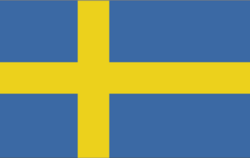 Swedish national flag (Flag of Sweden)
 Sweden country profile
 Travel advice for Sweden
As for the Swedish climate; temperate in south with cold, cloudy winters and cool, partly cloudy summers; subarctic in north.
Swede(s) speak Swedish, small Sami- and Finnish-speaking minorities.
Places of note in Sweden
- Stockholm
- Göteborg
- Malmö
- Uppsala
- Västerås
- Örebro
- Linköping
- Helsingborg
- Jönköping
- Norrköping
- Lund
- Umeå
- Gävle
- Borås
- Södertälje
- Eskilstuna
- Täby
- Karlstad
- Karlstad
- Karlstad
- Karlstad
- Karlstad
- Karlstad
- Karlstad
- Karlstad
- Karlstad
- Karlstad
- Karlstad
- Karlstad
- Karlstad
- Karlstad
- Karlstad
- Karlstad
- Karlstad
- Karlstad
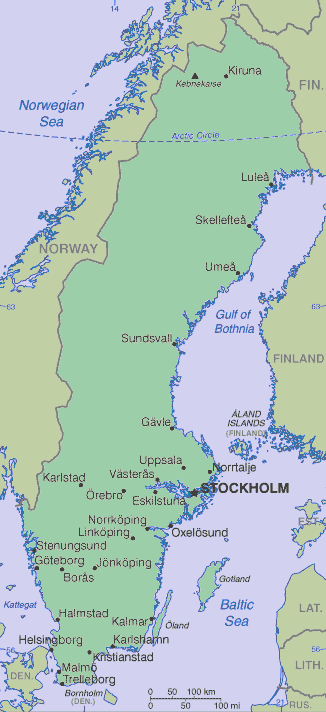 Swedish map
Regions of Sweden
- Blekinge Län
- Dalarnas Län
- Gävleborgs Län
- Gotlands Län
- Hallands Län
- Jämtlands Län
- Jönköpings Län
- Kalmar Län
- Kronobergs Län
- Norrbottens Län
- Örebro Län
- Östergötlands Län
- Skåne Län
- Södermanlands Län
- Stockholms Län
- Sweden (general)
- Uppsala Län
- Värmlands Län
- Västerbottens Län
- Västernorrlands Län
- Västmanlands Län
- Västra Götaland
A military power during the 17th century, Sweden has not participated in any war in almost two centuries. An armed neutrality was preserved in both World Wars. Sweden's long-successful economic formula of a capitalist system interlarded with substantial welfare elements was challenged in the 1990s by high unemployment and in 2000-02 by the global economic downturn, but fiscal discipline over the past several years has allowed the country to weather economic vagaries. Indecision over the country's role in the political and economic integration of Europe delayed Sweden's entry into the EU until 1995, and waived the introduction of the euro in 1999.
Aided by peace and neutrality for the whole of the 20th century, Sweden has achieved an enviable standard of living under a mixed system of high-tech capitalism and extensive welfare benefits. It has a modern distribution system, excellent internal and external communications, and a skilled labor force. Timber, hydropower, and iron ore constitute the resource base of an economy heavily oriented toward foreign trade. Privately owned firms account for about 90% of industrial output, of which the engineering sector accounts for 50% of output and exports. Agriculture accounts for only 2% of GDP and of jobs. The government's commitment to fiscal discipline resulted in a substantial budgetary surplus in 2001, which was cut by more than half in 2002, due to the global economic slowdown, declining revenue, and increased spending. The Swedish central bank (the Riksbank) focuses on price stability with its inflation target of 2%. Growth remained sluggish in 2003, but picked up in 2004 and 2005. Presumably because of generous sick-leave benefits, Swedish workers report in sick more often than other Europeans. In September 2003, Swedish voters turned down entry into the euro system, concerned about the impact on democracy and sovereignty.
Swedish natural resources include iron ore, copper, lead, zinc, gold, silver, tungsten, uranium, arsenic, feldspar, timber, hydropower
strategic location along Danish Straits linking Baltic and North Seas
Swedish religion is Lutheran 87%, Roman Catholic, Orthodox, Baptist, Muslim, Jewish, Buddhist.
Natural hazards in Sweden include ice floes in the surrounding waters, especially in the Gulf of Bothnia, can interfere with maritime traffic.
Travel Advice for Sweden
SwedenSUMMARY
- Sweden shares with the rest of the Europe a threat from international terrorism. Attacks could be indiscriminate and against civilian targets.
- Sweden can be affected by severe cold in the winter months, particularly in the North. You should be prepared for harsh conditions and if driving in the winter months cars should be winterised.
- Over half a million British nationals visit Sweden each year. Most visits to Sweden are trouble-free. The main type of incident for which British nationals require consular assistance is for replacing lost or stolen passports, help in contacting family members for additional funds, and the occasional arrest.
- You should check carefully on bona fides of anyone offering employment opportunities involving asphalting or seasonal work, and should contact the British Embassy in Stockholm for further advice.
- We strongly recommend that you obtain comprehensive travel and medical insurance before travelling. You should check any exclusions, and that your policy covers you for the activities you want to undertake. Please see: Travel Insurance.
SAFETY AND SECURITY
Sweden is generally a risk free country to visit. Petty crime occurs, but at much lower levels than in most European countries. Pickpocketing is rife in the summer months in the major cities when tourists are heavily targeted for their passports and cash.
Local Travel
Travelling within Sweden is easy. Although you may need to cover large distances (especially in Northern Sweden), the country's road and rail networks are efficient and extensive. Sweden's comfortable, modern trains are designed to deal with all kinds of weather.
Road/Rail Safety
If you are travelling by car you should note that driving conditions during the winter months of November to March can be extremely treacherous due to snow and ice.
From 1 December - 31 March (irrespective of weather conditions) Swedish registered cars are required by law to have either studded tyres or unstudded friction tyres bearing the following mark, M+S, M-s, M.S, M&S, MS or Mud and Snow.
Although foreign registered cars are exempt from this requirement, it would still be advisable to have winter tyres fitted.
For rail travel see www.sj.se/sj/jsp/polopoly.
LOCAL LAWS AND CUSTOMS
ENTRY REQUIREMENTS
You should be in possession of a valid passport. There is no minimum validity required but you should ensure that your passport is valid for your return journey. The Embassy in Stockholm has a full passport issuing service, which operates on a 10-day service.
If you are travelling with children other than your own you should be in possession of a letter of consent from the child’s parent/guardian. For further advice on requirements, please contact: Swedish Representation in the UK.
If you lose your passport in Sweden, you should contact the British Embassy in Stockholm (contact details below).
HEALTH
The Form E111 is no longer valid. You should obtain a European Health Insurance Card (EHIC) before leaving the UK. The EHIC is not a substitute for medical and travel insurance, but entitles you to emergency medical treatment on the same terms as Swedish nationals. You will not be covered for medical repatriation, on-going medical treatment or treatment of a non-urgent nature. Fore more information on how to obtain the EHIC please see: Europe and the EHIC
You should be aware of the risk of tick-borne encephalitis (TBE) in coastal areas, especially the Stockholm Archipelago. Advice on TBE, and inoculations, are generally available in the UK.
If you are visiting remote areas, you should consider the relative inaccessibility of the emergency services. The telephone number for emergencies in Sweden is 112.
You should seek medical advice before travelling and ensure that all appropriate vaccinations are up to date. For further information on health, check the Department of Health website at: www.dh.gov.uk.
Avian Influenza (Bird Flu)
The Swedish authorities have confirmed that there have been outbreaks of Avian Influenza (Bird Flu) in ducks and wild birds at various locations in Sweden. No domestic birds have been identified as having the virus. No human infections or deaths have been reported.
The risk to humans from Avian Influenza is believed to be very low. As a precaution, you should avoid visiting live animal markets, poultry farms and other places where you may come into close contact with domestic, caged or wild birds; and ensure poulty and egg dishes are thoroughly cooked.
You should read this advice in conjunction with the Avian and Pandemic Influenza Factsheet, which gives more detailed advice and information.
GENERAL
EU Aviation Regulations
The revised EU-wide security measures that came into effect for all passengers departing from UK airports in November 2006 are also being implemented in Sweden. For more details about this please see: DfT - Airline Security Update
Remember the currency for Sweden is Swedish Krona and not the Euro.
Sweden, and in particular the north of the country, does get affected by severe cold weather during the winter months. Temperatures can be extremely low, and if you visit in winter you should be prepared for these harsh conditions.
European Union
Information on the EU can be found at: Travelling and Living in the EU (pdf) and Britain in the EU.
OTHER