
 Search
Traveling Luck for Latvia. Latvia, Europe
Latvia is located in Eastern Europe, bordering the Baltic Sea, between Estonia and Lithuania.
Land in Latvia is low plain.
Latvian land covers an area of 64589 square kilometers which is slightly larger than West Virginia
Latvia has borders with Belarus for 141km, Estonia for 339km, Lithuania for 453km and Russia for 217km.
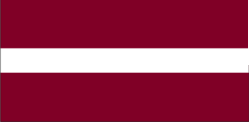 Latvian national flag (Flag of Latvia)
 Latvia country profile
 Travel advice for Latvia
As for the Latvian climate; maritime; wet, moderate winters.
Latvian(s) speak Latvian (official) 58.2%, Russian 37.5%, Lithuanian and other 4.3% (2000 census).
Places of note in Latvia
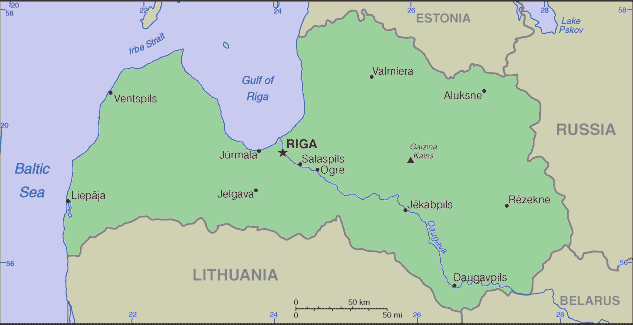 Latvian map
Regions of Latvia
- Aizkraukles Rajons
- Alūksnes Rajons
- Balvu Rajons
- Bauskas Rajons
- Cēsu Rajons
- Daugavpils
- Daugavpils Rajons
- Dobeles Rajons
- Gulbenes Rajons
- Jēkabpils Rajons
- Jelgava
- Jelgavas Rajons
- Jūrmala
- Krāslavas Rajons
- Kuldīgas Rajons
- Latvia (general)
- Liepāja
- Liepājas Rajons
- Limbažu Rajons
- Ludzas Rajons
- Madonas Rajons
- Ogres Rajons
- Preiļu Rajons
- Rēzekne
- Rēzeknes Rajons
- Rīga
- Rīgas Rajons
- Saldus Rajons
- Talsu Rajons
- Tukuma Rajons
- Valkas Rajons
- Valmieras Rajons
- Ventspils
- Ventspils Rajons
After a brief period of independence between the two World Wars, Latvia was annexed by the USSR in 1940. It reestablished its independence in 1991 following the breakup of the Soviet Union. Although the last Russian troops left in 1994, the status of the Russian minority (some 30% of the population) remains of concern to Moscow. Latvia joined both NATO and the EU in the spring of 2004.
Latvia's transitional economy recovered from the 1998 Russian financial crisis, largely due to the government's budget stringency and a gradual reorientation of exports toward EU countries, lessening Latvia's trade dependency on Russia. The majority of companies, banks, and real estate have been privatized, although the state still holds sizable stakes in a few large enterprises. Latvia officially joined the World Trade Organization in February 1999. EU membership, a top foreign policy goal, came in May 2004. The current account and internal government deficits remain major concerns, but the government's efforts to increase efficiency in revenue collection may lessen the budget deficit. A growing perception that many of Latvia's banks facilitate illicit activity could damage the country's vibrant financial sector.
Latvian natural resources include peat, limestone, dolomite, amber, hydropower, wood, arable land
most of the country is composed of fertile, low-lying plains, with some hills in the east
Latvian religion is Lutheran, Roman Catholic, Russian Orthodox.
Natural hazards in Latvia include NA.
Travel Advice for Latvia
LatviaSUMMARY
- The threat from terrorism is low. But you should be aware of the global risk of indiscriminate terrorist attacks which could be against civilian targets, including places frequented by foreigners.
- If you visit to forested areas you should seek medical advice about inoculations against rabies and tick-borne encephalitis.
- Around 75,000 British tourists visit Latvia every year. Most visits to Latvia are trouble-free. The main type of incident for which British nationals require consular assistance in Latvia is for lost/stolen passports.
- Road-hauliers should be prepared for severe delays at all Lithuania-Latvia border crossing points.
- There have been a number of reports recently of foreign tourists being charged extortionate prices for drinks in bars in Riga. Check the price of drinks before you order, especially if a stranger asks you to buy a drink for them.
- We strongly recommend that you obtain comprehensive travel and medical insurance before travelling. You should check any exclusions, and that your policy covers you for the activities you want to undertake. Please see: Travel Insurance.
SAFETY AND SECURITY
There has been an increase in the number of incidents relating to muggings of foreign nationals (some have had drinks spiked in casinos and clubs before being mugged). When walking you should be alert to the threat of pickpocketing and other forms of theft. Always avoid unlit streets and parks at night, and be extra vigilant if walking alone.
There have been a number of reports recently of foreign tourists being charged extortionate prices for drinks in bars. Some have then been assaulted or forced to withdraw money from a cashpoint to pay for the bill. You can help avoid situations like this by ensuring that you check the price of drinks before ordering, pay for one round at a time and seek recommendations for bars from trustworthy sources like your hotel or other holidaymakers. A search of the internet can also reveal good and bad feedback on individual bars and clubs.
Car theft is rife. Wherever possible guarded car parks should be used and valuables kept out of sight.
Political Situation
Local Travel
Road-hauliers should be prepared for severe delays at all Lithuania-Latvia border crossing points.
Road Safety
Drivers should carry original vehicle registration documents, when crossing the border into Latvia (including for motorcycles). Those who do not have these documents will not be allowed to take their vehicle back out of Latvia.
Road traffic accidents are common. Drivers should not attempt to move a vehicle, which has been involved in an accident, even if it is blocking the road, until the police give permission. In winter, equip your car for severe conditions.
Do not drink and drive. The legal limit is 0.5promille. Those found over the limit face a fine and immediate imprisonment.
Winter tyres are required between 1 December and 1 March. Local law states that drivers must use their headlights at all times, including during daylight hours.
LOCAL LAWS AND CUSTOMS
ENTRY REQUIREMENTS
HEALTH
Tick-borne encephalitis is a problem in Latvia, especially during the summer months from May to August. The incidence of mumps is on the increase and rabies is endemic in the region.
Following a recent outbreak of meningitis in the Latgale region, travellers are advised to seek medical advice before travelling to that region. Visitors should take precautions such as avoiding crowded places.
You should seek medical advice before travelling and ensure that all appropriate vaccinations are up to date. For further information on health, check the Department of Health’s website at: www.dh.gov.uk
Avian Influenza (Bird Flu)
There have been no reported cases of Avian Influenza (also known as Bird Flu) in Latvia during the current series of outbreaks. But The World Health Organisation (WHO) has confirmed cases elsewhere in the region.
GENERAL