
 Search
Traveling Luck for Greece. Greece, Europe
Greece is located in Southern Europe, bordering the Aegean Sea, Ionian Sea, and the Mediterranean Sea, between Albania and Turkey.
Land in Greece is mostly mountains with ranges extending into the sea as peninsulas or chains of islands.
Greek land covers an area of 131940 square kilometers which is slightly smaller than Alabama
Greece has borders with Albania for 282km, Bulgaria for 494km, FYR Macedonia for 246km and Turkey for 206km.
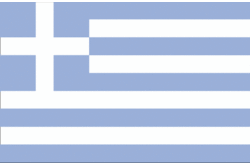 Greek national flag (Flag of Greece)
 Greece country profile
 Travel advice for Greece
As for the Greek climate; temperate; mild, wet winters; hot, dry summers.
Greek(s) speak Greek 99% (official), English, French.
Places of note in Greece
- Athens
- Thessaloníki
- Peiraiéfs
- Pátrai
- Peristérion
- Irákleion
- Lárisa
- Kallithéa
- Níkaia
- Kalamariá
- Vólos
- Akharnaí
- Néa Liósia
- Keratsínion
- Néa Smírni
- Khalándrion
- Aigáleo
- Amaroúsion
- Néa Ionía
- Palaión Fáliron
- Ioánnina
- Víron
- Ayía Paraskeví
- Kavála
- Galátsion
- Ródos
- Sérrai
- Chaniá
- Chalkís
- Kateríni
- Alexandroúpolis
- Petroúpolis
- Kalamáta
- Tríkala
- Xánthi
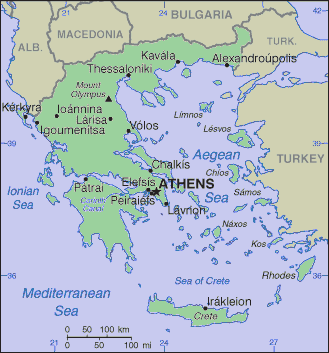 Greek map
Regions of Greece
- Achaḯa
- Aitolía kai Akarnanía
- Argolís
- Arkadía
- Árta
- Attikí
- Chalkidiki
- Chaníon
- Chíos
- Dodekánisos
- Dráma
- Évros
- Evrytanía
- Évvoia
- Flórina
- Fokídos
- Fthiótis
- Greece (general)
- Grevená
- Ileía
- Imathía
- Ioánnina
- Irákleion
- Kardítsa
- Kastoriá
- Kavála
- Kefallinía
- Kérkyra
- Kilkís
- Korinthía
- Kozáni
- Kykládes
- Lakonía
- Lárisa
- Lasíthi
- Lefkás
- Lésvos
- Magnisía
- Messinía
- Pélla
- Piería
- Préveza
- Rethýmnis
- Rodópi
- Sámos
- Sérrai
- Thesprotía
- Thessaloníki
- Tríkala
- Voiotía
- Xánthi
- Zákynthos
Greece achieved independence from the Ottoman Empire in 1829. During the second half of the 19th century and the first half of the 20th century, it gradually added neighboring islands and territories, most with Greek-speaking populations. In World War II, Greece was first invaded by Italy (1940) and subsequently occupied by Germany (1941-44); fighting endured in a protracted civil war between supporters of the king and Communist rebels. Following the latter's defeat in 1949, Greece joined NATO in 1952. A military dictatorship, which in 1967 suspended many political liberties and forced the king to flee the country, lasted seven years. The 1974 democratic elections and a referendum created a parliamentary republic and abolished the monarchy. In 1981 Greece joined the EC (now the EU); it became the 12th member of the euro zone in 2001.
Greece has a capitalist economy with the public sector accounting for about 40% of GDP and with per capita GDP at least 75% of the leading euro-zone economies. Tourism provides 15% of GDP. Immigrants make up nearly one-fifth of the work force, mainly in menial jobs. Greece is a major beneficiary of EU aid, equal to about 3.3% of annual GDP. The Greek economy grew by about 4.0% for the between 2003 and 2005, largely because of an investment boom and infrastructure upgrades for the 2004 Athens Olympic Games. Economic growth slowed to about 3% in 2005. Greece has not met the EU's Growth and Stability Pact budget deficit criteria of 3% of GDP since 2000. Public debt, inflation, and unemployment are above the euro-zone average. To overcome these challenges, the Greek Government is expected to continue cutting government spending, reducing the size of the public sector, and reforming the labor and pension systems.
Greek natural resources include lignite, petroleum, iron ore, bauxite, lead, zinc, nickel, magnesite, marble, salt, hydropower potential
strategic location dominating the Aegean Sea and southern approach to Turkish Straits; a peninsular country, possessing an archipelago of about 2,000 islands
Greek religion is Greek Orthodox 98%, Muslim 1.3%, other 0.7%.
Natural hazards in Greece include severe earthquakes.
Travel Advice for Greece
GreeceSUMMARY
- On 12 January 2007, a self propelled explosive was fired at the US Embassy compound in central Athens from the surrounding area, causing minor damage to the front windows and the roof. There were no casualties. Greek anarcho-terrorist group ‘Revolutionary Struggle’ have claimed responsibility for the attack. The British Embassy continues to take appropriate security precaution, and remains open for business as usual.
- Around 3 million British people visit Greece every year. Most visits are trouble-free. The main type of incident for which British nationals require consular assistance in Greece is for replacing lost or stolen passports.
- You should maintain high standards of public behaviour in Greece. Greek courts impose heavy fines or prison sentences on people who behave indecently.
- Greece shares with the rest of Europe a threat from terrorism. Attacks could be indiscriminate and against civilian targets. The Greek government has put in place measures to combat terrorism and has had notable success against the main Greek groups but a potential threat remains.
- You should maintain at least the same level of personal security awareness in Greece as in the UK.
- We strongly recommend that you obtain comprehensive travel and medical insurance before travelling. You should check any exclusions, and that your policy covers you for the activities you want to undertake. Please see: Travel Insurance.
SAFETY AND SECURITY
Greece Country Profile.
Generally there are no local travel restrictions, but you should be aware that certain areas near the Greek borders are militarily sensitive. Although these areas can be visited without any problems, do not take photographs or make notes near military or official installations. In addition, travellers should seek permission before photographing individuals.
LOCAL LAWS AND CUSTOMS
ENTRY REQUIREMENTS
HEALTH
The Form E111 is no longer valid. You should obtain a European Health Insurance Card (EHIC) before leaving the UK. The EHIC is not a substitute for medical and travel insurance, but entitles you to emergency medical treatment on the same terms as Greek nationals. You will not be covered for medical repatriation, on-going medical treatment or treatment of a non-urgent nature. For more information about how to obtain the EHIC please see: Europe and the EHIC.
We strongly recommend that you obtain comprehensive travel and medical insurance before travelling. You should check any exclusions, and that your policy covers you for the activities you want to undertake. Please see: Travel Insurance.
There are many Public and Private Hospitals and Medical Centres in Greece, all of varying standards. Doctors and facilities are generally good on the mainland, but may be limited on the islands. The standards of nursing and after care, particularly in the public health sector lag behind what is normally acceptable in the UK. The Public Ambulance Service, which will normally respond to any accident, is rudimentary. There are severe shortages of ambulances on some islands.
You should seek medical advice before travelling and ensure that all appropriate vaccinations are up to date. For further information on health, check the Department of Health’s website at: www.dh.gov.uk.
Avian Influenza (Bird Flu)
You should read this advice in conjunction with Avian and Pandemic Influenza Factsheet, which gives more detailed advice and information.
NATURAL DISASTERS
Forest fires can occur in Greece during the summer months. On 21 August 2006, a serous forest fire affected the Greek resort of Hanioti and nearby areas whilst there have also been other outbreaks, including Zakynthos and Laconia in southern Greece. During especially hot and dry periods there is a danger that forest fires will become more frequent. Please take care when visiting or driving through woodland areas; ensure that cigarette ends are properly extinguished, do not light barbecues and do not leave rubbish or empty bottles behind.
Mainland Greece and most of the Greek islands popular with British tourists are in seismically active zones, and earth tremors are common. Serious earthquakes are less frequent but do occur.
GENERAL
Money
You are reminded that the currency of Greece is the Euro.