
 Search
Traveling Luck for Belgium. Belgium, Europe
Belgium is located in Western Europe, bordering the North Sea, between France and the Netherlands.
Land in Belgium is flat coastal plains in northwest, central rolling hills, rugged mountains of Ardennes Forest in southeast.
Belgian land covers an area of 30528 square kilometers which is about the size of Maryland
Belgium has borders with Germany for 167km, France for 620km, Luxembourg for 148km and Netherlands for 450km.
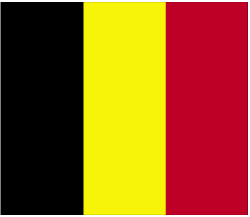 Belgian national flag (Flag of Belgium)
 Belgium country profile
 Travel advice for Belgium
As for the Belgian climate; temperate; mild winters, cool summers; rainy, humid, cloudy.
Belgian(s) speak Dutch (official) 60%, French (official) 40%, German (official) less than 1%, legally bilingual (Dutch and French).
Places of note in Belgium
- Brussels
- Antwerp
- Gent
- Charleroi
- Liège
- Brugge
- Namur
- Leuven
- Mons
- Aalst
- Mechelen
- La Louvière
- Kortrijk
- Hasselt
- Oostende
- Sint-Niklaas
- Tournai
- Genk
- Seraing
- Roeselare
- Verviers
- Mouscron
- Beveren
- Dendermonde
- Beringen
- Turnhout
- Dilbeek
- Heist-op-den-Berg
- Sint-Truiden
- Lokeren
- Brasschaat
- Vilvoorde
- Herstal
- Maasmechelen
- Waregem
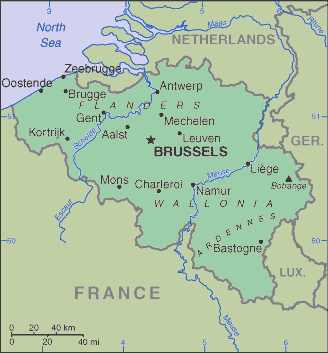 Belgian map
Regions of Belgium
Belgium became independent from the Netherlands in 1830; it was occupied by Germany during World Wars I and II. It has prospered in the past half century as a modern, technologically advanced European state and member of NATO and the EU. Tensions between the Dutch-speaking Flemings of the north and the French-speaking Walloons of the south have led in recent years to constitutional amendments granting these regions formal recognition and autonomy.
This modern, private-enterprise economy has capitalized on its central geographic location, highly developed transport network, and diversified industrial and commercial base. Industry is concentrated mainly in the populous Flemish area in the north. With few natural resources, Belgium must import substantial quantities of raw materials and export a large volume of manufactures, making its economy unusually dependent on the state of world markets. Roughly three-quarters of its trade is with other EU countries. Public debt is nearly 100% of GDP. On the positive side, the government has succeeded in balancing its budget, and income distribution is relatively equal. Belgium began circulating the euro currency in January 2002. Economic growth in 2001-03 dropped sharply because of the global economic slowdown, with moderate recovery in 2004-05.
Belgian natural resources include construction materials, silica sand, carbonates
crossroads of Western Europe; majority of West European capitals within 1,000 km of Brussels, the seat of both the European Union and NATO
Belgian religion is Roman Catholic 75%, Protestant or other 25%.
Natural hazards in Belgium include flooding is a threat along rivers and in areas of reclaimed coastal land, protected from the sea by concrete dikes.
Travel Advice for Belgium
BelgiumSUMMARY
- Belgium shares with the rest of Europe a threat from international terrorism. Attacks could be indiscriminate and against civilian targets.
- Around 1.5 million British tourists visit Belgium year. Most visits are trouble-free. The main type of incident for which British nationals require consular assistance in Belgium is a result of street and car crime. Theft and pick pocketing is a problem in crowded areas. You should take extra care, particularly of your belongings and passports, at the Gare du Midi (Eurostar terminal) and Gare Du Nord.
- We strongly recommend that you obtain comprehensive travel and medical insurance before travelling. You should check any exclusions, and that your policy covers you for the activities you want to undertake. Please see: Travel Insurance.
SAFETY AND SECURITY
Most visits to Belgium are trouble-free. The incidence of crimes such as mugging, bag snatching and pick pocketing are comparable with the UK. You should take normal, common sense precautions to avoid becoming a victim.
Take only the minimum amount of cash, credit cards and personal ID necessary when you go out. As far as possible leave jewellery, other valuables and documents in a secure place (eg hotel safe deposit). Avoid carrying money, bank/credit cards and your passport in the same bag or pocket. For safety, leave a photocopy of your passport and itinerary with a contact in the UK. Enter next-of-kin details into the back of your passport.
In the event of theft, contact the nearest police station and obtain a police report. This report is mandatory when applying for a replacement passport or insurance claim. If you have difficulty reporting the theft of your cards to your UK bank/credit card company, you can ask the Belgian group "Card Stop" to send a fax to your UK card company to block your card. Alternatively, if you have Belgian issued bank/credit cards, Card Stop will be able to block them. Card Stop's telephone number is: +32-(0)70/344 344.
You should be extra vigilant in Brussels and Antwerp at major railway stations, on the underground, buses and trams, particularly late at night. Thieves operate in the vicinity of the Brussels Gare du Midi/Zuidstation (Eurostar terminal), Gare du Nord and Schuman (the EU quarter). Pickpockets also operate on international trains, mainly Paris-Brussels and Amsterdam-Brussels. Never leave luggage or coats unattended.
Do not leave valuables such as purses, bags or mobile phones visible in your car, even when you are in it. Keep car doors locked and windows secure at all times. It is increasingly common for thieves, usually on motorbikes, to break a window and snatch valuables from the front or back passenger seat when the vehicle is stationary at traffic lights. Car jacking, especially of up-market vehicles, remains a risk.
Political Situation
Belgium Country Profile.
Road Safety
Belgian roads are generally in good condition and at night are well lit, including the motorway network. Traffic is fast and Belgium’s accident rate is high mainly due to speeding.
On 1 March 2004, the Belgian Government introduced a new law to improve road safety. Speed traps, cameras and unmarked vehicles are operational throughout the country. Fines have increased dramatically (eg up to € 2,750 for exceeding the speed limit by 40 kms/hr). If you are unable to pay an on the spot fine your vehicles may be impounded. More detailed information is available on: http://www.britishembassy.gov.uk/belgium.
Do not drink and drive, frequent alcohol checks are made, in daytime as well as at night. A maximum of 0.22 mg/l (0.5 promille) is allowed. A blood sample will be taken if you refuse to be breathalysed. Fines are heavy depending on the degree of intoxication and range from € 1,100 to € 11,000. In certain cases driving licences have been confiscated immediately.
You should also be aware of the ‘priority to the right’ rule: drivers must stop for traffic joining from the right, except on motorways, roundabouts, and roads sign-posted with an orange diamond within a white background.
Using a mobile 'phone while driving is not allowed and will incur a heavy fine. The use of "hands free" equipment is allowed.
Trams have priority over other traffic. If a tram or bus stops in the middle of the road to allow passengers off or on, you must stop.
There is a speed restriction of 30 kms/hr in school areas, which is valid 24 hours (even when schools are closed). The start and finish of these zones are not always clearly marked.
LOCAL LAWS AND CUSTOMS
Possession of drugs and trafficking in drugs are serious offences.
ENTRY REQUIREMENTS
If you intend to work or remain in Belgium for more than three months you must apply to the local communal authorities for a residence permit.
Single parents or other adults travelling alone with children should be aware that some countries require documentary evidence of parental responsibility before allowing lone parents to enter the country or, in some cases, before permitting the children to leave the country. For further information on exactly what will be required at immigration please contact the Belgian Embassy in London.
HEALTH
GENERAL