
 Search
Traveling Luck for Taiwan. Taiwan, Asia
Taiwan is located in Eastern Asia, islands bordering the East China Sea, Philippine Sea, South China Sea, and Taiwan Strait, north of the Philippines, off the southeastern coast of China.
Land in Taiwan is eastern two-thirds mostly rugged mountains; flat to gently rolling plains in west.
Taiwan land covers an area of 35980 square kilometers which is slightly smaller than Maryland and Delaware combined
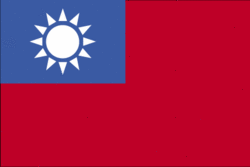 Taiwan national flag (Flag of Taiwan)
 Taiwan country profile
 Travel advice for Taiwan
As for the Taiwan climate; tropical; marine; rainy season during southwest monsoon (June to August); cloudiness is persistent and extensive all year.
Taiwan (singular and plural) speak Mandarin Chinese (official), Taiwanese (Min), Hakka dialects.
Places of note in Taiwan
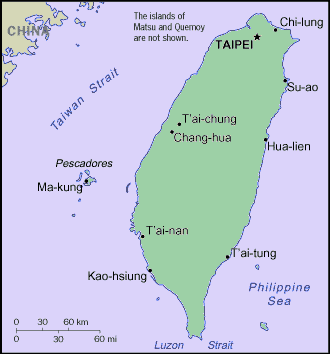 Taiwan map
Regions of Taiwan
In 1895, military defeat forced China to cede Taiwan to Japan. Taiwan reverted to Chinese control after World War II. Following the Communist victory on the mainland in 1949, 2 million Nationalists fled to Taiwan and established a government using the 1946 constitution drawn up for all of China. Over the next five decades, the ruling authorities gradually democratized and incorporated the native population within the governing structure. In 2000, Taiwan underwent its first peaceful transfer of power from the Nationalist to the Democratic Progressive Party. Throughout this period, the island prospered and became one of East Asia's economic "Tigers." The dominant political issues continue to be the relationship between Taiwan and China - specifically the question of eventual unification - as well as domestic political and economic reform.
Taiwan has a dynamic capitalist economy with gradually decreasing guidance of investment and foreign trade by government authorities. In keeping with this trend, some large, government-owned banks and industrial firms are being privatized. Exports have provided the primary impetus for industrialization. The trade surplus is substantial, and foreign reserves are the world's third largest. Agriculture contributes less than 2% to GDP, down from 32% in 1952. Taiwan is a major investor throughout Southeast Asia. China has overtaken the US to become Taiwan's largest export market and, in 2005, Taiwan's third-largest source of imports after Japan and the US. Taiwan has benefited from cross-Strait economic integration and a sharp increase in world demand to achieve substantial growth in its export sector and a seven-year-high real GDP growth of 6.1% in 2004. However, excess inventory, higher international oil prices, and rising interest rates dampened consumption in developed markets, and GDP growth dropped to 3.8% in 2005. The service sector, which accounts for 69% of Taiwan's GDP, has continued to expand, while unemployment and inflation rates have declined.
Taiwan natural resources include small deposits of coal, natural gas, limestone, marble, and asbestos
strategic location adjacent to both the Taiwan Strait and the Luzon Strait
Taiwan religion is mixture of Buddhist, Confucian, and Taoist 93%, Christian 4.5%, other 2.5%.
Natural hazards in Taiwan include earthquakes and typhoons.
Travel Advice for Taiwan
TaiwanSUMMARY
- The threat from terrorism is low. But you should be aware of the global risk of indiscriminate attacks, which could be against civilian targets, including places frequented by foreigners.
- Around 38,000 British nationals visit Taiwan every year. Most visits are trouble-free. British nationals mainly require consular assistance in Taiwan for guidance on visa/immigration rules and legal advice. You should take sensible precautions against small-scale and petty crimes, which are sometimes carried out against foreigners.
- The UK has no diplomatic relations with Taiwan so limited consular services are available to British nationals. Please see the General section of this travel advice for more information.
- If you are staying for longer than four weeks, you should register with British Trade Cultural Office.
- We strongly recommend that you obtain comprehensive travel and medical insurance before travelling to Taiwan. You should check any exclusions, and that your policy covers you for the activities you want to undertake. Please see: Travel Insurance
SAFETY AND SECURITY
Small-scale petty crime affecting foreign nationals exists but is not commonplace.
Advance Fee Frauds
People and companies in the UK (and elsewhere) often receive letters, faxes and e-mails, offering them large sums of money provided they send various 'advance fees' to Taiwanese bank accounts. The fraudsters have obtained the details from telephone or commercial directories, so recipients are not being specifically targeted.
The Serious Organised Crime Agency (SOCA) investigates advance fee frauds in the UK. You are recommended not to reply to these types of communication. The SOCA website at: http://www.soca.gov.uk/ contains more information on this type of fraud.
Political Situation
You should avoid large-scale political gatherings.
Local Travel
There is a risk of road blockages and landslides following typhoons, especially in central and southern Taiwan. You should check the Central Weather Bureau website (http://www.cwb.gov.tw) and the Directorate General of Highways website (http://www.thb.gov.tw) before travelling to these areas.
Road Safety
If you intend to drive in Taiwan, you will need an International Driver's Permit (IDP). Once in Taiwan, you will need to take your passport, IDP and a passport photograph to the nearest Vehicle Registration Dept and apply for a driver's licence visa which will then be secured in your IDP.
Be alert crossing roads, even on protected crossings.
LOCAL LAWS AND CUSTOMS
ENTRY REQUIREMENTS
Single parents or other adults travelling alone with children should be aware that some documentary evidence of parental responsibility may need to be shown to the local authorities before allowing lone parents to enter or, in some cases, before permitting the children to leave. For further information on exactly what will be required at immigration please contact the Taipei Representation in the UK at: http://www.roc-taiwan.org.uk/.
HEALTH
Taiwan has adequate health and dental facilities to handle routine, emergency and outpatient treatment. Some have English-speaking staff. Hospitals operate on a "pay as you use" basis so it is wise to take money with you. You might also be required to produce your passport. It is worth bearing in mind that unlike the UK, it is not normal practice for a paramedic to accompany an ambulance to an incident.
If walking in rural areas you should be wary of snakes, which can be extremely poisonous.
Dengue fever is endemic in southern Taiwan and you are advised to see a doctor if you have symptoms of fever, rashes, and sore muscles. You are also advised to ensure all food is fully cooked and you should drink only bottled water.
You should seek medical advice before travelling and ensure that all appropriate vaccinations are up to date. For further information on health, check the Department of Health’s website at: www.dh.gov.uk
Avian Influenza (Bird Flu)
There have been no reported cases of Avian Influenza (Bird Flu) in Taiwan during the current series of outbreaks. But the World Health Organisation has confirmed cases elsewhere in the region.
You should read this advice in conjunction with the FCO’s Avian and Pandemic Influenza Factsheet, which gives more detailed advice and information.
NATURAL DISASTERS
The typhoon/tropical storm season in Taiwan normally runs from May to November, sometimes resulting in local flooding and landslides. The Joint Typhoon Warning Centre (http://metoc.npmoc.navy.mil/jtwc.html) tracks and monitors active typhoons in the Pacific region. Please also see Hurricanes for more detailed information about what to do if you are caught up in a typhoon or tropical storm.
GENERAL
The UK does not have diplomatic relations with Taiwan. The British Assistance and Services Section of the British Trade and Cultural Office in Taipei can provide certain limited consular assistance. However, they cannot issue passports. Passport applications are accepted by the British Trade and Cultural Office, but are forwarded to Hong Kong for processing, which can take 5 working days. Emergency Passports can be issued the same day.
If you are staying for longer than four weeks please register with British Trade Cultural Office.
Western Union, Moneygram and Travellers Express have offices in Taipei. However, operating hours are restricted. Bank transfers can be slow. Some branches of The Bank of Taiwan and HSBC will accept British credit cards, but you will incur handling charges. ATMs are plentiful but not all accept British bank cards. Designated banks will accept American Express, Citibank or Thomas Cook travellers’ cheques (up to 1,000 US Dollars per day) but you should be prepared to produce your purchase certificate or receipt as well as your passport when cashing them in. If in doubt, check whether your travellers’ cheques will be accepted in Taiwan before you travel.