
 Search
Traveling Luck for Qatar. Qatar, Asia
Qatar is located in Middle East, peninsula bordering the Persian Gulf and Saudi Arabia.
Land in Qatar is mostly flat and barren desert covered with loose sand and gravel.
Qatari land covers an area of 11437 square kilometers which is slightly smaller than Connecticut
Qatar has borders with Saudi Arabia for 60km.
 Qatari national flag (Flag of Qatar)
 Qatar country profile
 Travel advice for Qatar
As for the Qatari climate; arid; mild, pleasant winters; very hot, humid summers.
Qatari(s) speak Arabic (official), English commonly used as a second language.
Places of note in Qatar
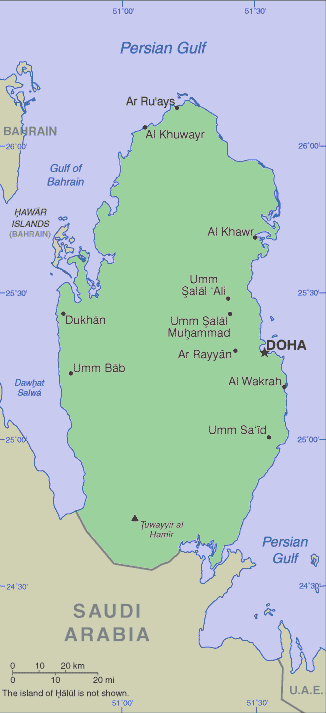 Qatari map
Regions of Qatar
Ruled by the al-Thani family since the mid-1800s, Qatar transformed itself from a poor British protectorate noted mainly for pearling into an independent state with significant oil and natural gas revenues. During the late 1980s and early 1990s, the Qatari economy was crippled by a continuous siphoning off of petroleum revenues by the amir, who had ruled the country since 1972. His son, the current Amir HAMAD bin Khalifa al-Thani, overthrew him in a bloodless coup in 1995. In 2001, Qatar resolved its longstanding border disputes with both Bahrain and Saudi Arabia. Oil and natural gas revenues enable Qatar to have one of the highest per capita incomes in the world.
Oil and gas account for more than 60% of GDP, roughly 85% of export earnings, and 70% of government revenues. Oil and gas have given Qatar a per capita GDP about 80% of that of the leading West European industrial countries. Proved oil reserves of 16 billion barrels should ensure continued output at current levels for 23 years. Qatar's proved reserves of natural gas exceed 25 trillion cubic meters, more than 5% of the world total and third largest in the world. Qatar has permitted substantial foreign investment in the development of its gas fields during the last decade and is expected to become the world's top liquefied natural gas (LNG) exporter by 2007. In recent years, Qatar has consistently posted trade surpluses largely because of high oil prices and increased natural gas exports, becoming one of the world's fastest growing and highest per-capita income countries.
Qatari natural resources include petroleum, natural gas, fish
strategic location in central Persian Gulf near major petroleum deposits
Qatari religion is Muslim 95%.
Natural hazards in Qatar include haze, dust storms, sandstorms common.
Travel Advice for Qatar
QatarSUMMARY
- You should be aware of the threat from terrorism in Qatar. Al Qa’ida continues to issue statements threatening to carry out attacks in the Gulf region. These include references to attacks on Western interests, including residential compounds, military, oil, transport and aviation interests.
- A suicide-bomb attack occurred on 19 March 2005, outside a theatre in Doha. One British national was killed and at least 12 other people were injured.
- You should review your security arrangements carefully. You should remain vigilant, particularly in public places. You should avoid any large gatherings or demonstrations.
- Around 30,000 British tourists visit Qatar every year. The main type of incident for which British nationals require consular assistance in Qatar are driving or drink related incidents.
- We strongly recommend that you obtain comprehensive travel and medical insurance before travelling. You should check any exclusions, and that your policy covers you for the activities you want to undertake. Please see: Travel Insurance.
SAFETY AND SECURITY
Some 4,500 British nationals live in Qatar, and approximately 30,000 visit annually. Most visits are trouble-free. Although incidents are not common, female visitors should take care when travelling alone at night and are advised to use one of the reputable limousine companies.
Political Situation
Developments in Iraq and on the Middle East Peace Process continue to have an impact on local public opinion in the region. You should be aware of local sensitivities on these issues. You should follow news reports and be alert to regional developments. You should take sensible precautions for your personal safety and avoid public gatherings and demonstrations.
Road Safety
Driving in Qatar is of a lower standard than in the UK. Road discipline is very poor, speeds are high and minor accidents commonplace. This is especially true in Doha.
Excursions to the desert can be hazardous unless undertaken in an adequately equipped 4 x 4 vehicle. Always travel in convoy with other cars, take a supply of water and a mobile telephone if you have one and leave travel plans with friends or relatives.
Driving is permitted on a valid UK licence for 7 days only. For longer periods you should obtain a temporary permit from the local traffic department. Once you obtain a residency permit, you must contact the local traffic department to obtain a full Qatar driving licence, as you will no longer be permitted to drive on a UK or temporary licence. Driving on an International driver’s licence is not permitted.
It is an offence in Qatar to drink and drive. There is zero tolerance for drinking and driving. Depending on the circumstances, offenders may incur detention, a substantial fine, a prison sentence and deportation. In cases that result in injury or death, punishment is severe.
You should note that any incident that results in a police case file being opened against you in respect if a driving or drinking related incident automatically results on a ban on your departure from Qatar until your case has been resolved. Most cases are straightforward and dealt with by the Public Prosecutor. However more serious cases can take up to six months to be heard. If a local lawyer is required, the fee will be around QR30,000 (£5000) to initially consider your case.
Sea Safety
Many areas of the Gulf are highly sensitive, including near maritime boundaries and the islands of Abu Musa and the Tunbs in the southern Gulf. Vessels entering these areas have been detained and inspected; and there have been occasional arrests. Mariners should make careful enquiries before entering these waters or considering visiting ports.
On 30 March 2006, a Dhow capsized in Bahrain. There were 58 fatalities, including 12 British nationals. You should exercise care when travelling by Dhow, as the safety of these vessels may not be up to UK standards. You should also ensure that life jackets are available.
LOCAL LAWS AND CUSTOMS
You should dress modestly, behave courteously and respect local customs and sensitivities.
Any intimacy in public between men and women (including teenagers) can lead to arrest.
Homosexual behaviour is illegal in Qatar.
ENTRY REQUIREMENTS
HEALTH
GENERAL