
 Search
Traveling Luck for Philippines. Philippines, Asia
Philippines is located in Southeastern Asia, archipelago between the Philippine Sea and the South China Sea, east of Vietnam.
Land in Philippines is mostly mountains with narrow to extensive coastal lowlands.
Philippine land covers an area of 300000 square kilometers which is slightly larger than Arizona
 Philippine national flag (Flag of Philippines)
 Philippines country profile
 Travel advice for Philippines
As for the Philippine climate; tropical marine; northeast monsoon (November to April); southwest monsoon (May to October).
Filipino(s) speak two official languages - Filipino (based on Tagalog) and English; eight major dialects - Tagalog, Cebuano, Ilocano, Hiligaynon or Ilonggo, Bicol, Waray, Pampango, and Pangasinan.
Places of note in Philippines
- Manila
- Davao
- Cebu City
- Antipolo
- Zamboanga
- Mansilingan
- Cagayan de Oro
- Dasmariñas
- Iloilo
- San Jose del Monte
- Bacoor
- Calamba
- Santol
- Mandaue City
- Cainta
- Baguio
- San Pedro
- Mantampay
- San Fernando
- Libertad
- Lapu-Lapu City
- Batangas
- Taytay
- Lucena
- Cabanatuan
- Olongapo
- Binangonan
- Santa Rosa
- Imus
- Lipa
- San Pablo
- Malolos
- Panalanoy
- Mabalacat
- Meycauayan
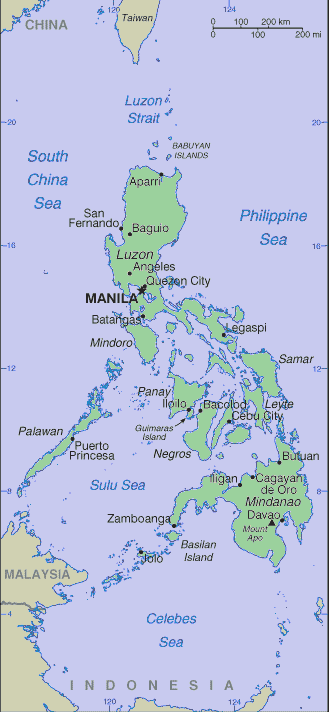 Philippine map
Regions of Philippines
- Abra
- Agusan del Norte
- Agusan del Sur
- Aklan
- Albay
- Angeles
- Antique
- Aurora
- Bacolod
- Bago
- Baguio
- Bais
- Basilan
- Basilan
- Bataan
- Batanes
- Batangas
- Batangas
- Benguet
- Bohol
- Bukidnon
- Bulacan
- Butuan
- Cabanatuan
- Cadiz
- Cagayan
- Cagayan de Oro
- Calbayog
- Caloocan
- Camarines Norte
- Camarines Sur
- Camiguin
- Canlaon
- Capiz
- Catanduanes
- Cavite
- Cavite
- Cebu
- Cebu
- Cotabato
- Dagupan
- Danao
- Dapitan
- Davao
- Davao
- Davao del Sur
- Davao Oriental
- Dipolog
- Dumaguete
- Eastern Samar
- General Santos
- Gingoog
- Ifugao
- Iligan
- Ilocos Norte
- Ilocos Sur
- Iloilo
- Iloilo
- Iriga
- Isabela
- Kalinga-Apayao
- La Carlota
- Laguna
- Lanao del Norte
- Lanao del Sur
- Laoag
- Lapu-Lapu
- La Union
- Legaspi
- Leyte
- Lipa
- Lucena
- Maguindanao
- Mandaue
- Manila
- Marawi
- Marinduque
- Masbate
- Mindoro Occidental
- Mindoro Oriental
- Misamis Occidental
- Misamis Oriental
- Mountain
- Naga
- Negros Occidental
- Negros Oriental
- North Cotabato
- Northern Samar
- Nueva Ecija
- Nueva Vizcaya
- Olongapo
- Ormoc
- Oroquieta
- Ozamis
- Pagadian
- Palawan
- Palayan
- Pampanga
- Pangasinan
- Pasay
- Philippines (general)
- Puerto Princesa
- Quezon
- Quezon
- Quirino
- Rizal
- Romblon
- Roxas
- (RP45)
- Samar
- San Carlos, Negros Occidental
- San Carlos, Pangasinan
- San Jose
- San Pablo
- Silay
- Siquijor
- Sorsogon
- South Cotabato
- Southern Leyte
- Sultan Kudarat
- Sulu
- Surigao
- Surigao del Norte
- Surigao del Sur
- Tacloban
- Tagaytay
- Tagbilaran
- Tangub
- Tarlac
- Tawi-Tawi
- Toledo
- Trece Martires
- Zambales
- Zamboanga
- Zamboanga del Norte
- Zamboanga del Sur
The Philippine Islands became a Spanish colony during the 16th century; they were ceded to the US in 1898 following the Spanish-American War. In 1935 the Philippines became a self-governing commonwealth. Manuel QUEZON was elected President and was tasked with preparing the country for independence after a 10-year transition. In 1942 the islands fell under Japanese occupation during WWII, and US forces and Filipinos fought together during 1944-45 to regain control. On 4 July 1946 the Philippines attained their independence. The 20-year rule of Ferdinand MARCOS ended in 1986, when a widespread popular rebellion forced him into exile and installed Corazon AQUINO as president. Her presidency was hampered by several coup attempts, which prevented a return to full political stability and economic development. Fidel RAMOS was elected president in 1992 and his administration was marked by greater stability and progress on economic reforms. In 1992, the US closed its last military bases on the islands. Joseph ESTRADA was elected president in 1998, but was succeeded by his vice-president, Gloria MACAPAGAL-ARROYO, in January 2001 after ESTRADA's stormy impeachment trial on corruption charges broke down and widespread demonstrations led to his ouster. MACAPAGAL-ARROYO was elected to a six-year term in May 2004. The Philippine Government faces threats from armed communist insurgencies and from Muslim separatists in the south.
The Philippines was less severely affected by the Asian financial crisis of 1998 than its neighbors, aided in part by its high level of annual remittances from overseas workers, and no sustained runup in asset prices or foreign borrowing prior to the crisis. From a 0.6% decline in 1998, GDP expanded by 2.4% in 1999, and 4.4% in 2000, but slowed to 3.2% in 2001 in the context of a global economic slowdown, an export slump, and political and security concerns. GDP growth accelerated to about 5% between 2002 and 2005 reflecting the continued resilience of the service sector, and improved exports and agricultural output. Nonetheless, it will take a higher, sustained growth path to make appreciable progress in the alleviation of poverty given the Philippines' high annual population growth rate and unequal distribution of income. The Philippines also faces higher oil prices, higher interest rates on its dollar borrowings, and higher inflation. Fiscal constraints limit Manila's ability to finance infrastructure and social spending. The Philippines' consistently large budget deficit has produced a high debt level, and this situation has forced Manila to spend a large portion of the national government budget on debt service. Large unprofitable public enterprises, especially in the energy sector, contribute to the government's debt because of slow progress on privatization. Credit rating agencies have at times expressed concern about the Philippines' ability to service the debt, though central bank reserves appear adequate and large remittance inflows appear stable. The implementation of the expanded Value Added Tax (VAT) in November 2005 boosted confidence in the government's fiscal capacity and helped to strengthen the peso, which gained 5.7 percent year-on-year, making it East Asia's best performing currency in 2005. Investors and credit rating institutions will continue to look for effective implementation of the new VAT and continued improvement in the government's overall fiscal capacity in the coming year.
Philippine natural resources include timber, petroleum, nickel, cobalt, silver, gold, salt, copper
the Philippine archipelago is made up of 7,107 islands; favorably located in relation to many of Southeast Asia's main water bodies: the South China Sea, Philippine Sea, Sulu Sea, Celebes Sea, and Luzon Strait
Philippine religion is Roman Catholic 80.9%, Evangelical 2.8%, Iglesia ni Kristo 2.3%, Aglipayan 2%, other Christian 4.5%, Muslim 5%, other 1.8%, unspecified 0.6%, none 0.1% (2000 census).
Natural hazards in Philippines include astride typhoon belt, usually affected by 15 and struck by five to six cyclonic storms per year; landslides; active volcanoes; destructive earthquakes; tsunamis.
Travel Advice for Philippines
PhilippinesSUMMARY
- We advise against all travel to Mindanao because of ongoing terrorist activity. On 10 January 2007, three bombs exploded in various locations in Mindanao (General Santos City, Kidapawan City and Cotabato City), killing seven people and injuring at least 27 others.
- We also advise against all travel to the Sulu archipelago including Basilan, Tawi-Tawi and Jolo, where there are ongoing military and police operations against insurgent groups.
- There is a high threat from terrorism throughout the Philippines. Terrorist groups continue to plan attacks and have the capacity and the intent to carry out these attacks at any time and anywhere in the country. Attacks could be indiscriminate and against civilian targets in public places including those frequented by foreigners.
- There is a threat of kidnapping throughout the Philippines. We continue to believe that terrorists and criminal elements plan to kidnap foreign tourists from islands and coastal areas in the southern Philippines - ie Mindanao and the Sulu archipelago. Kidnappings from other parts of the Philippines cannot be discounted. Boats travelling to and from offshore islands and dive sites are possible targets.
- Penalties for illegal drug importation and use are severe.
- You are required to show some identity if requested by police. You are allowed to carry photocopies of the relevant pages of passports.
- Around 50,000 British tourists visit the Philippines every year. Most visits are trouble-free. The main type of incidents for which British nationals require consular assistance in the Philippines are replacing lost or stolen passports, running out of money or overstaying their visa. You should be alert to the risk of street crime.
- We strongly recommend that you obtain comprehensive travel and medical insurance before travelling. You should check any exclusions, and that your policy covers you for the activities you want to undertake. Please see: Travel Insurance.
SAFETY AND SECURITY
Philippines Country Profile.
A week long state of emergency declared by the President of the Philippines following the arrest of three people for an attempted coup, was lifted on 3 March 2006. However, public protests remain likely. You should avoid demonstrations and large gatherings of people. There is often a rise in tensions and political unrest around Public Holidays, political events and important anniversaries.
Crime
There is a high incidence of street crime and robberies. Sensible precautions might include: arranging to be met at the airport or using hotel transfer services; using a driver or taxis from a reputable source and avoiding displays of cash or jewellery. Even well lit and busy city areas cannot be assumed to be safe. You should beware of strangers offering drinks or confectionery: criminals intent on robbery may lace these to render the victim unconscious.
Local Travel
Include safety measures in all your travel plans. Seek advice from local contacts, avoid travel off the beaten track and always leave travel plans with friends, colleagues or relatives. Safety standards on buses and boats can be low. You should take particular care during the rainy season when flash floods and landslides can occur.
Sea Safety
In addition to the threat from terrorism (see above) there is a high incidence of piracy and armed robbery against ships in and around Philippine waters. Inter-island travel by small boats can also be dangerous as storms appear quickly.
You should be aware that maritime rescue services in the Philippines may not be as comprehensive as they might be in the UK.
LOCAL LAWS AND CUSTOMS
ENTRY REQUIREMENTS
HEALTH
You should seek medical advice before travelling and ensure that all appropriate vaccinations are up-to-date. For further information on health, check the Department of Health's website at: DoH: Health Advice To Travellers
Both the Bulusan volcano in Sorsogon Province and Kanlaon volcano in Negros Oriental Province, are on Alert Level 1. The general public is prohibited from entering the four-kilometre radius Permanent Danger Zones, which have been established around the volcanoes. You should avoid the areas surrounding the volcanoes as sudden steam and ash explosions may occur.
The Philippines is in an earthquake zone.
GENERAL