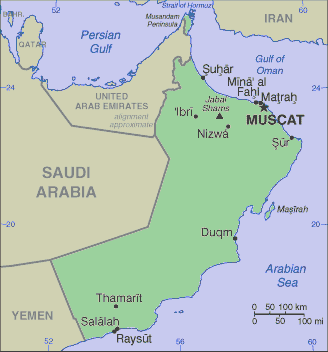
Oman is located in Middle East, bordering the Arabian Sea, Gulf of Oman, and Persian Gulf, between Yemen and UAE.
Land in Oman is central desert plain, rugged mountains in north and south.
Omani land covers an area of 212460 square kilometers which is slightly smaller than Kansas
As for the Omani climate; dry desert; hot, humid along coast; hot, dry interior; strong southwest summer monsoon (May to September) in far south.
Omani(s) speak Arabic (official), English, Baluchi, Urdu, Indian dialects.
In 1970, QABOOS bin Said al-Said ousted his father and has ruled as sultan ever since. His extensive modernization program has opened the country to the outside world and has preserved a longstanding political and military relationship with the UK. Oman's moderate, independent foreign policy has sought to maintain good relations with all Middle Eastern countries.
Country profile: Oman
The oldest independent state in the Arab world, Oman is one of the more traditional countries in the Gulf region and was, until the 1970s, one of the most isolated.
Occupying the south-east corner of the Arabian peninsula, it has a strategically important position at the mouth of the Gulf.
At one time Oman had its own empire, which at its peak in the 19th century stretched down the east African coast and vied with Portugal and Britain for influence in the Gulf and Indian Ocean.
Oman under Sultan Said bin Taimur, who came to power in 1938, experienced decades of international isolation, a society run along feudal lines and internal rebellion.
AT-A-GLANCE- Politics: Sultan Qaboos seized power in 1970 and rules by decree; he has moved to increase popular participation in decision making
- Economy: Oman is heavily dependent on oil; a diversification drive includes tourism; the policy of Omanisation aims to replace expatriate workers with locals
- International: Oman is a long-standing US ally; there is a free trade agreement between the two countries

After deposing his father in 1970, Sultan Qaboos Bin Said opened up the country, embarked on economic reforms and boosted spending on health, education and welfare.
As with other Gulf nations, oil is the mainstay of the economy, providing a large chunk of GDP, but compared to its neighbours Oman is a modest producer. Agriculture and fishing are important sources of income.
Tourism, another source of revenue, is on the rise. Oman's attractions include a largely-untouched coastline, mountains, deserts and the burgeoning capital Muscat, with its forts, palaces and old walled city.
Most Omanis follow the Ibadi sect of Islam - the only remaining expression of Kharijism, which was created as a result of one of the first schisms within the religion.
The country has so far been spared the militant Islamist violence that has plagued some of its neighbours.
- Full name: Sultanate of Oman
- Population: 3 million (UN, 2005)
- Capital: Muscat
- Area: 309,500 sq km (119,500 sq miles)
- Major language: Arabic
- Major religion: Islam
- Life expectancy: 73 years (men), 76 years (women) (UN)
- Monetary unit: 1 Rial = 1000 biaza
- Main export: Oil
- GNI per capita: US $9,070 (World Bank, 2006)
- Internet domain: .om
- International dialling code: +968
Sultan, prime minister, foreign minister: Qaboos Bin Said Al Said
Sultan Qaboos seized power in a coup against his father, Said Bin Taimur, in 1970.
As sultan, he took on the role of prime minister and heads the foreign, defence and finance ministries.
His policies have proved popular in spite of the lack of a democratic government. He instigated the use of oil revenues to develop the country's infrastructure and modernised the government structure with the establishment of a Consultative Assembly in 1981, replaced by the Consultative Council - the majlis al-shura - in 1990 and the Council of State in 1997.
However, all important decisions are still made by the sultan.
The government operates Oman's television and radio stations. However, the go-ahead has been given for private, Omani-owned radio and TV stations.
The use of satellite dishes is permitted and stations from Saudi Arabia, the UAE and Yemen may also be picked up.
A press act allows the government to censor publications for political or cultural reasons.
There are more than 20 publications, including dailies and weeklies.
Press
Al-Watan - daily
Oman Daily - Arabic-language daily Oman Observer - English-language
Times of Oman - English-language
Television
Oman TV - state-run
Radio
Radio Oman - state-run, operates Arabic and English-language networks
News agency
Oman News Agency
Oman is a middle-income economy in the Middle East with notable oil and gas resources, a substantial trade surplus, and low inflation. Work on a new liquefied natural gas (LNG) facility progressed in 2005 and will contribute to slightly higher oil and gas exports in 2006. Oman continues to liberalize its markets and joined the World Trade Organization (WTO) in November 2000. To reduce unemployment and limit dependence on foreign labor, the government is encouraging the replacement of foreign expatriate workers with local workers. Training in information technology, business management, and English support this objective. Industrial development plans focus on gas resources, metal manufacturing, petrochemicals, and international transshipment ports. In 2005, Oman signed agreements with several foreign investors to boost oil reserves, build and operate a power plant, and develop a second mobile phone network in the country.
Omani natural resources include petroleum, copper, asbestos, some marble, limestone, chromium, gypsum, natural gas
strategic location on Musandam Peninsula adjacent to Strait of Hormuz, a vital transit point for world crude oil
Omani religion is Ibadhi Muslim 75%, Sunni Muslim, Shi'a Muslim, Hindu.
Natural hazards in Oman include summer winds often raise large sandstorms and dust storms in interior; periodic droughts.
Oman
This advice has been reviewed and reissued with an amendment to the Road Safety section (driving outside Muscat). The overall level of the advice has not changed.
SUMMARY
- You should be aware of the threat from terrorism. Al Qa’ida continues to issue statements threatening to carry out attacks in the Gulf region. These include references to attacks on Western interests, including residential compounds, military, oil, transport and aviation interests.
- You should review your security arrangements carefully. You should remain vigilant, particularly in public places. You should avoid any large gatherings or demonstrations.
- Around 95,000 British tourists visit Oman every year. The main type of incident for which British nationals require consular assistance in Oman is for road related incidents.
- We strongly recommend that you obtain comprehensive travel and medical insurance before travelling. You should check any exclusions, and that your policy covers you for the activities you want to undertake. Please see: Travel Insurance.
SAFETY AND SECURITY
Developments in Iraq and on the Middle East Peace Process continue to have an impact on local public opinion in the region. You should be aware of local sensitivities on these issues. You should follow news reports and be alert to local and regional developments, which might trigger public disturbances.
You should take sensible precautions for your personal safety and avoid public gatherings and demonstrations.
Road Safety
Driving at night can be dangerous outside Muscat, as there is a risk of hitting camels that stray on the road. Rental and company vehicles particularly have been vulnerable to robbery in the Thumrait, Marmul and Nimr area of Southern Oman. If you rent a car, you should take advice on security from the hire company before undertaking travel. All off road travel should be with at least two vehicles suitably equipped in case of emergencies. If you are intending such travel, you should take out sufficient insurance to meet the costs of a major rescue operation.
Driving is on the right. The standards of the roads in Muscat and between Muscat and Nizwa in the interior are good. Driving standards are generally high, by regional levels, but drivers do tend to speed and tailgate. Extra vigilance should be taken when driving outside Muscat on main roads, which are not dual carriageways, as drivers can overtake with little consideration for oncoming traffic.
You should not to offend local culture when driving, e.g. through abusive gestures or language. This can lead to complaints being lodged with the police, who have been taking forward cases of reported insulting behaviour to Omani citizens.
If you are travelling alone by car at night it is prudent (especially if you are a woman) to lock all doors and ensure car windows are closed.
Sea Safety
Many areas of the Gulf are highly sensitive, including near maritime boundaries and the islands of Abu Musa and the Tunbs in the southern Gulf. Vessels entering these areas have been detained and inspected; and there have been occasional arrests. Mariners should make careful enquiries before entering these waters or considering visiting ports.
On 30 March 2006, a Dhow capsized in Bahrain. There were 58 fatalities, including 12 British nationals. You should exercise care when travelling by Dhow, as the safety of these vessels may not be up to UK standards. You should also ensure that life jackets are available.
LOCAL LAWS AND CUSTOMS
We strongly recommend that British visitors to Oman and British citizens who are resident in Oman carry a copy of their passport or their Omani ID at all times.
Seat belts must be worn in the front seats and you are not allowed to use a mobile phone whilst driving (you can be given an on-the-spot fine). Speed limits are clearly posted on major roads. There is a minimum 48 hours in jail for any traffic offence in which the driver tests positive for alcohol. (The legal blood alcohol level in Oman is close to zero). Traffic laws in Oman are strictly imposed.
The import (even temporary) of right hand drive vehicles is not allowed.
Oman is a Muslim state and Islamic customs, in public, are strictly observed.
In public, general modesty of behaviour and dress is expected. Women who wear shorts or tight-fitting clothes, in particular in downtown areas, are likely to attract unwelcome attention. There have been some reported cases of sexual harassment.
The import and use of narcotics and obscene material are forbidden and can lead to imprisonment. There are severe penalties for drug offences including, in some cases, the death penalty. "Soft" drugs are treated as seriously as "hard" drugs. Possession of cannabis, even in quantities of less than one gram, will bring a minimum prison sentence of 12 months followed by deportation. Non-Muslims can import alcohol, to a maximum of 2 litres per family. It can be bought at a duty free shop at the airport on arrival, but within Oman, alcohol can be purchased only by personal licence or at licensed hotels and restaurants. Pork products are available at specially licensed food outlets.
Homosexual behaviour is illegal in Oman.
ENTRY REQUIREMENTS
British passport holders can obtain an entry visa upon arrival at any land, sea or air entry port in Oman. There are two options:
-
A one-month combined tourist/business visa costing 6 Omani Rials (OR). This can be extended for one month for a further 6 OR;
-
A one year multiple entry visa, which is valid for three weeks, after which nationals must leave Oman for at least three weeks before returning. The cost for this is 10 OR.
Overstaying without the proper authority can lead to fines of 10 OR per day. You are advised to check visa requirements well in advance with: Omani Representation in London
Some prescription medicines common in the United Kingdom are banned in Oman. If you are travelling to Oman with prescription drugs you should carry a copy of the prescription. Not to do so can be an offence if the drugs are on the banned list, and the penalties, including prison, can be severe. If you have any queries, you are advised to check well in advance with Oman's Ministry of Health or with: Omani Representation in London, from whom a list of banned drugs is available.
Single parents or other adults travelling alone with children should be aware that some countries require documentary evidence of parental responsibility before allowing lone parents to enter the country or, in some cases, before permitting the children to leave the country. For further information on exactly what will be required at immigration please contact: Omani Representation in London
HEALTH
We strongly recommend that you obtain comprehensive travel and medical insurance before travelling. You should check any exclusions, and that your policy covers you for the activities you want to undertake. Please see: Travel Insurance
You should seek medical advice before travelling and ensure that all appropriate vaccinations are up-to-date. For further information on health, check the Department of Health website at www.dh.gov.uk
GENERAL
If things go wrong when overseas, please see: What We Can Do To Help
You or your tour company should register your presence in Oman with the British Embassy in Muscat.