
 Search
Traveling Luck for Maldives. Maldives, Asia
Maldives is located in Southern Asia, group of atolls in the Indian Ocean, south-southwest of India.
Land in Maldives is flat, with white sandy beaches.
Maldivian land covers an area of 300 square kilometers which is about 1.7 times the size of Washington, DC
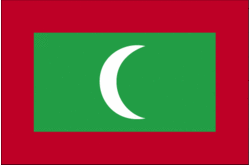 Maldivian national flag (Flag of Maldives)
 Maldives country profile
 Travel advice for Maldives
As for the Maldivian climate; tropical; hot, humid; dry, northeast monsoon (November to March); rainy, southwest monsoon (June to August).
Maldivian(s) speak Maldivian Dhivehi (dialect of Sinhala, script derived from Arabic), English spoken by most government officials.
Places of note in Maldives
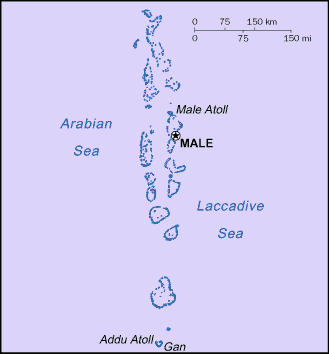 Maldivian map
Regions of Maldives
The Maldives was long a sultanate, first under Dutch and then under British protection. It became a republic in 1968, three years after independence. Since 1978, President Maumoon Abdul GAYOOM - currently in his sixth term in office - has dominated the islands' political scene. Following riots in the capital Male in August 2004, the president and his government have pledged to embark upon democratic reforms, including a more representative political system and expanded political freedoms. Tourism and fishing are being developed on the archipelago.
Tourism, Maldives' largest industry, accounts for 20% of GDP and more than 60% of the Maldives' foreign exchange receipts. Over 90% of government tax revenue comes from import duties and tourism-related taxes. Fishing is a second leading sector. The Maldivian Government began an economic reform program in 1989 initially by lifting import quotas and opening some exports to the private sector. Subsequently, it has liberalized regulations to allow more foreign investment. Agriculture and manufacturing continue to play a lesser role in the economy, constrained by the limited availability of cultivable land and the shortage of domestic labor. Most staple foods must be imported. Industry, which consists mainly of garment production, boat building, and handicrafts, accounts for about 18% of GDP. Maldivian authorities worry about the impact of erosion and possible global warming on their low-lying country; 80% of the area is one meter or less above sea level. In late December 2004, a major tsunami left more than 100 dead, 12,000 displaced, and property damage exceeding $300 million. Over the past decade, real GDP growth averaged over 7.5% per year. As a result of the tsunami, the GDP contracted by about 5.5% in 2005.
Maldivian natural resources include fish
1,190 coral islands grouped into 26 atolls (200 inhabited islands, plus 80 islands with tourist resorts); archipelago with strategic location astride and along major sea lanes in Indian Ocean
Maldivian religion is Sunni Muslim.
Natural hazards in Maldives include low level of islands makes them very sensitive to sea level rise.
Travel Advice for Maldives
MaldivesSUMMARY
- There is no British diplomatic mission in Maldives. A Consular Correspondent in Malé can liaise with the British High Commission in Sri Lanka on emergency consular matters.
- You should avoid demonstrations or large gatherings as some demonstrations on Malé island and in non-resort islands, have ended in violence.
- The threat from terrorism is low. But you should be aware of the global risk of indiscriminate terrorist attacks which could be against civilian targets, including places frequented by foreigners.
- Possession of illegal drugs carries severe penalties.
- Public observance of any religion other than Islam is prohibited.
- The main types of incident for which British nationals require consular assistance in Maldives are replacing lost passports and swimming/diving related accidents. Petty crime occurs: you should take care of your valuables and other personal possessions.
- We recommend that all British nationals who are resident and/or working in Maldives register with the British High Commission in Colombo.
- We strongly recommend that you obtain comprehensive travel and medical insurance before travelling. You should check any exclusions, and that your policy covers you for the activities you want to undertake. Please see: Travel Insurance
SAFETY AND SECURITY
Crime
Crime levels in Maldives are relatively low, but petty crime, including the theft of goods left unattended on the beach or in hotel rooms, does occur. You should take care of your valuables and other personal possessions. Use safe deposit boxes on island resorts.
Political Situation
Maldives is undergoing a period of political reform. There have been some demonstrations on the capital island of Malé and non-resort islands, which have ended in violence. The majority of visitors to Maldives do not go to the capital island of Malé or other affected islands (the international airport is on a separate island within the larger Malé atoll). Visitors to Malé island and non-resort islands should avoid any demonstrations, or large political gatherings.
Maldives Country Profile
Local Travel
The authorities in Maldives generally restrict travel by foreign visitors to the capital island, Malé, and resort islands. Advance approval is normally required to visit most non-resort islands. Travel between islands is by boat or seaplane, and many of these services stop before sunset.
LOCAL LAWS AND CUSTOMS
ENTRY REQUIREMENTS
HEALTH
You should seek medical advice before travelling and ensure that all appropriate vaccinations are up-to-date. For further information on health, check the Department of Health website at www.dh.gov.uk.
NATURAL DISASTERS
Maldives was hit by the December 2004 tsunami. More than 90 people were killed. There was serious damage to a number of islands, including 19 resort islands. The large majority of resorts affected are now operating normally. Check with your tour operators and/or hotel for the latest information.
GENERAL
Island resorts in Maldives are generally expensive and you should bring sufficient funds. There are no cash machines and travellers' cheques are used infrequently. Major credit cards are accepted at most resorts and hotels. US dollars can be exchanged at the airport, banks or hotels.
There is no British diplomatic mission in Maldives. Enquiries before travel should be directed to the British High Commission in Sri Lanka (see Contact Details below).
There is a British Consular Correspondent in Maldives who will liaise with the British High Commission in Sri Lanka on emergency consular matters. Contact c/o Dhiraagu, 19 Medhuziyaaraiy Magu, Malé, Republic of Maldives: Tel: +960 322 802 (switchboard); Fax: +960 317981); email: UKconsular@dhiraagu.com.mv.