
 Search
Traveling Luck for Iraq. Iraq, Asia
Iraq is located in Middle East, bordering the Persian Gulf, between Iran and Kuwait.
Land in Iraq is mostly broad plains; reedy marshes along Iranian border in south with large flooded areas; mountains along borders with Iran and Turkey.
Iraqi land covers an area of 437072 square kilometers which is slightly more than twice the size of Idaho
Iraq has borders with Iran for 1458km, Jordan for 181km, Kuwait for 240km, Saudi Arabia for 814km, Syria for 605km and Turkey for 352km.
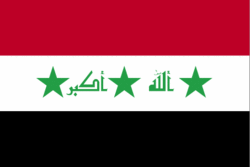 Iraqi national flag (Flag of Iraq)
 Iraq country profile
 Travel advice for Iraq
As for the Iraqi climate; mostly desert; mild to cool winters with dry, hot, cloudless summers; northern mountainous regions along Iranian and Turkish borders experience cold winters with occasionally heavy snows that melt in early spring, sometimes causing extensive flooding in central and southern Iraq.
Iraqi(s) speak Arabic, Kurdish (official in Kurdish regions), Assyrian, Armenian.
Places of note in Iraq
- Baghdad
- Al Mawşil al Jadīdah
- Al Başrah al Qadīmah
- Arbīl
- As Sulaymānīyah
- Kirkuk
- An Najaf
- Karbalā'
- An Nāşirīyah
- Al `Amārah
- Ad Dīwānīyah
- Al Kūt
- Al Ḩillah
- Ar Ramādī
- Al Fallūjah
- Sāmarrā'
- As Samāwah
- Ba`qūbah
- Sīnā
- Az Zubayr
- Al Fāw
- Zakho
- Al Hārithah
- Ash Shaţrah
- Al Ḩayy
- Chamchamal
- Al Khāliş
- Tozkhurmato
- Ash Shāmīyah
- Al Hindīyah
- Ḩalabjah
- Al Miqdādīyah
- Ar Rumaythah
- Koi Sanjaq
- Al `Azīzīyah
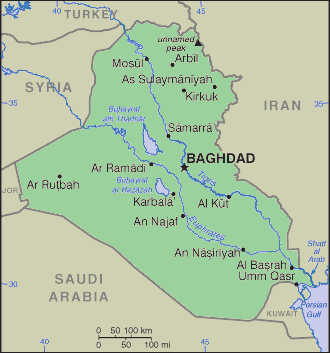 Iraqi map
Regions of Iraq
Formerly part of the Ottoman Empire, Iraq was occupied by Britain during the course of World War I; in 1920, it was declared a League of Nations mandate under UK administration. In stages over the next dozen years, Iraq attained its independence as a kingdom in 1932. A "republic" was proclaimed in 1958, but in actuality a series of military strongmen ruled the country, the latest was SADDAM Husayn. Territorial disputes with Iran led to an inconclusive and costly eight-year war (1980-88). In August 1990, Iraq seized Kuwait, but was expelled by US-led, UN coalition forces during the Gulf War of January-February 1991. Following Kuwait's liberation, the UN Security Council (UNSC) required Iraq to scrap all weapons of mass destruction and long-range missiles and to allow UN verification inspections. Continued Iraqi noncompliance with UNSC resolutions over a period of 12 years led to the US-led invasion of Iraq in March 2003 and the ouster of the SADDAM Husayn regime. Coalition forces remain in Iraq, helping to restore degraded infrastructure and facilitating the establishment of a freely elected government, while simultaneously dealing with a robust insurgency. The Coalition Provisional Authority, which temporarily administered Iraq after the invasion, transferred full governmental authority on 28 June 2004, to the Iraqi Interim Government (IG), which governed under the Transitional Administrative Law for Iraq (TAL). Under the TAL, elections for a 275-member Transitional National Assembly (TNA) were held in Iraq on 30 January 2005. Following these elections, the Iraqi Transitional Government (ITG) assumed office. The TNA was charged with drafting Iraq's permanent constitution, which was approved in a 15 October 2005 constitutional referendum. An election under the constitution for a 275-member Council of Representatives (CoR) was held in December 2005. The CoR approval in the selection of most of the cabinet ministers on 20 May 2006 marked the transition from the ITG to Iraq's full-term government.
Iraq's economy is dominated by the oil sector, which has traditionally provided about 95% of foreign exchange earnings. Iraq's seizure of Kuwait in August 1990, subsequent international economic sanctions, and damage from military action by an international coalition beginning in January 1991 drastically reduced economic activity. Although government policies supporting large military and internal security forces and allocating resources to key supporters of the regime hurt the economy, implementation of the UN's oil-for-food program, which began in December 1996, helped improve conditions for the average Iraqi citizen. Iraq was allowed to export limited amounts of oil in exchange for food, medicine, and some infrastructure spare parts. In December 1999, the UN Security Council authorized Iraq to export under the program as much oil as required to meet humanitarian needs. Per capita food imports increased significantly, while medical supplies and health care services steadily improved. Per capita output and living standards were still well below the pre-1991 level, but any estimates have a wide range of error. The military victory of the US-led coalition in March-April 2003 resulted in the shutdown of much of the central economic administrative structure. Although a comparatively small amount of capital plant was damaged during the hostilities, looting, insurgent attacks, and sabotage have undermined efforts to rebuild the economy. Attacks on key economic facilities - especially oil pipelines and infrastructure - have prevented Iraq from reaching projected export volumes, but total government revenues have been higher than anticipated due to high oil prices. Despite political uncertainty, Iraq has established the institutions needed to implement economic policy, has successfully concluded a three-stage debt reduction agreement with the Paris Club, and is working toward a Standby Arrangement with the IMF. The Standby Arrangement would clear the way for continued debt relief from the Paris Club.
Iraqi natural resources include petroleum, natural gas, phosphates, sulfur
strategic location on Shatt al Arab waterway and at the head of the Persian Gulf
Iraqi religion is Muslim 97% (Shi'a 60%-65%, Sunni 32%-37%), Christian or other 3%.
Natural hazards in Iraq include dust storms, sandstorms, floods.
Travel Advice for Iraq
IraqSUMMARY
- We strongly advise against all travel to Baghdad and the surrounding area, the provinces of Basra, Maysan, Al Anbar, Salah Ad Din, Diyala, Wasit, Babil, Ninawa and At- Tamim (At -Tamim is often referred to as "Kirkuk Province").
- We advise against all but essential travel to the provinces of Al Qadisiyah, Muthanna, Najaf, Karbala, and Dhi Qar.
- Travellers to the Kurdistan Regional Government controlled provinces of Dohuk, Erbil and Sulaymaniyah (Note: this does not include Kirkuk) should be aware that there remains a serious threat from terrorist groups in the region. You are strongly advised to seek professional security advice and make arrangements for your security throughout your visit.
- The security situation in Iraq remains highly dangerous with a continuing high threat of terrorism and violence targeting foreign nationals, including individuals of non-western appearance.
- The threat of kidnap of foreign nationals across Iraq remains high. There have been many kidnappings, some of which have resulted in the murder of hostages.
- You should consider whether your presence in Iraq is essential. If it is you should review your security arrangements carefully and seek professional security advice on their adequacy. You should register your presence with the British Embassy in Baghdad.
- Curfews exist in many areas of Iraq and may be lengthened at short notice. You should follow all curfew times and avoid large gatherings.
- Outbreaks of Avian Influenza (Bird Flu) near Sulaimaniyah, Northern Iraq have resulted in a small number of human fatalities. As a precaution, you should avoid live animal markets, poultry farms and other places where you may come into contact with domestic, caged or wild birds; and ensure poultry and egg dishes are thoroughly cooked. For further information see the Health section below and also read: Avian and Pandemic Influenza Factsheet.
- The main type of incident for which British nationals require consular assistance in Iraq is for deaths, repatriation of bodies and hospitalisations. The British Embassy in Baghdad is able to offer only limited consular assistance. The British Consulates in Basra and Kirkuk do not currently offer consular services.
- We strongly recommend that you obtain comprehensive travel and medical insurance before travelling. You should check any exclusions, and that your policy covers you for medical assistance and repatriation. Please see: Travel Insurance.
SAFETY AND SECURITY
LOCAL LAWS AND CUSTOMS
ENTRY REQUIREMENTS
HEALTH
The World Health Organisation (WHO) has confirmed two human deaths from the H5N1 Avian Flu (Bird Flu) virus near Sulaimaniyah in the Kurdistan Regional Government administered northern area of Iraq. Since the end of 2003, a number of human deaths from Avian Influenza have occurred in Azerbaijan, Vietnam, Thailand, Indonesia, Cambodia, China and Turkey.
The risk to humans from Avian Influenza is believed to be very low. However, as a precaution, you should avoid visiting live animal markets, poultry farms and other places where you may come into close contact with domestic, caged or wild birds; and ensure poultry and egg dishes are thoroughly cooked.
The WHO has warned of the possibility that the Avian Influenza outbreaks could lead at some point to a human flu pandemic, if the virus mutates to a form which is easily transmissible between people.
British nationals living longer term in an Avian Influenza affected region should take personal responsibility for their own safety in the event of a further pandemic, including considering their access to adequate healthcare and ensuring travel documents are up to date.
You should read this advice in conjunction with the Avian and Pandemic Influenza Factsheet.
GENERAL
OTHER
Iraq Country Profile
For general enquiries please contact Iraq Policy Unit, Foreign & Commonwealth Office, London, SW1A 2AH, telephone 020 7008 1500 or email iraqtraveladvice@fco.gov.uk