
 Search
Traveling Luck for Ethiopia. Ethiopia, Africa
Ethiopia is located in Eastern Africa, west of Somalia.
Land in Ethiopia is high plateau with central mountain range divided by Great Rift Valley.
Ethiopian land covers an area of 1127127 square kilometers which is slightly less than twice the size of Texas
Ethiopia has borders with Djibouti for 349km, Eritrea for 912km, Kenya for 861km, Sudan for 1606km and Somalia for 1600km.
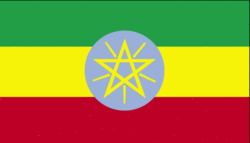 Ethiopian national flag (Flag of Ethiopia)
 Ethiopia country profile
 Travel advice for Ethiopia
As for the Ethiopian climate; tropical monsoon with wide topographic-induced variation.
Ethiopian(s) speak Amharic, Tigrinya, Oromigna, Guaragigna, Somali, Arabic, other local languages, English (major foreign language taught in schools).
Places of note in Ethiopia
- Addis Ababa
- Dirē Dawa
- Nazrēt
- Bahir Dar
- Gonder
- Desē
- Āwasa
- Jīma
- Debre Zeyit
- Kombolcha
- Hārer
- Shashemenē
- Ārba Minch'
- Debre Mark'os
- Debre Birhan
- Jijiga
- Inda Silasē
- Ziway
- Dīla
- Hāgere Hiywet
- Gambēla
- Āksum
- Giyon
- Yirga `Alem
- Mojo
- Goba
- Shakīso
- Felege Neway
- Āreka
- Bodītī
- Debre Tabor
- Jinka
- Gīmbī
- Āsbe Teferī
- Korem
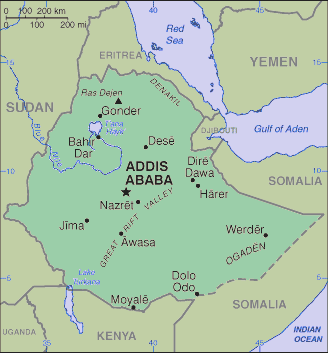 Ethiopian map
Regions of Ethiopia
- Ādīs Ābeba
- Āfar
- Āmara
- Bīnshangul Gumuz
- Dirē Dawa
- (ET01)
- (ET02)
- (ET03)
- (ET04)
- (ET05)
- (ET06)
- (ET07)
- (ET08)
- (ET09)
- (ET10)
- (ET11)
- (ET12)
- (ET13)
- (ET14)
- (ET15)
- (ET17)
- (ET18)
- (ET19)
- (ET20)
- (ET21)
- (ET22)
- (ET23)
- (ET24)
- (ET25)
- (ET26)
- (ET27)
- (ET28)
- (ET29)
- (ET30)
- (ET31)
- (ET32)
- (ET33)
- (ET34)
- (ET35)
- (ET37)
- (ET38)
- (ET39)
- (ET40)
- (ET41)
- (ET42)
- (ET43)
- Ethiopia (general)
- Gambēla Hizboch
- Hārerī Hizb
- Oromīya
- Sumalē
- Tigray
- YeDebub Bihēroch Bihēreseboch na Hizboch
Unique among African countries, the ancient Ethiopian monarchy maintained its freedom from colonial rule with the exception of the 1936-41 Italian occupation during World War II. In 1974, a military junta, the Derg, deposed Emperor Haile SELASSIE (who had ruled since 1930) and established a socialist state. Torn by bloody coups, uprisings, wide-scale drought, and massive refugee problems, the regime was finally toppled in 1991 by a coalition of rebel forces, the Ethiopian People's Revolutionary Democratic Front (EPRDF). A constitution was adopted in 1994, and Ethiopia's first multiparty elections were held in 1995. A border war with Eritrea late in the 1990's ended with a peace treaty in December 2000. Final demarcation of the boundary is currently on hold due to Ethiopian objections to an international commission's finding requiring it to surrender territory considered sensitive to Ethiopia.
Ethiopia's poverty-stricken economy is based on agriculture, accounting for half of GDP, 60% of exports, and 80% of total employment. The agricultural sector suffers from frequent drought and poor cultivation practices. Coffee is critical to the Ethiopian economy with exports of some $156 million in 2002, but historically low prices have seen many farmers switching to qat to supplement income. The war with Eritrea in 1998-2000 and recurrent drought have buffeted the economy, in particular coffee production. In November 2001, Ethiopia qualified for debt relief from the Highly Indebted Poor Countries (HIPC) initiative, and in December 2005 the International Monetary Fund voted to forgive Ethiopia's debt to the body. Under Ethiopia's land tenure system, the government owns all land and provides long-term leases to the tenants; the system continues to hamper growth in the industrial sector as entrepreneurs are unable to use land as collateral for loans. Drought struck again late in 2002, leading to a 2% decline in GDP in 2003. Normal weather patterns late in 2003 helped agricultural and GDP growth recover in 2004-05.
Ethiopian natural resources include small reserves of gold, platinum, copper, potash, natural gas, hydropower
landlocked - entire coastline along the Red Sea was lost with the de jure independence of Eritrea on 24 May 1993; the Blue Nile, the chief headstream of the Nile by water volume, rises in T'ana Hayk (Lake Tana) in northwest Ethiopia; three major crops are believed to have originated in Ethiopia: coffee, grain sorghum, and castor bean
Ethiopian religion is Muslim 45%-50%, Ethiopian Orthodox 35%-40%, animist 12%, other 3%-8%.
Natural hazards in Ethiopia include geologically active Great Rift Valley susceptible to earthquakes, volcanic eruptions; frequent droughts.
Travel Advice for Ethiopia
EthiopiaSUMMARY
- We advise against all travel to the Gambella Region at any time, where continuing unrest and sporadic violence has led to many deaths since December 2003. On 11 June 2006, there was an attack on a bus outside Gambella in which a number of people are believed to have been killed. The situation remains tense.
- We also advise against all travel within 20 kms of the Eritrean border in the Tigray and Afar regions at any time, which remain predominantly military zones. The Ethiopia/Eritrea border remains closed. On 16 October, the UN Mission in Ethiopia and Eritrea reported that Eritrean troops have moved troops and tanks into the Temporary Security Zone (TSZ) separating the two countries. The situation is very tense and could deteriorate extremely rapidly.
- We advise against crossing the Ethiopia/Somalia border by road at any time, and against all travel in the area east of the Harar to Gode line. The outbreak of conflict in Somalia could increase the risk of conflict in Somali Regional State. On 20 September 2006, ICRC confirmed that two aid workers were kidnapped near Gode. Since the mid-1990's, Somali groups affiliated with terrorist organisations have clashed with government forces in the Somali regional state, particularly in the Ogaden region. They may also occasionally operate within the Oromiya, and Afar regions. A number of explosions have occurred in Jijiga, most recently on 3 September 2006.
- There is a high threat from terrorism in Ethiopia; attacks could be against civilian targets including places frequented by foreigners. The Union of Islamic Courts in Somalia have recently made threats against Ethiopia including reportedly claiming to "be on their way to Addis Ababa".
- Following serious disturbances in November 2005, the situation remains unpredictable in Addis Ababa and there are continued reports of incidents, often involving educational establishments. There were explosions in Addis Ababa on 12 May 2006, resulting in four deaths and 43 injured. On 27 March 2006, there were five explosions in various parts of Addis Ababa, killing one person and injuring 17. As yet, nobody has claimed responsibility.
- At all times, we advise you to remain extremely vigilant if in public places and avoid any public demonstrations and large gatherings of people.
- If you are visiting Ethiopia either on a long or short-term basis, you should register with the British Embassy in Addis Ababa on arrival. Full details are on the Embassy website, see below.
- Around 8,000 British tourists visit Ethiopia each year. The main type of incident for which British nationals require consular assistance in Ethiopia is for lost passports/stolen property.
- We strongly recommend that you obtain comprehensive travel and medical insurance before travelling. You should check any exclusions, and that your policy covers you for the activities you want to undertake. Please see: Travel Insurance.
SAFETY AND SECURITY
General elections took place in Ethiopia on 15 May 2005. Final results were announced on 5 September 2005. On 8 June 2005, localised clashes between protestors and police in Addis Ababa resulted in over 30 deaths and large numbers were detained. In early November 2005, serious disturbances across the capital resulted in further deaths. There were further demonstrations and violence in Addis Ababa on 19 and 20 January 2006 and a number of small bomb explosions occurred.
Although the violence in Addis Ababa and other towns across Ethiopia has abated, the situation remains unpredictable.
Explosions occurred in Addis Ababa and Ambo on 22 and 23 January 2006 and also in March 2006 (see above). The motivation behind these incidents is not clear. Further violence, whether in Addis Ababa or elsewhere in Ethiopia, could flare up at any time. There continue to be small scale disturbances involving confrontation between security forces and educational establishments in Addis Ababa, Oromiya, and Gondar. We advise you to be prudent and keep a low profile, avoid public demonstrations and large crowds and remain vigilant in public places throughout the country.
On Friday 4 August and Friday 11 August 2006, there were demonstrations in Piazza and Mercato areas of Addis Ababa by young Muslims, frustrated at the closure of an informal prayer site. On 26 September and 15 October 2006, in Jimma Zone, Agaro town, clashes between Christians and Muslims are reported to have resulted in a number of deaths.
There was tension between the authorities and local residents in mid March 2006 around the Shakisso and Bore areas in Southern Ethiopia. Although the situation appears to have calmed, it could re-ignite with little warning.
There were reports of unrest in Nazret (on the main road South East of Addis Ababa) overnight on 26/27 May, resulting in one person killed and five others injured (according to police reports).
Crime
We advise against all travel to the Gambella Region at any time. Continuing unrest and sporadic violence has led to many deaths since December 2003, when a number of UN personnel were ambushed and killed. In October 2005, a further outbreak of violence resulted in the death of police officers and civilians. On 11 June, there was an attack on a bus travelling from Addis, which resulted in an unconfirmed number of deaths. The situation remains unpredictable.
Explosive devices, such as grenades, are readily obtainable throughout Ethiopia and are occasionally used during domestic disputes. You should remain vigilant in public places throughout the country. Incidents involving British nationals are few and far between and are usually a case of being in the wrong place at the wrong time.
Banditry is a problem along border areas, particularly with Somalia.
Petty theft is common particularly in the Piazza or Mercato areas of Addis Ababa. Keep valuables, particularly cameras and passports out of sight. Be aware of bag and jewellery snatching, pick-pocketing and opportunistic snatching from vehicles stopped at traffic lights in Addis Ababa.
Local Travel
We advise against all travel to the Gambella Region following continuing unrest in the area that has resulted in many deaths (see Crime section above).
We advise against all travel within 20kms of the Eritrean border in the Tigray and Afar regions, which remain a predominantly military zone. On 16 October, the UN Mission in Ethiopia and Eritrea reported that Eritrean troops have moved troops and tanks into the Temporary Security Zone (TSZ) separating the two countries. Tensions are increasing and the border remains closed. The situation is very volatile and could deteriorate extremely rapidly.
There are occasional acts of banditry in more remote areas. The most recent incident was an attack on a tourist bus west of the town Awash, on 7 November 2005. A government opposition group has issued a warning of reprisals against foreigners working on the Ethiopia/Eritrea border demarcation taking place in the Afar region. There is also a strict no fly zone in force between Ethiopia and Eritrea. Eritrea has recently extended the ban to UN aircraft operating within Eritrea. There have been troop movements on both sides of the border. Tensions are increasing and the border remains closed. The situation is very volatile and could deteriorate rapidly.
Since the mid-1990's, insurgent groups, some affiliated with terrorist organisations have clashed with government forces in the Somali regional state, particularly in the Ogaden region. They may also occasionally operate within the Oromiya, and Afar regions. There were reports in late May 2006, of rioting in Jijiga. We advise against crossing the Ethiopia/Somalia border by road, and against all travel in the area east of the Harar to Gode line. On 20 September 2006, ICRC confirmed that two aid workers were kidnapped near Gode It is not clear who is responsible for the abduction.
If you intend to travel into the Republic of Djibouti by road or rail, you should check with the British Embassy in Addis Ababa on the current situation before setting off. We advise particular caution if travelling in the Kenya/Ethiopia border region. If crossing into Kenyaor Sudan, keep to the main road and seek advice from local authorities about travelling in convoy. If travelling overland to Kenya via Moyale, we recommend that you consult the FCO Travel Advice for Kenya.
Since the beginning of August 2006, severe floods have affected some areas of Ethiopia, in particular the town of Dire Dawa, and South Omo Zone. Government sources report that over 600 people have been killed and tens of thousands displaced Dams are at critical levels in some areas. You should keep yourself abreast of local and international news and contact the British Embassy for latest information.
Independent travellers should keep themselves abreast of local and international news and contact the British Embassy for latest information before travelling to more remote areas off the tourist route. Avoid driving after dark in rural areas: vehicles often have no lights and livestock may be roaming the roads.
LOCAL LAWS AND CUSTOMS
There is a large Moslem population and generally Ethiopians dress in a conservative manner. Ethiopian antiques need an export certificate to be taken out of the country. Major tourist outlets in Addis Ababa can offer assistance in obtaining one.
Male homosexual behaviour is illegal and carries a penalty of up to five years imprisonment. Although there is no provision under Ethiopian law for lesbianism there is the presumption that the punishment would be the same.
Drug offences are treated seriously in Ethiopia. You should not become involved with drugs of any kind.
ENTRY REQUIREMENTS
Single parents or other adults travelling alone with children should be aware that some countries require documentary evidence of parental responsibility before allowing lone parents to enter the country, or in some cases, before permitting the children to leave the country. For further information on exactly what will be required at immigration, please contact the Ethiopian representation in the UK.
Since 1 November 2005, all airport departure taxes for international flights departing Ethiopia and for internal flights within Ethiopia are no longer collected on departure as they are now included in the price of airline tickets.
HEALTH
GENERAL
Credit cards are accepted at only a very few outlets in Addis Ababa. It is not normally possible to obtain currency advances against a credit card in Ethiopia. You should ensure you have an adequate supply of hard currency or travellers-cheques.
British nationals, visiting Ethiopia either on a long or short-term basis should register with the British Embassy in Addis Ababa on arrival. Full details are on the Embassy website, see below. Please ensure you keep your entry up to date.