
 Search
Traveling Luck for Chad. Chad, Africa
Chad is located in Central Africa, south of Libya.
Land in Chad is broad, arid plains in center, desert in north, mountains in northwest, lowlands in south.
Chadian land covers an area of 1284000 square kilometers which is slightly more than three times the size of California
Chad has borders with Central African Republic for 1197km, Cameroon for 1094km, Libya for 1055km, Niger for 1175km, Nigeria for 87km and Sudan for 1360km.
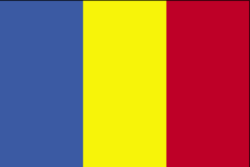 Chadian national flag (Flag of Chad)
 Chad country profile
 Travel advice for Chad
As for the Chadian climate; tropical in south, desert in north.
Chadian(s) speak French (official), Arabic (official), Sara (in south), more than 120 different languages and dialects.
Places of note in Chad
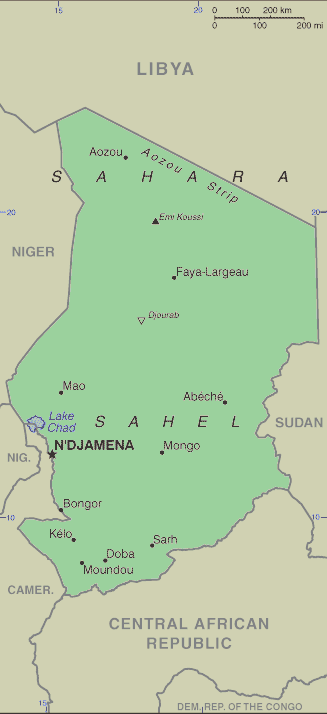 Chadian map
Regions of Chad
Chad, part of France's African holdings until 1960, endured three decades of civil warfare as well as invasions by Libya before a semblance of peace was finally restored in 1990. The government eventually drafted a democratic constitution, and held flawed presidential elections in 1996 and 2001. In 1998, a rebellion broke out in northern Chad, which sporadically flares up despite several peace agreements between the government and the rebels. In 2005 new rebel groups emerged in western Sudan and have made probing attacks into eastern Chad. Power remains in the hands of an ethnic minority. In June 2005, President Idriss DEBY held a referendum successfully removing constitutional term limits.
Chad's primarily agricultural economy will continue to be boosted by major foreign direct investment projects in the oil sector that began in 2000. Over 80% of Chad's population relies on subsistence farming and livestock raising for its livelihood. Chad's economy has long been handicapped by its landlocked position, high energy costs, and a history of instability. Chad relies on foreign assistance and foreign capital for most public and private sector investment projects. A consortium led by two US companies has been investing $3.7 billion to develop oil reserves - estimated at 1 billion barrels - in southern Chad. The nation's total oil reserves has been estimated to be 2 billion barrels. Oil production came on stream in late 2003. Chad began to export oil in 2004. Cotton, cattle, and gum arabic provide the bulk of Chad's non-oil export earnings.
Chadian natural resources include petroleum, uranium, natron, kaolin, fish (Lake Chad), gold, limestone, sand and gravel, salt
landlocked; Lake Chad is the most significant water body in the Sahel
Chadian religion is Muslim 51%, Christian 35%, animist 7%, other 7%.
Natural hazards in Chad include hot, dry, dusty harmattan winds occur in north; periodic droughts; locust plagues.
Travel Advice for Chad
ChadSUMMARY
- We advise against all but essential travel to N’djamena and against all travel to the rest of Chad. On 13 November 2006, the Government of Chad issued a State of Emergency in a number of eastern regions of Chad and the capital, N’Djamena. The State of Emergency also reinstated censorship of the independent media and forbade radio coverage of issues “affecting public order.
- If you are in eastern Chad, or in the area bordering Sudan/the Central African Republic (CAR) you should consider whether your presence is essential; if not you should consider leaving. There has been heavy fighting in this area. Please see the Political Situation of this travel advice for more details.
- Further rebel attacks, especially in eastern Chad, cannot be ruled out. If, against our advice, you decide to remain in eastern Chad or the areas near the borders with Sudan/the CAR, you should keep a low profile, seek local advice and continue to monitor this travel advice.
- The overall political and security situation is uncertain, and could change rapidly. If you do travel to Chad, we recommend that you keep abreast of events through the local media and ensure that you are registered with the British High Commission in Yaoundé.
- There is no British Embassy in Chad.
- You should carry identification at all times (either a residence permit or a certified copy of your passport). Failure to produce such identification can lead to detention by the police.
The borders with Sudan, Libya and the CAR are subject to closure at little or no notice. - You should also be aware of the global risk of indiscriminate terrorist attacks, which could be against civilian targets, including places frequented by foreigners.
- More than 900 cases of Cholera have been reported in Chad since April 2006, more than 200 of these in the capital N'Djamena. Please see the Health section of this travel advice for more details.
- We strongly recommend that you obtain comprehensive travel and medical insurance before travelling. You should check any exclusions, and that your policy covers you for the activities you want to undertake. Please see: Travel Insurance.
SAFETY AND SECURITY
Crime
Incidents of petty theft and theft from vehicles occur. There are also reports of armed robbery, sometimes targeting expatriates. Highway bandits are known to operate in Chad. There is a high level of banditry; much of it car–jacking, south of Goz Beida. You should take sensible personal security precautions. We recommend that you avoid carrying valuables or wearing jewellery in public and avoid isolated or poorer areas of towns. You should avoid walking around and travelling at night.
Political Situation
Chad Country Profile.
Local Travel
We advise against all but essential travel to N’djamena and against all travel to the rest of Chad. If, against our advice, you decide to travel, you should exercise caution, seek local advice, and ensure you register with the British High Commission in Yaoundé.
Air Safety
The European Commission has published a list of air carriers that are subject to an operating ban or restrictions within the European Union. You should check http://europa.eu.int/comm/transport/air/safety/flywell_en.htm to see whether this will affect your travel.
British Government employees do not use domestic flights run by Chadian airline companies unless this is unavoidable. You should bear this in mind when making your travel plans.
LOCAL LAWS AND CUSTOMS
Penalties for the use and possession of drugs are severe and usually include a prison sentence.
Homosexuality is not widely accepted in central African society and some sexual acts between members of the same sex are illegal.
Photography of military sites, government buildings and airports is prohibited. Other photography requires a government permit.
You should carry identification at all times (either a residence permit or a certified copy of your passport). Failure to produce such identification can lead to detention by the police.
ENTRY REQUIREMENTS
You will be asked to produce a yellow fever vaccination certificate on arrival in the country. Failure to do so may result in a further vaccination being administered, for which a charge is made.
Single parents or other adults travelling alone with children should be aware that some countries require documentary evidence of parental responsibility before allowing lone parents to enter the country or, in some cases, before permitting the children to leave the country. For further information on exactly what will be required at immigration please contact the Chadian Embassies in Brussels or Paris.
HEALTH
Medical facilities are poor. Hospitals in N’Djamena are sometimes affected by strikes by Government workers. You need to keep in mind the possibility that medical services, stretched at the best of times, may be even less responsive than usual.
Water-borne diseases, HIV/AIDS and malaria are prevalent. More than three-quarters of British travellers who contracted malaria in 2005 did not take preventive measures, such as malaria prevention tablets. However, malaria can occur despite appropriate prevention, and therefore you should promptly seek medical care in the event of a fever or flu-like illness in country or in the first year following your return from travelling to a malaria risk country. Before travelling you should seek medical advice about the malaria risk in Chad. You should drink only bottled water.
Since 2001 Chad has experienced several serious outbreaks of cholera, measles, hepatitis E and meningitis. Meningitis outbreaks are especially common in the south of the country, which lies within the African meningitis belt stretching from Senegal to Ethiopia. More than 900 cases of cholera have been reported in Chad since April this year, more than 200 of these in the capital N’Djamena. Ensure hygiene at home, drink only bottled water when out and avoid food and drink from street vendors.
You should seek medical advice before travelling and ensure that all appropriate vaccinations are up to date. For further information visit the Department of Health website at www.dh.gov.uk.
GENERAL
There is no British Embassy in Chad.
All visitors should register their presence with the High Commission in Yaoundé, Cameroon. This is easily done by e-mail. Full contact details are given below.
You should carry identification at all times (either a residence permit or a certified copy of your passport). Failure to produce such identification can lead to detention by the police.