
 Search
Traveling Luck for Benin. Benin, Africa
Benin is located in Western Africa, bordering the Bight of Benin, between Nigeria and Togo.
Land in Benin is mostly flat to undulating plain; some hills and low mountains.
Beninese land covers an area of 112620 square kilometers which is slightly smaller than Pennsylvania
Benin has borders with Burkina Faso for 306km, Niger for 266km, Nigeria for 773km and Togo for 644km.
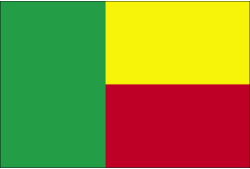 Beninese national flag (Flag of Benin)
 Benin country profile
 Travel advice for Benin
As for the Beninese climate; tropical; hot, humid in south; semiarid in north.
Beninese (singular and plural) speak French (official), Fon and Yoruba (most common vernaculars in south), tribal languages (at least six major ones in north).
Places of note in Benin
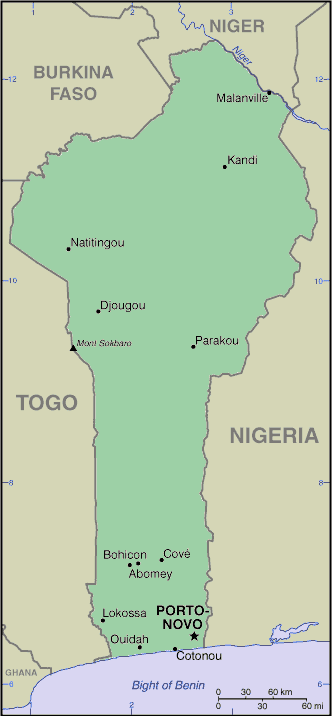 Beninese map
Regions of Benin
Present day Benin was the site of Dahomey, a prominent West African kingdom that rose in the 15th century. The territory became a French Colony in 1872 and achieved independence on 1 August 1960, as the Republic of Benin. A succession of military governments ended in 1972 with the rise to power of Mathieu KEREKOU and the establishment of a government based on Marxist-Leninist principles. A move to representative government began in 1989. Two years later, free elections ushered in former Prime Minister Nicephore SOGLO as president, marking the first successful transfer of power in Africa from a dictatorship to a democracy. KEREKOU was returned to power by elections held in 1996 and 2001, though some irregularities were alleged.
The economy of Benin remains underdeveloped and dependent on subsistence agriculture, cotton production, and regional trade. Growth in real output has averaged around 5% in the past six years, but rapid population growth has offset much of this increase. Inflation has subsided over the past several years. In order to raise growth still further, Benin plans to attract more foreign investment, place more emphasis on tourism, facilitate the development of new food processing systems and agricultural products, and encourage new information and communication technology. Many of these proposals are included in Benin's application to receive Millennium Challenge Account funding - for which it was a finalist in 2004-05. The 2001 privatization policy continues in telecommunications, water, electricity, and agriculture in spite of government reluctance. The Paris Club and bilateral creditors have eased the external debt situation, with Benin benefiting from a G8 debt reduction announced in July 2005, while pressing for more rapid structural reforms. Benin continues to be hurt by Nigerian trade protection that bans imports of a growing list of products from Benin and elsewhere, which has resulted in increased smuggling and criminality in the border region.
Beninese natural resources include small offshore oil deposits, limestone, marble, timber
sandbanks create difficult access to a coast with no natural harbors, river mouths, or islands
Beninese religion is indigenous beliefs 50%, Christian 30%, Muslim 20%.
Natural hazards in Benin include hot, dry, dusty harmattan wind may affect north from December to March.
Travel Advice for Benin
BeninSUMMARY
- There is no formal British representation in Benin.
- You should be aware of the global risk of indiscriminate terrorist attacks, which could be against civilian targets, including places frequented by foreigners.
- We are not aware of any British nationals who have required consular assistance in Benin in the past year.
- We strongly recommend that you obtain comprehensive travel and medical insurance before travelling. You should check any exclusions, and that your policy covers you for the activities you want to undertake. Please see: Travel Insurance.
SAFETY AND SECURITY
Political Situation
Benin Country Profile.
The EU has published a list of air carriers that are subject to an operating ban or restrictions within the community. You should check the following link to see whether this will affect your travel: http://europa.eu.int/comm/transport/air/safety/flywell_en.htm
LOCAL LAWS AND CUSTOMS
Possession, use or trafficking in illegal drugs is a serious offence and can result in lengthy prison sentences and heavy fines.
Do not take pictures of military zones, airports or government offices.
ENTRY REQUIREMENTS
HEALTH
Medical facilities are poor in Benin, particularly in rural areas.
Waterborne diseases (including cholera), HIV/AIDS, tuberculosis, meningitis and malaria are prevalent. More than three-quarters of British travellers who contracted malaria in 2005 did not take preventive measures, such as malaria prevention tablets. However, malaria can occur despite appropriate prevention, and therefore you should promptly seek medical care in the event of a fever or flu-like illness in country or in the first year following your return from travelling to a malaria risk country. Before travelling you should seek medical advice about the malaria risk in the Benin.
You should seek medical advice before travelling and ensure that all appropriate vaccinations are up to date. For further information on health, check the Department of Health’s website at: www.dh.gov.uk.
GENERAL